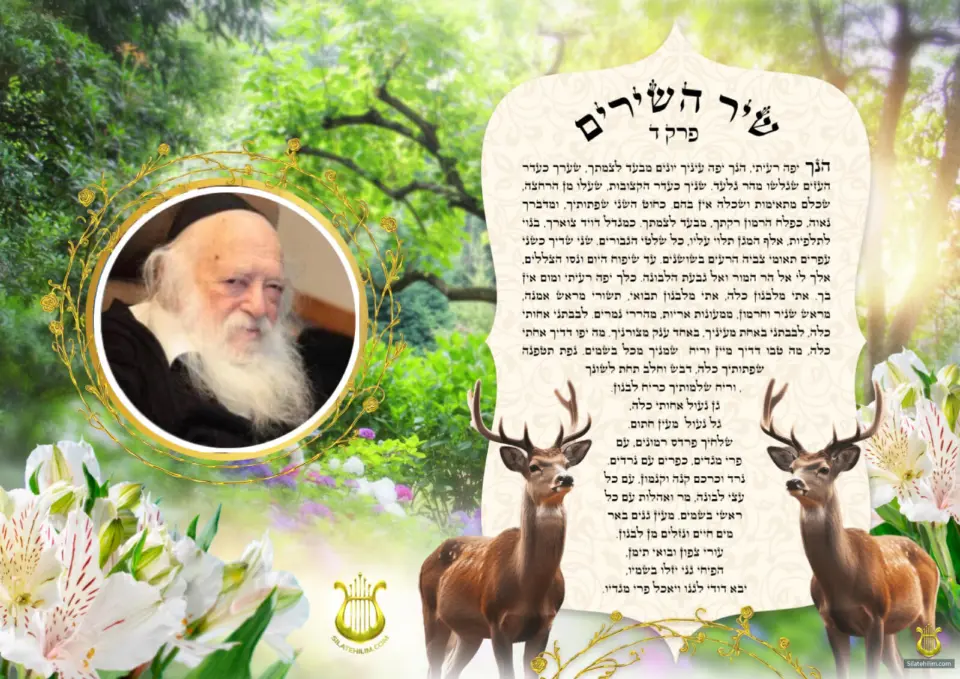
Shir HaShirim on Erev Shabbat, or the Tikkun of Shlomo HaMelech According to the Sephardic Minhag
Students of
the Gaon Rabbi Chaim Kanievsky (may he live long) relate a story that took place not long ago.
One day, a Jew came to see the Gaon with a very serious problem. The Gaon, may Hashem lengthen his days, naturally helped him. When the visitor returned to thank the Gaon, he could not restrain himself and asked:
“Kavod HaRav, you have been helping Jews for so many years. Have you noticed anything distinctive—anything unusual—in our generation?”
The Gadol HaDor replied:
“I have noticed that Sephardim have fewer problems than Ashkenazim.”
The astonished man asked:
“What do you think this is connected with?”
Rabbi Chaim Kanievsky answered with complete seriousness:
“They read Shir HaShirim every Erev Shabbat.”
The Tikkun of Shlomo HaMelech According to the Sephardic Minhag
Midrash Talpiyot, by the greatest Sephardic rabbi,
Rabbi Eliyahu Ha-Kohen Itamari of Smyrna (a direct descendant of Itamar, the son of Aharon HaKohen), based on the
holy Zohar, calculated in Parashat
“Noach” that the souls of sinners condemned to suffer in Gehinnom are granted relief from their suffering during the three daily prayer services: Shacharit, Mincha, and Arvit.
Midrash Talpiyot writes that each of the three daily prayers lasts one and a half hours (in earlier times, even Mincha and Arvit lasted 90 minutes). This means that sinners enjoy 4.5 hours of respite from their suffering—or 27 hours per week—excluding Shabbat, when they are granted a full 24 hours of rest.
Thus, out of the 144 hours of the working week (24 × 6), the souls of sinners suffer in Gehinnom for 117 hours.
The sefer
“Shir HaShirim” was composed by
Shlomo HaMelech with exactly 117 verses, corresponding to the 117 hours of sinners’ suffering in Gehinnom.
Shlomo HaMelech wrote this book in order to atone for three sins he had committed, violating the Torah’s limitations concerning the number of wives, wealth, and horses a king may possess.
Each transgression is punished with 39 lashes, and 39 multiplied by 3 equals 117; therefore, he composed Shir HaShirim with 117 pesukim.
This Tikkun every Erev Shabbat was prescribed for himself by Shlomo HaMelech in order to atone for his errors and mitigate the judgments of Gehinnom.
Therefore, the Sephardim established a beautiful custom: in order to enter the Holy Shabbat purified, one should cleanse oneself through
“Shir HaShirim” of all the sins of the week, perform the Tikkun, and save oneself from the judgments of Gehinnom.
But the
Sephardic Mekubalim reveal one more secret: why must the entire “Shir HaShirim” be read on Erev Shabbat?
Rabbi Yaniv Assuri, Gaon and Rosh Yeshivah of “Yodei Binah,” teaches that upon reaching verse 10 of chapter 5 of
“Shir HaShirim,” one should pause and have the proper kavanah for the phrase: “Dodi
tzach ve-ad
om, dag
ul merev
avah” – (My beloved is radiant and ruddy, distinguished among ten thousand).
דודי צח ואדום דגול מרבבה – the final letters of the words in this expression form the word
מחילה – “mechilah” (forgiveness).
Chazal teach that these words, recited with tears and from the depths of the heart, together with a plea for forgiveness for one’s sins, help annul all judgments and decrees before Shabbat.
Chazal also teach that this verse is the culmination of all of “Shir HaShirim”—one must know how to concentrate and ask Hashem for forgiveness.
Anyone who has spent a Shabbat in the city of Hadera at the
“Yodei Binah” Yeshivah and heard them sing “Shir HaShirim” from a
klaf (scroll), reaching the phrase
“Dodi tzach ve-adom, dagul merevavah” led by the
Rosh Yeshivah, the Gaon Rabbi Yaniv Assuri (when one literally ceases to feel reality, the soul soars, and one wishes it would never end) will understand the words of the following passage from the
holy Zohar:
36)
“He [Rabbi Eliezer] taught him [Rabbi Akiva] the 216 meanings concealed in the verses of “Shir HaShirim.” Tears streamed from Rabbi Akiva’s eyes. And the fire returned, surrounding them as it had at first. When they reached the passage, “Sustain me with flagons, refresh me with apples, for I am lovesick,” Rabbi Akiva, unable to endure any longer, raised his voice in weeping and roared like an ox. He could not utter a word because of his profound awe of the Shechinah that was present there.
37)
“He taught him all the depth and the supernal secrets contained in “Shir HaShirim.” And he made him swear that he would not use any passage contained therein, lest the Creator destroy the world because of it. For He does not desire that created beings make use of it, because of the great holiness contained within it. Then Rabbi Akiva departed weeping.” (Zohar, Va'eira 35–36)
Among Ashkenazim, it is customary to read “Shir HaShirim” on Pesach, and this too is connected with the number 117, since the Exodus from Egypt is mentioned exactly 117 times in the Torah.
The simplest reason for reading
“Shir HaShirim” on
Erev Shabbat is that the Jewish people are called the
“Kallah” – (bride) of the Almighty:
“Ba'ti le-gani achoti kallah,” “Libavtini achoti kallah,” ... and this relates to Shabbat, which is also called
“Kallah” – (bride), as we say in the Friday-night prayer:
“Bo'i kallah, bo'i kallah, bo'i kallah.”
According to the holy Jewish books,
Erev Shabbat is also the most auspicious time for the marital union between husband and wife. This is precisely why men sing the hymn
“Eishet Chayil” on Erev Shabbat.
It should also be remembered that this is not merely a song, but the Song of Songs—
“Shir HaShirim” – “Kodesh Kodashim” (according to Rabbi Akiva)—and that King Shlomo uttered them approximately
“five thousand” years ago.
(Melachim 5:12)
Chazal added: read not “Shir HaShirim,” but “Shir HaSarim”—the Song of the Angels.
(Taamei Minhagim 256, Rabbi Eli Mansour; “Yodei Binah” Yeshivah – Hadera)
Shir HaShirim and Mechilah
Shir HaShirim and Mechilah
Seven Names of Shlomo HaMelech and “Shir HaShirim”
7 Names of Shlomo HaMelech and Shir HaShirim
18 Important Kavanot of “Shir HaShirim”
18 Important Kavanot for Shir HaShirim
Shir HaShirim – The Secret of Women’s Jewelry
Shir HaShirim – The Secret of Women's Jewelry
Shir HaShirim for Yeshuot
Shir HaShirim for Yeshuot
Shir HaShirim and the Secret of Nekudot (Vowels)
Shir HaShirim and the Mystery of Nekudot (Vowel Signs)
Shir HaShirim for Ayelet HaShachar
Shir HaShirim for Ayelet HaShachar
Shir HaShirim About a Tzadik as Olive Oil
Shir HaShirim on the Tzadik as Olive Oil
Morning Washing with Kavanot from Shir HaShirim for Protection Throughout the Day
Morning Netilat Yadayim with Kavanot from Shir HaShirim for Protection Throughout the Day
Please note: some articles on our site contain the holy Names of the Almighty. If you print these articles, they may not be thrown away or destroyed. Please handle printed copies with care and respect.