The Mystery of Netilat Yadayim in the Zohar HaKadosh
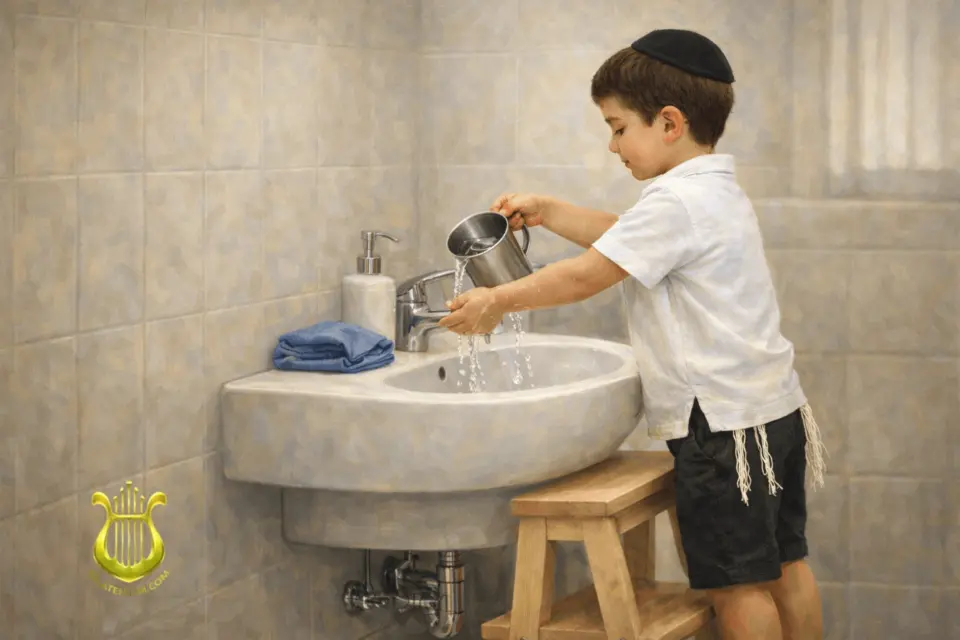
Tehillim 26:6 אֶרְחַ֣ץ בְּנִקָּי֣וֹן כַּפָּ֑י וַאֲסֹבְבָ֖ה אֶת־מִזְבַּחֲךָ֣ יְהוָֽה - “Erchatz b'nikayon kapai, va'asovevah et-mizbechacha Ado-nai” – (“I wash my hands in purity and circle Your altar, G-d.”) The Zohar HaKadosh says: “Rabbi Shimon began and said: ‘I wash my hands in purity and circle Your altar, G-d.’ Come and see this mystery: there is no one in the world who does not experience a taste of death at night, and a spirit of impurity rests upon the body. This is because the holy soul leaves the person... When it returns, this impurity disappears, but it remains on the hands. Therefore, one may not touch one's eyes before washing one's hands; afterward, the person is cleansed and sanctified. And how should one sanctify oneself? One must have two vessels: wash one's hands with water from the upper vessel and pour the impurity into the lower one. In one there is blessing, and in the other, a curse. Before washing one's hands, one may not recite blessings, since the person is impure. Water used for washing the hands may not be used for any purpose, so that no one will be harmed by it. It should be poured out in a place where people do not walk, because it contains impurity that can cause harm... The Almighty, blessed be He, desires to grant Israel the merit of holiness.” (Zohar, Vayeshev, p. 184) The hands are washed alternately three times, as stated in the Shulchan Aruch, first the right hand and then the left. Thus it is said in the Zohar: “Upon rising in the morning, one should wash one's hands with water from a vessel: first the right hand, holding the vessel in the left, in order to establish the right over the left and cause the evil inclination to lose its dominion.” (Zohar, Miketz, p. 198) Immediately after washing the hands, one should use the restroom. This, too, brings about a great tikkun in the upper worlds, as explained in the writings of the Ari, for the impure shells are separated from holiness. Before this, one briefly says: “I am going to cleanse myself in order to separate holiness from impurity.” Whoever studies the works of the Ari will find profound ideas in them. One should be careful and wash thoroughly in order to remove all impurity from oneself. Afterward, the hands are washed three times. Although according to halachah it is sufficient to wash the hands twice after using the restroom, the Zohar HaKadosh does not distinguish between washing the hands in the morning and washing them after using the restroom, maintaining that they should be washed three times in both cases. Thus it is said in the Zohar: “Upon rising in the morning, one should bless one's Master... However, one may not recite a blessing with impure hands. The reason is that during a person's nighttime sleep, the soul leaves him, and a spirit of impurity envelops his body. It remains on his hands and makes them impure. During the day, when a person is awake and the soul does not leave him, the spirit of impurity does not rest upon him. Nevertheless, he may not recite a blessing or read even a single word of Torah after using the restroom before washing his hands. The reason is not that they are dirty. Woe to them, the children of man, who do not contemplate the glory of their Master and do not consider upon what the world is founded. There is one spirit in all the restrooms in the world, nourished by impurity, which immediately defiles the fingers of anyone who enters there.” (Zohar, Bereshit, p. 10) After using the restroom, one must wash one's hands as in the morning, raise them with the fingers separated to head level, and recite the blessing עַל נְטִילַת יָדַיִם “Al Netilat Yadayim,” which brings about a tikkun in the upper worlds. Afterward, one lowers the hands and recites the blessing אֲשֶׁר יָצַר “Asher Yatzar.” Kavanah for the Acceptance of Prayers The Mekubalim teach that, in order to achieve purification and the acceptance of one's prayers, one should have kavanah when reciting the pasuk: “Erchatz b'nikayon kapai, va'asovevah et-mizbechacha Ado-nai” – (“I wash my hands in purity and circle Your altar, G-d.”)This pasuk is recited during Sukkot at the Hakafot (the seven circuits around the table with the Torah scrolls) – “va'asovevah et-mizbechacha Ha-Shem” (“I will circle Your altar”).
The Sages teach that when a person washes his hands and recites this pasuk with kavanah, the word ארחצ “erchatz” (“to wash”) has a gematria of 300 (with the kolel), and the milui of the Name of Ha-Shem “Elokim” אלהים also equals 300:אלפ – א
למד - ל
הי - ה
יוד - י
מם - מ
then all prayers will be accepted;
(Based on Sefer Rav Alexander Ziskind's “Yesod VeShoresh HaAvodah”; based on a lesson by Rabbi Yisrael Yakobov)