Segulot for Tu BiShvat by Rabbanit Yamima Mizrachi
Tu BiShvat is the New Year for the trees. On this day, the Almighty judges the fruit trees and determines their future—what the fruit harvest will be in the coming year.
The great Rabbi Moshe Chaim Luzzatto (Ramchal) teaches in
"Derech Hashem" that the higher spiritual sefirot are roots whose influence ultimately manifests through branches and leaves in the lower worlds.
In the 16th century, the Kabbalists of Safed composed the
Seder Tu BiShvat, modeled after the Passover seder. This seder is described in the book
"Pri Etz Hadar."
The Seder with the Haggadah for Tu BiShvat is here:
Tu BiShvat Seder According to Kabbalah
Segulot
1. Tzedakah—91
Before the Tu BiShvat meal, it is good to give tzedakah equal to
91. This is the gematria of the word
"ilan", meaning tree, because
Tu BiShvat is the
"Day of Judgment" for the trees, and "charity annuls a harsh decree." Therefore, it is customary to give tzedakah.
2. Blessings over fruit with kavanah
When Adam and Eve were in the Garden of Eden, they were permitted to eat only fruits and vegetables. When reciting blessings over fruit on Tu BiShvat, one should have the kavanah of rectifying Adam's sin.
The Arizal teaches in
"Sha'arei HaMitzvot" that a person should be careful regarding blessings.
It is stated in
"Sha'ar Ruach HaKodesh" that the most powerful way to attain
"ruach hakodesh" is to recite blessings with concentration, thereby removing the kelipot and sanctifying oneself.
3. Reading passages from the Holy Books—the Zohar HaKadosh and Tehillim
Since the Holy Temple was destroyed, the Jewish people could no longer bring the first fruits (bikkurim) to Jerusalem.
On Tu BiShvat, we instead offer the fruit of our lips, praising G-d for all the fruit trees in the world. (Zohar, Parashat Terumah)
4. The custom of Tu BiShvat
Tu BiShvat is not a matter of halachah, but rather a custom that carries beautiful qualities which draw abundance and blessings.
The Ashkenazi custom is to place at least
15 types of fruit on the table, and to recite a chapter from
"Shir HaMaalot" (the 15 chapters of Tehillim) for each type of food.
The custom of the Kabbalists (and consequently of Sephardim) is to prepare
4 different dishes, each containing from
4 to 10 fruits, and from
12 to 30 (from the book
"Pri Etz Hadar").
First dish— fruits that are
eaten in their entirety, both the peel and the fruit itself, such as
: grapes, figs, apples (the small seeds are considered part of the fruit), pears, strawberries, quinces, persimmons.
At this time, it is customary to ask Hashem that we be beautiful both outwardly and inwardly.
Second dish— fruits whose
flesh is edible, but whose inner pit is not, such as
: olives, dates, apricots, peaches, plums, blueberries, cherries, mangoes.
Here, we ask the Almighty to free us from unnecessary things: hatred, jealousy, sadness, rivalry, and resentment.
Third dish— fruits whose
peel (kelipah) is inedible, while the fruit itself is fit to eat: pineapples, chestnuts, pomegranates, nuts, almonds, pistachios, hazelnuts, grapefruits, kiwis, coconuts.
As we eat these fruits, we ask: "May we see the goodness and pleasantness in every person, including ourselves, and may we judge everyone favorably rather than looking only at the external 'shell.'"
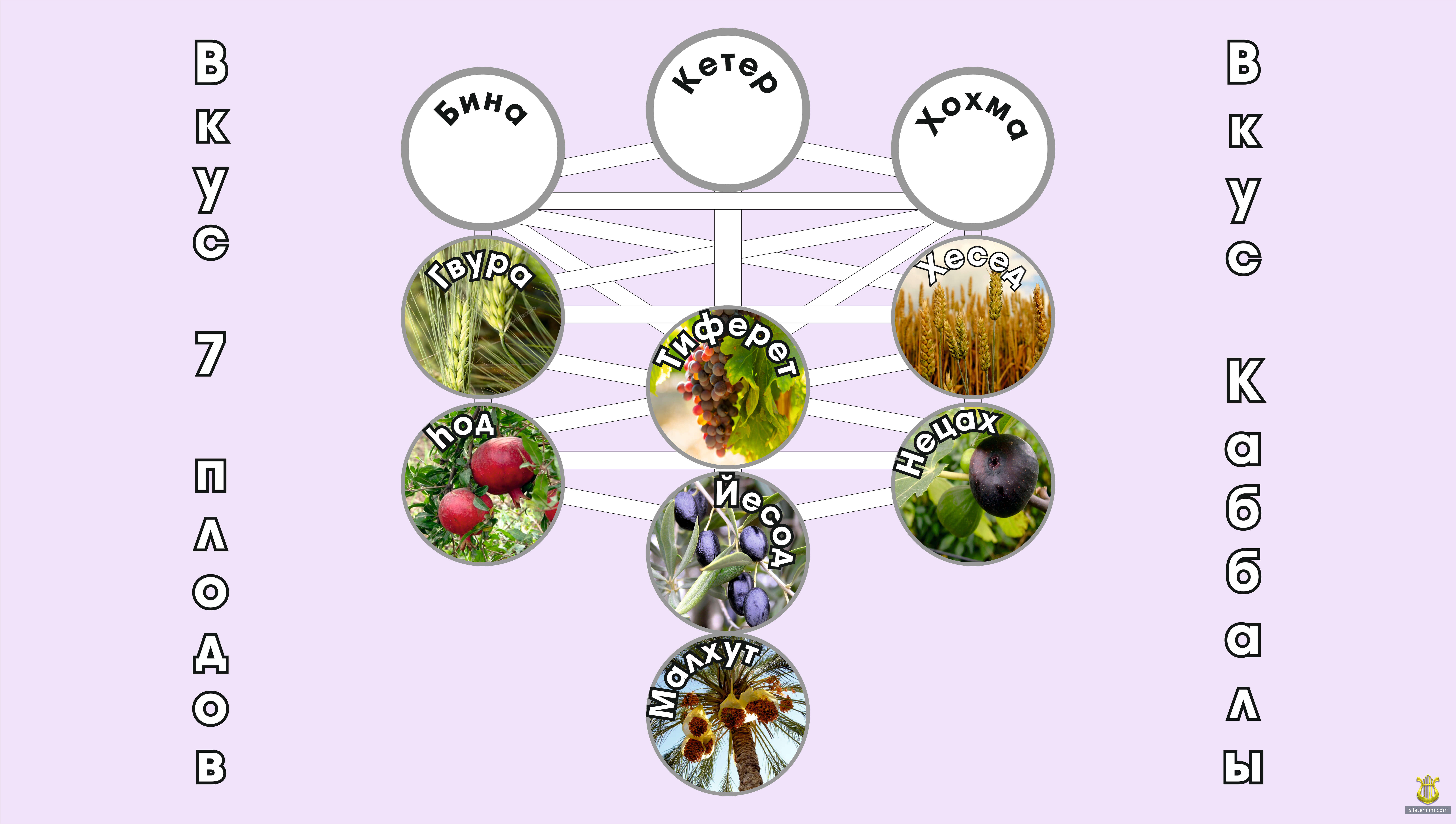
Fourth dish—7 types of fruit for which the Land of Israel is renowned: figs, dates, pomegranates, olives, grapes (raisins), wheat, and barley (in the form of bread and pastries).
Kavanot for the fruits of Israel:
As we look at the dish, we should have a kavanah (intention, direction of the heart) for each fruit:
1. Wheat—(cookies, bread) symbolizes "calm."
This is a segulah for developing intelligence and wisdom, as well as for success in learning. It is also a segulah for abundance.
When we raise our hands after
netilat yadayim, before reciting the blessing over bread, we remind ourselves that the food we are about to eat comes from Hashem:
"va'achilehu meichelev chitah"—"and I will feed him the finest wheat" (Tehillim 81:17).
2. Barley—beer and pearl barley—a segulah for peace and shalom bayit.
It is also a segulah for the birth of sons.
3. Grapes (including wine, grape juice, raisins, and grape leaves)—all of these symbolize fertility.
4. Figs—a symbol of patience, since figs do not have a single harvest season.
5. Pomegranates—symbolize the lips: "like a thread of your lips"—the unique ability to restrain one's mouth from improper speech.
6. Olives and olive oil—a symbol of the righteousness of one's children. Just as the leaves of the olive tree do not fall, so may our children not stray onto the wrong path. "Your sons will be like olive saplings around your table" (Tehillim 128:3).
Olive oil is a segulah for memory—but not the olives themselves.
7. Dates—a wonderful virtue for success and recognition. Dates reach toward the heavens, so we ask for help in standing and rising like a date palm. "The righteous shall flourish like a palm tree" (Tehillim 92:13).
Four cups of wine
At the Tu BiShvat meal, it is customary to drink
four cups of wine, as at the Passover seder:
The first cup—pure white wine;
The second cup—pale pink (a drop of red wine is added to the white);
The third cup—deep pink (with more red wine added);
The fourth cup—almost entirely red wine (with a drop of white).
White wine represents nature in potential.
Red wine represents nature in full bloom.
On this day, we begin to leave winter behind and enter a period of renewal and life.
The Zohar states: "Wine has two colors—white and red. White is on the right side [of kindness]; red is on the left side [of strength and judgment]. As we progress from white to red, we move from potential to reality. We can appreciate Hashem's judgment as well as His kindness. Wine gladdens the human heart. This refers to the wine of Torah. The gematria of yayin is 70, the numerical value of sod (secret), meaning mystery—[wine represents the hidden aspects of the Torah]." (Zohar, Parashat Pinchas).
P.S. (A detailed Seder Tu BiShvat is available as a PDF on the site, in the Books section.)
("Sila Tehilim," based on a lesson by Rabbanit Yamima Mizrachi on Tu BiShvat)
Please note: some articles on our site contain the holy Names of the Almighty. If you print these articles, they may not be thrown away or destroyed. Please handle printed copies with care and respect.