The Taste of the Seven Species of Israel—the Taste of Kabbalah
The Taste of the Seven Species of Israel—the Taste of Kabbalah
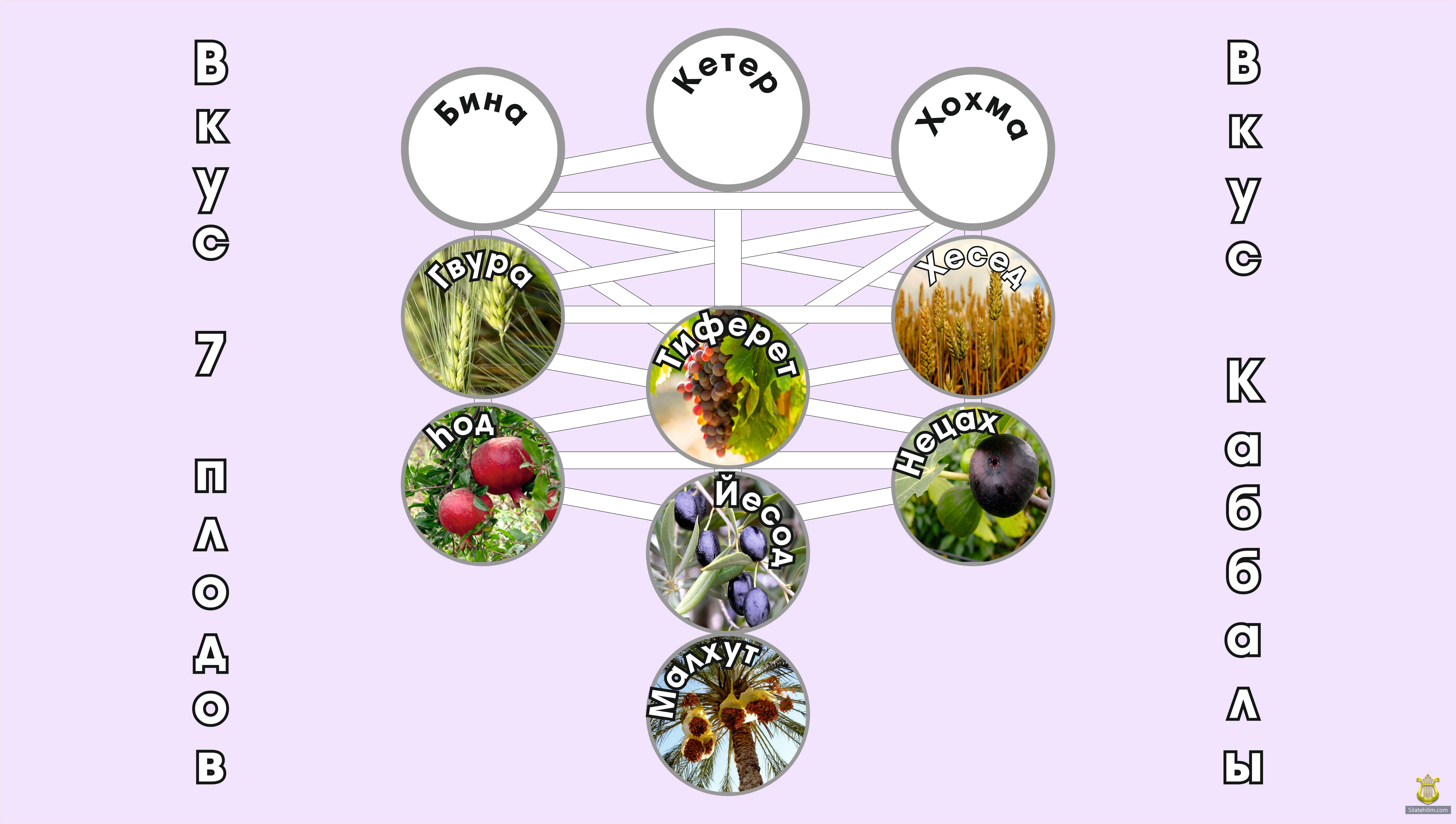
The Seven Species of Israel According to Kabbalah1. Wheat – חטה — gematria = 22, the same as the word טובה “goodness.”
Mentioned 29 times in Tanakh.“Wheat bread is Chesed, and through Chesed He sustains the flesh.” (Biurei Aggadot, Afikei Yam, Kiddushin 31b)
The quality of Chesed is characterized by the desire to spread and influence those around it, bestowing its goodness upon the world.
The same is true of wheat: its kernels nourish and sustain a person. Chesed, through which this world was created, is often compared to the skeleton—the supporting framework of the human body.
Wheat, meanwhile, is the basic food of humanity, nourishing and sustaining the body.
In modern Hebrew, the word “wheat” is written חיטה “chita,” while in the Torah it appears without the letter י “yud”; instead, it has the vowel sign hiriq, which likewise represents the sound “i.”
The letters ח and י form the word חי “chai” (life).
But when the word חיטה (chita) loses the letter י, wheat immediately loses its connection to the Source of life—the Holy One, blessed be He.
Perhaps this is because wheat is associated with the Tree of Knowledge, through which humanity became mortal. The word “life” is absent from the name of this grain, serving as a kind of allusion to death—the antonym of that word. This may be why so many people today suffer from wheat intolerance.
There is also a notable similarity between חיטה “wheat” (chita) and חטה “sin” (chet): when a person sins, it is as though he becomes detached from the Source of life.
In the days of Mashiach, the letters ח and י will once again unite in the word חיטה (chita), returning to the Tree of Life the branch it once lost.
Once the word חי “life” returns to the name of wheat, חיטה, all the material and spiritual potential of this grain will rise to a new level and attain perfection. Wheat, which previously symbolized the Tree of Knowledge, will become a fruit of the Tree of Life—the true material expression of the Torah.
It is no coincidence that Mashiach will be a direct descendant of King David, who once lived in the city of Beit Lechem (literally, “house of bread”). Even this detail indicates that the conflict between humanity and wheat is not eternal. The time will come when it will be resolved. In those long-awaited days, wheat will bear witness to the rectification of human nature and the full revelation of its potential. Then, “in the Land of Israel, rich loaves of bread will once again grow on the trees.” (Shabbat 30b)
2. Barley – שעורה — gematria = 575, the same as the word “nichreta”: ‘Let us make [a covenant].’ (Bereishit 31:44)
Mentioned 36 times in Tanakh.“Barley is connected with the left side. Therefore, the sotah brings an offering consisting of barley, since barley symbolizes all the Gevurot.”(Arizal, Sefer HaLikutim, Eikev 8)
The offering brought in the Torah by the sotah (a woman suspected of marital infidelity) consisted of barley. “She behaved like an animal, and therefore she brings animal feed to the Temple.” (Sotah 14a)
This is the offering of jealousy, because she violated the covenant with the man who had chosen her to become a vessel for her husband.
Barley represents Gevurah and is associated with the sefirah of Gevurah.
This reminds us that everything in the material world has its boundaries. When a woman marries, she becomes a vessel for the spiritual light her husband brings into the world. On the physical level, she becomes a vessel for her husband’s seed, thereby helping him fulfill the mitzvah to “be fruitful and multiply.”
A woman is associated with the lowest of the sefirot, Malchut, of which it is said that “she has nothing of her own,” but is merely a vessel for the light of all the other higher sefirot.
Boaz gave Ruth six barley grains, representing the masculine aspect of the sefirah of Yesod, which includes the five preceding sefirot. These six grains symbolized the six great descendants she longed for. Each of these figures is connected with the sefirah of Yesod, since all of them form the foundation of the Jewish people. Therefore, each was granted six blessings. Yesod contains all blessings, just as the sixth of the Patriarchs, Yosef (also corresponding to the sefirah of Yesod), received all the blessings of his father.
The Hebrew word for barley, “se'orah”, is שערה. Rearranging its three root letters produces the word “rasha” — רשע — (a wicked person). The Holy One, blessed be He, is absolute goodness, and the restriction and concealment of His light are the spiritual source of evil. A person can use these same letters to create spiritual gates—“shaar” — שער — for tefillah, teshuvah, and tzedakah. Thus, the barley omer (associated with boundary and measure—“shiur”) was brought as an allusion to the secret of the sefirah of Gevurah, so that a person would overcome himself during the days of the Omer count.
In Hebrew there is the expression “ruach se'arah” — רוח שערה — (a storm wind). This concept is contrasted with “Ruach HaKodesh” — רוח הקדש — the Divine spirit.
The soul’s capacity is connected with the sefirah of Gevurah, which, like a storm wind, sweeps everything from its path to make way for something new. Ruach HaKodesh is the goodness of the Holy One, blessed be He, flowing down into the lower worlds, while ruach se'arah is a person’s striving toward the Divine Source.
3. Grapes – גפן — gematria = 133, the same as the word לנגן “to make music.” (Shmuel I 16:17)
Mentioned 216 times in Tanakh.“One may not recite the blessing Shehakol over pressed grape juice. The grape changed its form in order to glorify the vine, for this is Tiferet, mistress of the six directions (the six sefirot).”(Sefer HaKaneh, Inyan Yirat HaMakom)
The sefirah of Tiferet unites opposites: the expansiveness of Chesed with the restraint of Gevurah. Perhaps this is why grapes likewise combine opposites: on the one hand, they nourish, while on the other, they cleanse the body. Harmony appears when Gevurah contains Chesed, and Chesed restrains itself through Gevurah. This balance of forces is called Tiferet (beauty) and reflects the perfection of the world created by the Holy One, blessed be He.
The sefirah of Tiferet is associated with the muscular system of the human body, and the most important muscle in our body is, of course, the heart.
Kabbalists maintain that Tiferet is located in the heart. (Raavad on Sefer Yetzirah 1:3)
A cluster of grapes resembles a heart in shape, and each grape resembles a red blood cell. This accords with the fact that wine and grapes strengthen the cardiovascular system. King David said of this in Tehillim:
“Wine that gladdens the heart.” (Tehillim 104:15)
In Aramaic, “wine” is “chamar” — חמר — and the gematria of this word is 248, equal to the number of limbs in the human body. We see from this that wine penetrates every organ of the body.
If the vine is a symbol of the Jewish people, then wine is a symbol of the Torah.
The Hebrew gematria of “wine” is “yayin” — יין = 70. The gematria of “sod”—secret—is also 70. From this, Chazal concluded that wine can enable a person to grasp the secrets of the Torah.
4. Figs – תאנים — gematria 456, the same as the word “me'achuzat” — (of the possession). (Bamidbar 35:8)
Mentioned 44 times in Tanakh.“The fig draws its strength from Netzach.” (Arizal, Sefer HaLikutim, Eikev 8)
The fig tree is associated with the sefirah of Netzach (eternity), symbolizing the ability to overcome death and decay.
For this reason, during the Temple era, when a person who had come into contact with the dead required ritual purification, the red heifer was burned using fig wood. In addition, fig wood burns without producing smoke, which is why it was chosen for burning sacrifices in the Temple.
As is known, death entered the world after Adam and Chavah ate from the Tree of Knowledge. According to one opinion, the fruit they ate was a fig. Having caused humanity’s downfall, it also became a means of rectifying the sin: fig leaves served as their clothing, both physically and as a “garment” for the soul.
The flowers of the fig tree are invisible because the flower itself is not on the outside but inside the fruit. Thus, the fig expresses the quality of “tzniut” (modesty).
5. Pomegranate — רימון — gematria = 296, the same as the word “ha-aretz” — (this land).
Mentioned 31 times in Tanakh.“The gematria of the word ‘rimon’ — רימון, with the inclusion of the kolel, equals the gematria of the angel’s name Nuriel נוריאל.” (Arizal, Sefer Likkutei Torah, Eikev)
The angel Nuriel’s name has the same numerical value as the word “rimon” = 296. Nuriel is the guardian of the inner fire. He is the mysterious fifth angel who helps people balance the energies of Uriel, Raphael, Gabriel, and Michael.
If the two letters טט (tet) are removed from the name מטטרון — Metatron, the angel who guided the Jewish people during the Exodus—the remaining letters form the word “rimon”רימון (pomegranate).
The gematria of the two letters טט (tet) is 18, equal to the gematria of the word “chai”הי (life). Thus, the “rimon” is a vessel in which the life force, represented by the two letters טט (tet), is clothed.
The prophet Yechezkel states that the highest angels are called chayot. The prophet describes them as being in continuous motion, moving forward and backward. The word רצוא – “ratzo” (to move forward, to run) has the same numerical value—296—as the word “rimon” (pomegranate). Forward motion recalls the blessing given to Naftali (the swift-footed hind) in connection with the sefirah of Hod. Forward movement is impossible without returning to those same “beautiful words” associated with Naftali. The word “vashov” (“and returns,” “and back”) has the same numerical value as the Name of G-d (Shaddai) and the name of the highest of the angels (Metatron), whose gematria is 314. This equals the gematria of the words “rimon” and “ratzo” together with the gematria of the word “chai”. The striving of an idea forward without the intention of returning is doomed to fail, because it lacks “chai” (life).
The Name of G-d, Shaddai, symbolizes an abundance of every kind of blessing. This Name is an acronym for the phrase “Shomer Daltot Yisrael” (Guardian of the gates of Israel). By this Name, the Holy One, blessed be He, resembles a guardian: He protects Israel, distinguishing what may pass “through the gates” from what may not.
The Name Shaddai can also be understood as an abbreviation of the phrase “mi she-amar le-olamo dai” (He who said to His world, “Enough”).
The principle that “everything is good in moderation” is the function of the sefirah of Hod.
The abundance of seeds in a pomegranate symbolizes generosity in good deeds and an abundance of mitzvot. Therefore, the pomegranate occupies a central place on Rosh Hashanah: may our merits be as numerous as the seeds of a pomegranate.
The pomegranate is a symbol of the prayers of sinners: “A prayer in which the sinners of the Jewish people are not present cannot be called a prayer.” This is alluded to in the garments of the High Priest: the golden bells alternated with pomegranates made of threads. Our prayers will be heard only when sinners pray together with everyone else.
The good deeds of people who combine something good with a measure of personal gain resemble a pomegranate, in which sweet seeds alternate with bitter membranes.
The process of studying Kabbalah is called walking through a pomegranate orchard; this is the meaning of the title of the Ramak’s book “Pardes Rimonim.”6. Olive– זית — gematria = 407.
Mentioned 109 times in Tanakh.“A land of olive oil and honey. Yesod is called olive oil.” (Arizal, Sefer HaLikutim, Eikev 8)
“A land of wheat and barley, vines, figs, and pomegranates; a land of olive trees and honey”—in the Torah’s enumeration of the Seven Species of Israel, the word “land” interrupts the list and separates the olive trees and date honey from the other fruits.
As Rabbi Tzadok HaKohen of Lublin explains, the reason for this division is that olive oil (symbolizing the sefirah of Yesod) and honey (symbolizing the sefirah of Malchut) are connected with one another.
This is why all Jewish kings (Malchut) were anointed with olive oil (Yesod).
Furthermore, both olives and dates are directly connected with the Land of Israel, since these fruits became part of our ancestors’ diet only after the Jewish people left Egypt and settled in Eretz Yisrael. These two types of plants are mentioned separately because, figuratively speaking, they gave the Jews the right to possess the land.
Olive oil is associated with wisdom, while Yesod (the ninth of the sefirot) receives its rectification through the sefirah of Chochmah (which means “wisdom”) and is also the ninth sefirah when counting upward from Malchut. Yesod and Chochmah have a spiritual connection, which explains why the size of an olive became the standard measure established by Jewish law: the quantity of food over which a blessing is recited is called “kezayit” (the size of an olive). Olives were chosen as the standard because of their similarity to the soul and the body: just as oil is contained within the olive, the soul is contained within the body. The body (whose attribute is forgetfulness) corresponds to the olive fruit, while the soul (whose quality is memory) corresponds to olive oil. The purpose of eating is to elevate the soul; therefore, the minimum standard quantity of food is the size of an olive.
From the Ark to the Menorah“The dove returned to him in the evening, and behold, an olive leaf freshly plucked was in its mouth; and Noach knew that the waters had subsided from upon the earth.” (Bereishit 8:11)
By plucking an olive leaf, the dove wanted to show that “it would rather eat food as bitter as olives, but from the hand of the Holy One, blessed be He, than the tastiest grains from the hand of a mortal.” (Perek Shirah)
The olive branch brought by the dove had grown in the Garden of Eden.
The dove brought it to heal Noach from a terrible cough with bloody phlegm, which he had developed because he had tended to the animals in the Ark day and night. (Ateret Yehoshua, Noach)
Noach pressed oil from the fruit that had been brought, and hid some of it in a jug. He later gave it to his son Shem, who in turn passed the precious vessel to Avraham. From Avraham, the oil came to his son Yitzchak, who passed it on to his son Yaakov. On the eve of his encounter with Esav, Yaakov was left alone because he had returned to the bank of the Yabok River for some vessels he had forgotten. One of the jugs for which Yaakov risked his life was precisely this vessel containing the precious oil produced by Noach. This jug of oil was successively held by all seven Patriarchs of the Jewish people, until it reached King David. David, through Ruach HaKodesh, concealed the jug when laying the foundations of the Temple in Jerusalem, foreseeing that the sacred vessel of oil would be needed by the Jewish people in the future, when the events of Chanukah would take place.
It was precisely this jug that the Maccabees found when they liberated the defiled Temple from Greek presence. It contained the very oil that miraculously burned in the Temple Menorah for eight days. Having passed through the hands of the seven Patriarchs of the Jewish people, the oil had absorbed the distinctive qualities of their service of the Holy One, blessed be He, and was therefore perfectly suited for kindling the seven lamps of the Menorah. (Imrei Noam)7. Dates — תמרים — gematria = 306, the same as the word אשה — “isha” — woman.
Mentioned 36 times in Tanakh.“Malchut is called a date palm, and its secret is in the verse: ‘Your stature is like a palm tree.’” (Arizal, Sefer HaLikutim, Shoftim 4)
Dates are associated with the sefirah of Malchut.
The distinctive feature of the sefirah of Malchut is that it receives the spiritual light of all the other sefirot, synthesizes it, and transmits it to other spiritual levels.
The palm, stretching upward, is likewise a kind of conduit: it absorbs the earth’s sap, transforms it into sweet fruit, and shares that sweetness with humanity.
Just as the fruits of the date palm, thanks to their stickiness, can bind ingredients into a homogeneous mass, so the task of a king is to unite his people. The date palm has a single trunk and therefore also symbolizes unity.
Kabbalah teaches us that the sefirah of Malchut has no distinctive qualities of its own.
Malchut is a transparent channel that transmits Divine energy to the lower worlds. The date palm is the same: a tall, powerful tree with a strong, straight trunk and branching roots that reach deep into sandy soil. It seems to connect heaven and earth.
Each sefirah corresponds to a particular organ of the human body. Malchut is associated with several organs at once: the mouth, the female reproductive organ, and the legs. (Yitzchak Ginsburgh, “Fundamentals of Kabbalah: The Ten Sefirot”)
Thus, Malchut is expressed in the human body as an energy channel running from top to bottom: mouth—reproductive system (uterus)—digestive system (the end of the large intestine)—legs.
“And He said: If you will diligently heed the voice of the L-rd your G-d, and do what is upright in His eyes, and listen to His commandments and observe all His statutes, then all the diseases that I brought upon Egypt I will not bring upon you, for I am the L-rd, your healer;And they came to Elim, where there were twelve springs of water and seventy date palms, and they encamped there by the water.” (Shemot 15:27)
In this passage, G-d first promises to be humanity’s healer, and then the Torah describes a place called Elim, where seventy palms grew and twelve springs flowed. What is the connection between the Holy One, blessed be He, being a healer and the appearance of the oasis at Elim?
The juxtaposition of these two details indicates that the healing energy of the Holy One, blessed be He, is manifested through the seventy date palms.
The twelve springs that nourish the seventy palms with water symbolize the twelve tribes of Israel, which in turn receive their life force from the Holy One, blessed be He.
The name of the place, Elim, is an abbreviation of the Name of G-d, Elohim.
Seventy is an important number in Jewish tradition. It symbolizes the “seventy faces of the Torah.” Just as the seventy palms were nourished by the twelve springs, so the seventy nations will depend upon the Jewish people when the Jewish people themselves become a true vessel for Divine energy.
The seventy palms correspond to the seventy angels surrounding the Throne of Glory of the Holy One, blessed be He. Each angel serves as the guardian of one of the seventy nations. There are seventy varieties of date palm, each with its own taste and distinctive characteristics. The verse tells us that the seventy palms draw their life force from the twelve springs, which are connected with the four camps of the Shechinah. The angels surrounding the Throne of Glory are compared to date palms because, like the palms, they stand straight and proudly before the throne of the Holy One, blessed be He.
The twelve springs represent the twelve tribes of Israel, which, when the people camped in the wilderness, stood in four camps around the Tabernacle. From the twelve sons of Yaakov, the founders of the tribes, came the seventy souls of Israel. (Rabbeinu Bachya, Shemot 15:27) (Compiled from the book by Rabbanit H. B. Silgelbaum, “The Seven Species of the Land of Israel”)
Was this helpful?
100% of readers found this article helpful (23 votes).
Please note: some articles on our site contain the holy Names of the Almighty. If you print these articles, they may not be thrown away or destroyed. Please handle printed copies with care and respect.
Material from our site may be copied for the purpose of spreading Torah, provided a link to Silatehilim.com is included. Any use of the site's material in print publications or for commercial purposes is prohibited without the rights holder's consent.