(based on the book Pri Etz Hadar, included in the book Chemdat Ha-Yamim)
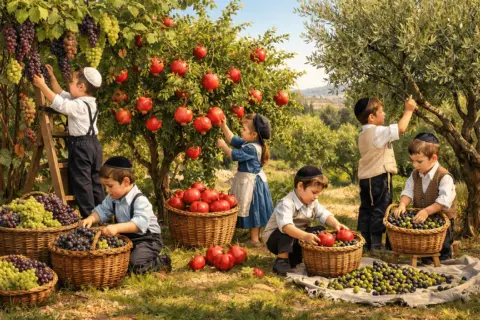
On the holiday of Tu BiShvat, we do not merely celebrate the return to the land promised to us by the Almighty; we also look forward to our return to the Garden of Eden, where we will eat the fruit of the Tree of Life.
At the center of the festive seder, place four dishes of fruit, corresponding to the four spiritual worlds. Each dish should contain fruits associated with one of the four worlds: Atzilut, Beriah, Yetzirah, and Asiyah. Participants in the seder taste fruit from each group and drink a glass of wine.
It is recommended to prepare an additional 30 fruits in advance, corresponding to the ten sefirot of each of the three lower worlds.
A total of four glasses of wine are drunk during this festive meal, as on Passover.
Four glasses of wine—four spiritual worlds
For the first glass, it is customary to use white wine, symbolizing the highest and most perfect spiritual world, Atzilut (the world of Divine emanation).
This is followed by the second glass of white wine, to which a drop of red wine is added; it corresponds to the spiritual world of Beriah.
The third glass of wine, containing equal portions of white and red wine, alludes to the spiritual world of Yetzirah (the world of formation).
The final fourth glass, containing red wine, recalls the lowest world of Asiyah (the world of action).
Four dishes—four spiritual worlds
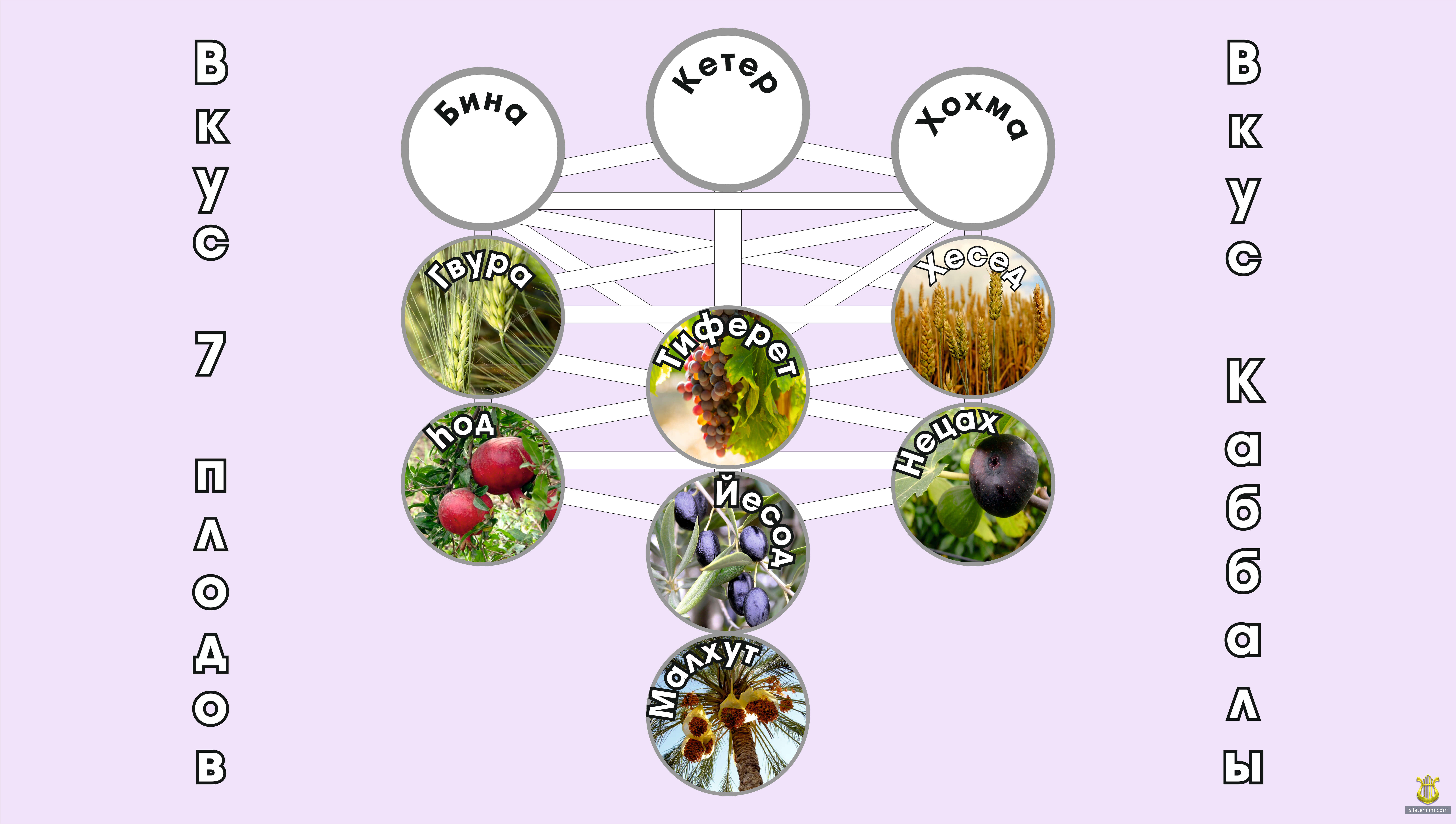
There is no fruit that Kabbalah associates with the spiritual world of Atzilut, since this world is immeasurably higher than embodiment in any physical form. Nevertheless, all seven of the fruits for which the Land of Israel is renowned may be identified with this world, since these fruits have a special status according to Jewish law.
First dish—containing the seven fruits for which Israel is renowned—AtzilutSecond dish—fruits that are eaten whole correspond to the world of creation—Beriah: grapes, figs, persimmons.
Third dish—fruits that are edible except for a hard, inedible pit correspond to the world of formation—Yetzirah: olives, dates, apricots, plums.
Fourth dish—fruits with a hard, inedible outer shell are associated with the world of action—Asiyah: pineapple, walnuts, chestnuts, kiwi, grapefruit.
Tu BiShvat Seder
1. Atzilut—the world of Divine emanation
Fill the glass with white wine.
Wheat
“Would that He feed them the finest wheat, and satisfy them with honey from the rock.” (Tehillim 81:17)
Barley
“A land of wheat and barley, of vines, figs, and pomegranates, a land of olive trees and honey.” (Devarim 8:8)
Olives
“But I am like a verdant olive tree in the house of G-d; I trust in G-d’s faithfulness forever and ever!” (Tehillim 52:10)
Dates
“The righteous shall flourish like a palm tree, grow tall like a cedar in Lebanon.” (Tehillim 92:13)
Grapes
“But every man shall sit under his grapevine or under his fig tree, with no one to disturb him—for the mouth of the L-rd of Hosts has spoken.” (Micha 4:4)
Figs
“Whoever tends a fig tree will eat its fruit, and whoever looks after his master will be honored.” (Mishlei 27:18)
Pomegranate
“Let us go early to the vineyards; let us see if the vine has flowered, if the blossoms have opened, if the pomegranates are in bloom. There I will give you my love.” (Shir HaShirim 7:13)
Wine
“There are three tendrils on the vine; it is in bloom, its buds have opened, and its clusters have ripened into grapes.” (Bereishit 40:10)
2. Beriah—the world of creation
Fill the glass with white wine and add a drop of red wine.
Etrog
“On the first day you shall take the fruit of a beautiful tree, branches of date palms, boughs of leafy trees, and willows of the brook; and you shall rejoice before the L-rd your G-d seven days.” (Vayikra 23:40)
Apple
“Like an apple tree among the trees of the forest, so is my beloved among the youths. I delighted to sit in his shade, and his fruit was sweet to my palate.” (Shir HaShirim 2:3)
Carob
“Every day a heavenly voice goes forth from Mount Horeb and proclaims: The entire world is sustained in the merit of Hanina ben Dosa, my son, while for Hanina himself, one measure of carobs from Friday to Friday is sufficient.” (Babylonian Talmud, Berakhot 17b)
Pear
“It is permitted to crossbreed such fruit trees as the pear, wild pear, quince, and azarole hawthorn. The apple, wild apple, peach, almond, plum, and jujube—even though they resemble one another, it is forbidden to crossbreed these plants.” (Mishnah Kilayim 1:4)
Wine
“He brought me to the banquet hall, and his banner over me was love.” (Shir HaShirim 2:4)
3. Yetzirah—the world of formation
Fill the glass halfway with white wine and halfway with red wine.
Plum
“Do not stare at me because I am swarthy, because the sun has gazed upon me...” (Shir HaShirim 1:6)
Peach
“When is the tithe separated from produce? From figs—when the fruit begins to ripen; from grapes and wild grapes—when the berries become visible; from sumac and berries—when the fruit turns red; and likewise from all red fruits, the tithe is separated when the fruit reddens; from pomegranates, when the fruit becomes soft; from dates, when the fruit fills with honey; from peaches, when red veins appear on the fruit; from nuts, when the fruit’s husk becomes a vessel. Rabbi Yehudah said: ‘From nuts and almonds—when the fruit’s husk takes on its complete form.’” (Mishnah, Ma'asrot 1:2)
Apricot
Rabbi Hisda said: “It is written: ‘...and I will give you a desirable land, a heritage like the gazelle.’ Why is the Land of Israel compared to a gazelle? To tell you that just as a gazelle’s hide cannot contain its flesh, so the Land of Israel cannot contain all its produce. Another explanation: Just as the gazelle is the swiftest of all animals, so the Land of Israel yields its produce more quickly than other lands; just as the gazelle is light and its meat is not fat, so the Land of Israel produces its crops with ease, and its fruit is not excessively rich. The Talmud says: ‘A land flowing with milk and honey’—its fruit is richer than its milk and sweeter than honey.” (Babylonian Talmud, Ketubot 112a)
Cherry
“If various kinds [of fruit] are served at the table,” says Rabbi Yehudah, “and one of them is one of the Seven Species, the blessing is recited over it.” But the Sages say: “The blessing may be recited over any kind.” (Mishnah, Berakhot 6:4)
Wine
“Your palate is like the best wine, flowing smoothly for my beloved, gliding over the lips of sleepers.” (Shir HaShirim 7:10)
4. Asiyah—the world of action
Fill the glass with red wine.
Walnut
“I went down to the nut garden to look at the fresh growth, to see whether the vine had flowered, whether the pomegranates were in bloom.” (Shir HaShirim 6:11)
Almond
“The next day, when Moses entered the Tent of Testimony, he saw that Aaron’s staff, representing the house of Levi, had blossomed: it had brought forth buds, produced blossoms, and ripened almonds.” (Bamidbar 17:23)
Pistachios
“If wine is served to them during the meal, each person recites the blessing for himself; after the meal, one recites the blessing on behalf of all, and he also recites the blessing over incense, even though incense is served only after the meal has ended.” (Mishnah, Berakhot 6:6)
Hazelnut
“Jacob then took fresh rods of poplar, almond, and plane tree and peeled white streaks in them, laying bare the white on the rods.” (Bereishit 30:37)
Wine
“Wine that gladdens the human heart, oil that makes the face shine, and bread that sustains the human heart.” (Tehillim 104:15)
P.S.—The Haggadah and Tu BiShvat Seder in PDF format are available here
5782 PDF
(based on the book by Rabbanit H. B. Siegelbaum, “The Seven Species of the Land of Israel,” and on a lesson by Rabbi Alex Sypkov)
Was this helpful?
99% of readers found this article helpful (109 votes).
Please note: some articles on our site contain the holy Names of the Almighty. If you print these articles, they may not be thrown away or destroyed. Please handle printed copies with care and respect.
Material from our site may be copied for the purpose of spreading Torah, provided a link to Silatehilim.com is included. Any use of the site's material in print publications or for commercial purposes is prohibited without the rights holder's consent.