The Importance of Reciting Hallel and Al HaNissim on Chanukah
“Hallel and Al HaNissim”
An integral part of
Chanukah is the recitation of “Hallel” and “Al HaNissim.”
In fact, we will see that this is the pinnacle of Chanukah.
To explain this, we will repeat a lesson from
Rabbi Shlomo Kluger—the Maharshak.
During Chanukah, a Jewish prisoner was given the opportunity to leave prison for a short time. Rabbi Shlomo Kluger was asked whether he should leave in the evening to light the Chanukah candles, or in the morning to recite Hallel and Al HaNissim in the Beit Midrash.
The Maharshak replied that it would be better for him to leave in the morning and recite
Hallel and Al HaNissim with a minyan.
Many people think that the most important thing is lighting the Chanukah candles. But from this answer, given by a great rabbi and Kabbalist, we understand that reciting Hallel and Al HaNissim is the pinnacle of Chanukah.
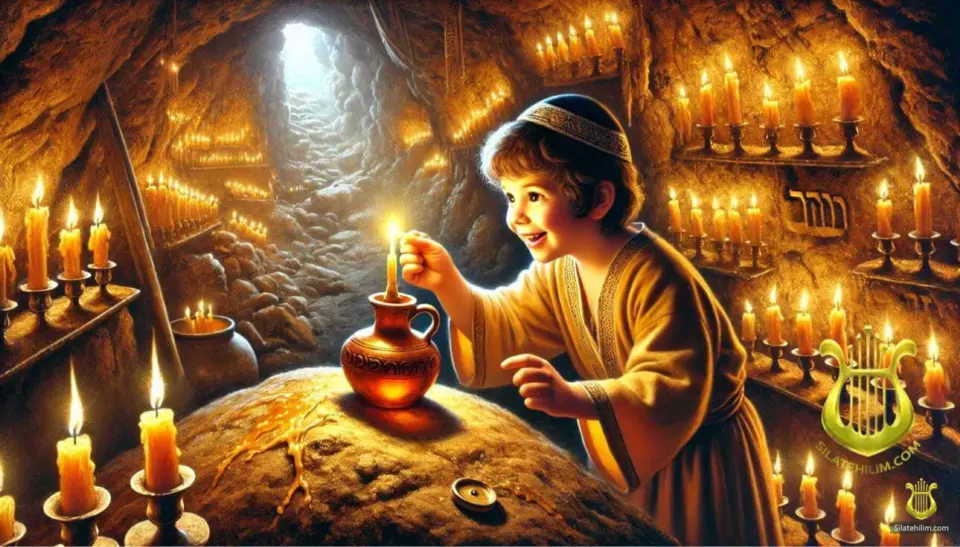
The Sages (Shabbat 21) say: “There was enough oil for one day. A miracle occurred, and the oil burned for eight days. The following year, they established these days as a festival on which
Hallel and Al HaNissim would be recited.”
Rabbi Yehudah Aryeh-Leib of Gur—the Sfat Emet—says that the words of the Gemara hint that
Hallel and Al HaNissim create the festival. It was established that this day should become a festival—a day when people praise the Almighty.
Rabbi Shmuel Munkacz, a famous student of the
Alter Rebbe, once heard a melamed teaching boys the first Mishnah of Bava Metzia, which discusses two people arguing over ownership of a garment.
“One says, ‘It is entirely mine,’ and the other says, ‘It is entirely mine.’”
Reb Shmuel asked the melamed and the boys: “Perhaps you can answer a question for me. In Hallel, we repeat several pesukim twice. For example, we say, ‘I thank You, for You have answered me and become my salvation’ twice. In most siddurim, the first line is printed in large type, while the second line is printed in small type. But in the Mishnah you are studying, the words ‘It is entirely mine’ are also repeated twice, yet both times they are printed in large letters. Why?”
No one knew the answer.
Reb Shmuel said to them: “When two people argue over ownership of something, both shout, ‘It is entirely mine!’ They both cry out with all their souls and all their hearts. Therefore, both instances are printed in large type, to show the loudness of their voices. But when we recite Hallel, people become lazy. Even if they say the first line loudly, the second time they repeat it quietly, without inspiration. Therefore, the second line is printed in small type.”
In this way, Reb Shmuel Munkacz taught the children about the importance of reciting Hallel with inspiration and feeling. We repeat Hallel for all eight days of Chanukah, but do not allow yourself to become lazy. Remember that reciting Hallel is the most important part of Chanukah.
The Tzebiner Rav said: “Hallel on Chanukah should not be the same as Hallel on Rosh Chodesh, because on Rosh Chodesh it is a custom, whereas on Chanukah Hallel is a mitzvah.”
Some of the Rishonim say that Hallel is a mitzvah from the Torah. (Reb Yerucham Fishel Perlow on the SeMaG, mitzvat aseh, p. 258)
Masechet Soferim (20:9) says: “We recite the complete Hallel throughout the eight days of Chanukah, and we recite a blessing before and after Hallel, and it should be read in a sweet and pleasant voice.”
It is written (Mishlei 27:21): “The crucible is for silver, and the furnace is for gold, and a person is tested according to his praise.”
Rabbeinu Chida explains that just as a furnace purifies silver and gold, a person is purified when he praises the Almighty.
It is written (Tehillim 106:47): “…to glory in Your praise.” This means that a person is purified when he praises the Almighty.
A Dybbuk and Hallel
Once, a dybbuk—a possessing spirit—entered a man, and during Chanukah he was brought to the
Admor of Tzanz, the Divrei Chaim. Divrei Chaim said: “Bring him to the Beit Midrash when we recite Hallel.” They did so, and the dybbuk immediately left the man’s body and flew out through the window. This is because, by reciting Hallel, a person can rid himself of any impurity.
The Gemara (Pesachim 117) says: “In Hallel we say, ‘so that no troubles should come…’”
Ben Ish Chai says that these words hint that Hallel helps prevent troubles from reaching us.
Rabbi Tzvi Elimelech Shapira of Dinov—the Bnei Yissachar (Kislev 4:134) teaches that when a person praises the Almighty, he can use that praise as a prayer.
For example, in the second blessing of the Shemoneh Esrei, we praise the Almighty as “He Who heals the sick.” When a person says these words, he can intend to pray for someone: “Almighty, please heal this person.”
When we recite an ordinary prayer, the angels may prevent it from rising, since the person may not be worthy of having his requests fulfilled.
But who can stop a Jew from praising the Almighty?
Praises rise Heavenward, and the Almighty reads between the lines, understands the intention, and fulfills the person’s request.
This is the meaning of the pasuk (Tehillim 18:4): “I call upon the L-rd, Who is worthy of praise, and I am saved from my enemies.”
It is also written (Tehillim 118:21): “I thank You, for You have answered me and become my salvation.” I praise You in my distress, and through these praises I will certainly merit deliverance.
Sfat Emet said that when a person recites the words “
Ana Ado-nai” (Please answer me, Almighty), he will receive an answer to all his requests. And when a person says “
Ana Ado-nai” in Hallel, all his requests are fulfilled.
The Chassidim thought that the Sfat Emet was referring to the pasuk “
Ana Ado-nai, hoshi'a na”—(Please, L-rd, save us now).
Imrei Emet says that it is a different pasuk: “
Ana Ado-nai, ki ani avdecha”—(Please, L-rd, for I am Your servant). (Tehillim 116:16)
When we recite the blessing of “Al HaMichya” (for flour-based foods, wine, and the seven species), we do not add an insertion for Chanukah, as we do on Shabbat, Rosh Chodesh, and Yom Tov. This is because praise of the Almighty cannot consist of a single sentence. Praise requires elaboration and explanation.
When Chassidim assisted
Rabbi Aharon of Belz, he insisted on thanking them personally.
The gabbai'im asked: “For more important matters, the Rebbe sends the gabbai'im. Why can we not convey the thanks to those who helped? Why does the Rebbe trouble himself to thank them personally?”
The Rebbe replied: “When the chazzan recites the prayer of Modim (thanksgiving), the congregation recites Modim deRabbanan along with him. This is because when it comes to expressing gratitude, one cannot do so through an agent. A person must do it himself.”
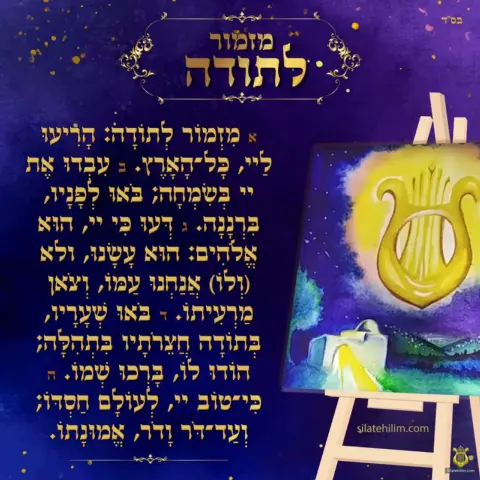
The Full Text of Hallel Is Here:
Festive Hallel (Transliteration)
(“The Well of Torah,” by Rabbi Elimelech Biderman)
Please note: some articles on our site contain the holy Names of the Almighty. If you print these articles, they may not be thrown away or destroyed. Please handle printed copies with care and respect.