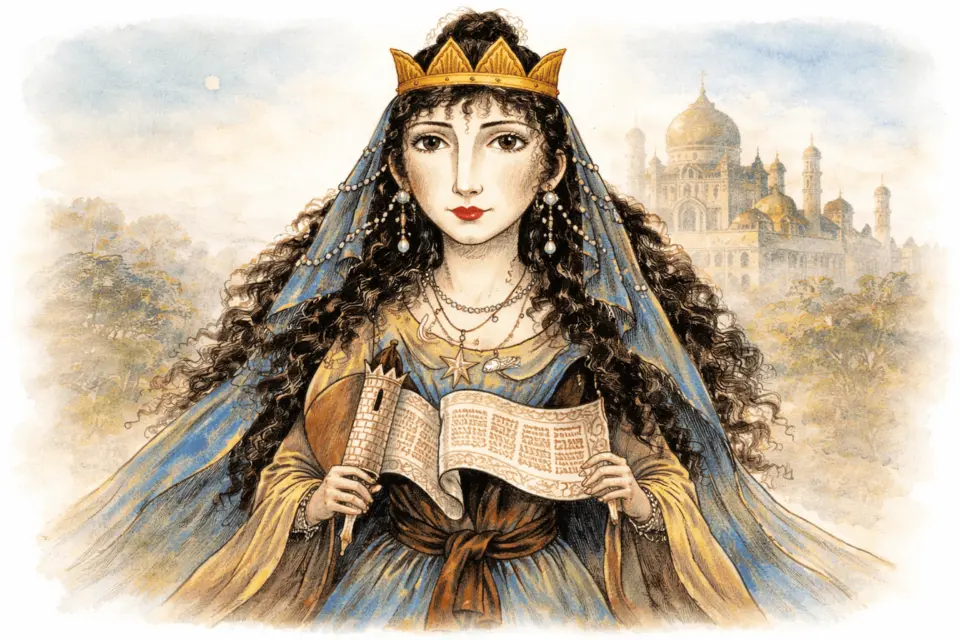
The Prayer of Esther HaMalka According to the Zohar HaKadosh
The Prayer of Esther HaMalka According to the Zohar HaKadosh
Queen Esther was utterly and boundlessly devoted to faith. Before her eyes there was only the One G-d—she did not see Achashverosh at all. When we read, “And Esther spoke again before the king, and fell at his feet, and pleaded with him and implored him...” (Megillat Esther 8:3), this does not mean that she pleaded with King Achashverosh, G-d forbid, but rather that she prayed and entreated the King of the Universe.
The Zohar HaKadosh says: “And Esther stood in the inner court of the king’s house, opposite the king’s house.” (Megillat Esther 5:1) —
— wherever the word “king” appears by itself, it refers to the Holy One, blessed be He;
— “and she stood”—standing always signifies prayer;
— “opposite the king’s house”—facing the Temple. (Zohar III, 109a)
Queen Esther fasted for three days and three nights.
On the first day she said: “My G-d!”
On the second day she said: “My G-d!”
On the third day she cried out aloud: “My G-d, my G-d, why have You forsaken me?”—“Eli, Eli, lama azavtani” (Tehillim 22:2)
She also said: “My soul thirsts for G-d” (Tehillim 42:3)
Esther did not rely on her beauty, wisdom, or cleverness, but only on the power of her prayer, placing her trust in the Creator of the Universe.
“Esther clothed herself in royal garments” (Megillat Esther 5:1)
What does “in royal garments” mean?
The Holy Zohar says: “On the third day of the fast, when Esther’s body had grown completely weak, she was sustained solely by spiritual strength. It was then that it is written: ‘Esther clothed herself in royal garments.’ Did she dress in ceremonial garments of twisted fine linen? No, indeed—she clothed herself in the Ruach HaKodesh.” (Zohar III, 169b)
“And when Esther’s turn came... And Esther found favor in the eyes of all who saw her...” (Megillat Esther 2:15)
A person of faith who devotes much time to prayer nourishes all the worlds through his influence!
And this is called “finding favor,” as it is said: “And Esther found favor in the eyes of all who saw her,” because she appeared to each person as a member of his own nation. (Megillah 13a)
“For one who possesses the power of prayer is likened to the word of the L-rd; therefore, the heavenly hosts and all the higher rulers regard him as a member of their own nation—that is, they find favor in him. Everyone feels that he is concerned only with them, because all receive benefit from him.”
(Translated by the Sila Tehilim website from the sefer “Likutey Moharan,” by Rabbi Nachman of Breslov)
Was this helpful?
100% of readers found this article helpful (37 votes).
Please note: some articles on our site contain the holy Names of the Almighty. If you print these articles, they may not be thrown away or destroyed. Please handle printed copies with care and respect.
Tags: Megillat Esther, Zohar HaKadosh, Esther Malka, The Prayer of Esther Malka, Jewish Holidays