Birkat Kohanim
“Yevarechecha Ad-nai v’yishmerecha!
Ya’er Ad-nai panav eilecha vichuneka!
Yisa Ad-nai panav eilecha v’yasem lecha shalom!”
(May G-d bless you and safeguard you!
May G-d illuminate you and show you favor!
May G-d turn His countenance toward you and grant you peace!)
(Bamidbar 6:24–26)
The Priestly Blessing begins with the letter yud and contains 15 words; the letter yud appears in each of the first 13 words.
According to Kabbalah, these 13 yuds correspond to the 13 Divine Attributes of Mercy—“Middot HaRachamim,” whose source is in the realm of Keter.
The yud corresponds to the sefirah of Chochmah. It is the root and essence of all Creation, as it says in Tehillim: “You have made them all with wisdom (be-Chochmah)”—therefore, the yud is the primordial seed of life.
On the physical level, the primordial seed is represented by the bones, from which the body is renewed, since the blood cells—the carriers of life—are produced in the “bone marrow.” This is indicated by the fact that the substance within a bone is called “marrow”—the same word used for the brain:
“Chochmah – mo’ach” (wisdom – brain). (Tikkunei Zohar 17:1)
The Mishnah (Ohalot 1:8) states that each hand contains 30 bones.
These are 30 of the 248 bones that form the entire human skeleton and correspond to the 248 positive commandments.
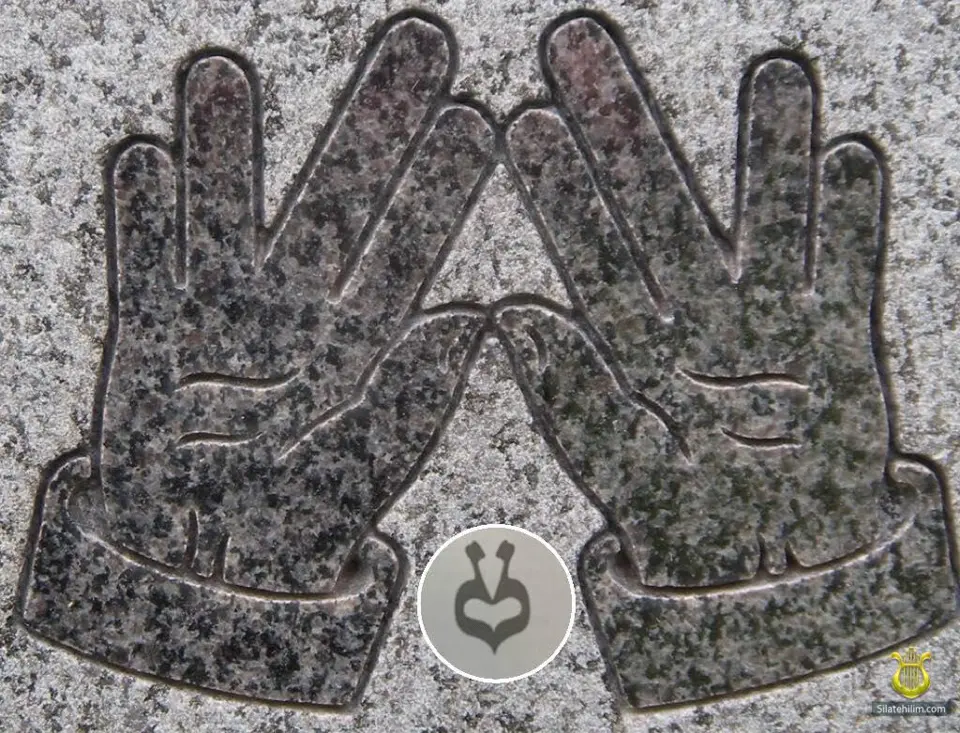
Thus, the two hands contain 60 bones, corresponding to the 60 letters of the special prayer and blessing known as Birkat Kohanim, with which the Kohanim bless the Jewish people while raising both hands before them and arranging their fingers in a special manner.
This indicates that the light contained in the 60 letters of the Priestly Blessing flows from the 60 bones of the two hands.
Interestingly, 30 times 30—for example, when we clap our hands, striking one hand against the other, as if multiplying one hand by the other (the strike, hak’ah, in Hebrew, denotes multiplication)—equals 900.
The number 900 is the numerical value of the final letter tzadi. This is the last of the 27 letters of the Hebrew alphabet (22 regular letters and 5 final forms—Manzepach). The number 27 is the gematria of the word zach—pure.
The numerical value of the letter ל “lamed” is 30.
It represents the 30 bones of each hand.
Two letters ל “lamed” facing one another, symbolizing the Kohen’s two palms during the blessing, create the visual image of a heart.
The first to draw attention to two lameds in mirror image was the great Kabbalist Rabbi Abraham Abulafia (for many years on Odnoklassniki, we practiced reading Psalm 30 twice as a segulah for finding a marriage partner).
The Hebrew word for heart—“lev” – לב—is composed of the letters lamed and bet. Since the numerical value of the letter bet is 2, the word can be interpreted as “two lameds”—a hint that two lameds form a heart, as Rabbi Abraham Abulafia taught in “Imrei Shafer 3.”
Two lameds turned toward one another resemble both a heart and the way the Kohanim arrange their hands during the blessing.
It says in “Shir HaShirim”: “Behold, it is Solomon’s couch, surrounded by sixty warriors, of the warriors of Israel.”
Chazal explain: “The sixty warriors” are the Priestly Blessing, consisting of 60 letters. This blessing endows the Jewish people with great strength. (Midrash Rabbah, Shir HaShirim 3)
The Tikkunei Zohar says: “Sixty warriors surrounding it” refers to the 60 tractates of “Shisha Sidrei Mishnayot.” (Tikkunei Zohar).
The sages also said that the sixty warriors are the 60 divisions that served in the Temple: 24 watches of Kohanim, 24 watches of Levites, and 12 auxiliary groups of Israelites. (Metzudat David, Midrash “Shir HaShirim” 3:7)
“Sefer HaBahir” (124) writes that the Kohen’s palms represent the letter yud—his ten fingers, corresponding to the ten sefirot of Creation—when he blesses the congregation of Israel.
(Rabbi Yitzchak Ginsburgh, “Body, Mind and Soul,” “Shir HaShirim,” Adam Davydov)
Was this helpful?
97% of readers found this article helpful (37 votes).
Please note: some articles on our site contain the holy Names of the Almighty. If you print these articles, they may not be thrown away or destroyed. Please handle printed copies with care and respect.
Material from our site may be copied for the purpose of spreading Torah, provided a link to Silatehilim.com is included. Any use of the site's material in print publications or for commercial purposes is prohibited without the rights holder's consent.