The Number 36 and Or Ha-Ganuz (the Hidden Light) on Hanukkah
The Number 36 and Or Ha-Ganuz (the Hidden Light) on Hanukkah
The five words of the evening Kiddush: “Vayechulu hashamayim vehaaretz vechol tzevaam” correspond to the five Books of the Torah, which served as the blueprint for Creation, as it is stated in the Zohar HaKadosh: “He looked into the Torah and created the worlds.” (Ba'al Ha-Rokeach)
The five words of this verse also correspond to the word “or” (light), which is mentioned five times in the opening verses of the Torah.
The numerical value of the word “or” is 207. Multiplied by 5, this equals 1,035.
In Hebrew, the word “elef” (one thousand) consists of the same letters as the word “alef” (one).
The Ari, of blessed memory, explains that if in the number 1,035, “elef” (1,000) is replaced with “alef” (1), the result is 36.
This number alludes to the 36 hours during which the primordial light of Creation illuminated Adam: from his creation on Friday morning until the conclusion of Shabbat. This Light was concealed until the End of Days and is therefore called “Or Ha-Ganuz”—the Hidden Light. (Kehillat Yaakov)
It is this Light that is sung about in the song “Atkinu Seudata” of the Ari, composed for the daytime Shabbat meal.
In the words “neora yishrei bah” (the light remains here), “neora” alludes to Or Ha-Ganuz.
Or Ha-Ganuz
The Sages explain that the primordial Divine Light, called “Or Ha-Ganuz” (the Hidden Light), shone for only 36 hours.
Bereishit Rabbah states that this Light shone throughout all 24 hours of the first Shabbat, as well as during the 12 hours preceding that Shabbat, from the time Adam and Eve were created on the sixth day.
The Light disappeared at the conclusion of Shabbat. This is one of the reasons we perform Havdalah at the end of Shabbat, symbolizing our hope for the restoration of this Light.
According to another view, the Light shone during the first three days of Creation, before the luminaries were created on the fourth day.
Since each day consisted of 12 hours of light and 12 hours of darkness, this means that each of the three days contained 12 hours of this Divine Light, for a total of 36 hours.
Originally, the Divine Light shone during the first three days—36 hours—and was then concealed within the physical luminaries.
On the sixth day, when G-d created Adam and Eve, He entrusted this Light to them, and they possessed it for 36 hours, until the conclusion of the first Shabbat.
When Adam and Eve sinned, the Light was returned to Heaven and placed beneath G-d’s Throne
Ayeka
The Almighty asked Adam: איכה “ayeka” — where are you?
The gematria of the word איכה is 36. When G-d called to Adam and said “ayeka,” He did not mean “Where are you?” but rather, “Where is the Light?”
Although Or Ha-Ganuz is currently concealed, it manifests itself in this world through the following channels.
Specifically, there are exactly 36 sacred writings in Tanakh: 21 in Nevi'im, 13 in Ketuvim, and the Torah itself.
Although they are grouped into the 24 books of Tanakh, there are in fact 36.
This indicates that all of Or Ha-Ganuz is contained within the Holy Scriptures.
Interestingly, when the Almighty called to Abraham in the “Binding of Isaac,” he answered “Hineni”—here I am—as if correcting Adam’s act of hiding and refusing to answer the question “ayeka.”
Bnei Yissaschar (Rabbi Tzvi Elimelech of Dinov) points out that the Talmud contains 36 tractates.
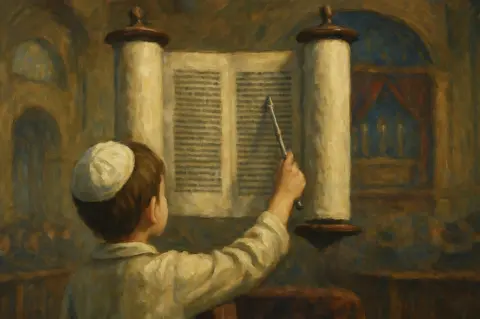
Studying the Torah—whether the Written Torah (Tanakh) or the Oral Torah (Talmud)—gradually restores this Divine Light.
This also corresponds to the 36 perfect hidden tzadikim. The Sages teach that in every generation there are exactly 36 nistarim, and that the world continues to exist in their merit. (Sanhedrin 97b)
There is a month in the Jewish calendar that contains Or Ha-Ganuz.
This is the month of Kislev, which, as Bnei Yissaschar explains, is an abbreviation of “kis” (כס) (hidden) and “lev” (לו), whose value is 36—that is, the Hidden Light.
On Hanukkah, we light one candle on the first night, two on the second, and so on. The total number of candles lit over the eight days is 36. The lights of Hanukkah symbolize this special holy Light of Creation.
Or Ha-Ganuz on Hanukkah
Rabbi Israel of Ruzhin once said:
“Angels stand above them” (mima'al lo). The numerical value of “lo” (above it) is 36. Angels stand above the 36 Hanukkah lights and directly elevate every prayer recited beside the candles to Heaven. The number 36 also alludes to the 36 hours during which the Hidden Light (Or Ha-Ganuz) shone during the creation of the world—and it is specifically on Hanukkah that one can draw it down.
The Torah begins with the words: “Bereishit bara…”—(and G-d said, “Let there be light”).
This is the first occurrence of the word “Or” in the Torah.
According to Kabbalah, the use of the word “Light” is also the first manifestation of the Creator’s Light in its complete form. Afterward, “all” the Light was concealed (and became “Or Ha-Ganuz”—“the concealed Light,” or more precisely, “the Light placed in safekeeping”), leaving us with its “taste.” The manifest Light was then further transformed into various forms—the heavens and the earth, the sea and all that lives within it, all that “the earth brings forth,” and everything that swarms within it.
The first use of the word “Light”—“Or”—is the 25th word in the Torah. It is no coincidence that the 25th of Kislev is the first day of Hanukkah. The 25th encampment of the Children of Israel was Chashmonah, an allusion to the Hasmoneans.
We cannot begin to grasp the greatness of the Hanukkah lights.
In the days of the Temple, the Menorah contained the Upper Source of Light. Therefore, the Temple windows were narrower on the inside than on the outside, so that the Menorah would illuminate the entire world.
A Jew who lights a hanukkiah is like a kohen who lights the Menorah in the Temple. On Hanukkah, through the lights of our hanukkiot, Or Ha-Ganuz shines—the great Hidden Light, which is also concealed within the Torah.
Bnei Yissaschar says that one of the holiest books, the Zohar HaKadosh, avoids discussing Hanukkah, mentioning it only twice and even then only in passing—in the Zohar Chadash (248) and in the Tikkunei Zohar (29).
Rabbi Tzvi Elimelech of Dinov (Bnei Yissaschar), drawing on the works of Torah giants—Rabbi Eliezer Ha-Rokeach, the Maharal of Prague, and Rabbi Pinchas of Koretz—reveals that on Hanukkah, through the light of the Hanukkah candles, Or Ha-Ganuz comes to us: the Light that was created on the first day of Creation, through which it was possible to see “the entire world, from one end to the other.”
Then the Almighty concealed this Light so that it would not fall into the hands of evildoers, but in the future it will be revealed to the righteous as a reward for their righteousness. Where is this Light found today?
From the Baal Shem Tov we know that it is in the Torah, and that even today a tzadik can merit it through studying holy books. Rabbi Pinchas of Koretz says that this is precisely why the Babylonian Talmud contains exactly 36 tractates, corresponding to the number of hours during which this Light existed before it was concealed.
“Bnei Yissaschar” cites the very passage from the Zohar in which the word “Hanukkah” is mentioned in passing. It states that the punishment of the wicked in Gehinnom lasts for a year: half of this period in fire and half in cold. But those who have the merit of fulfilling a number of mitzvot are protected from this punishment. Which mitzvot are these? The Zohar names several pairs of mitzvot that save a person from Gehinnom. One such pair is a mezuzah and the Hanukkah candles. Jewish law requires that the hanukkiah be placed opposite the mezuzah, with the mezuzah on the right of the person entering and the Hanukkah candles on the left. In the merit of these two mitzvot, one can be saved from Gehinnom.
(Compiled from Midrash Bereishit Rabbah; Rabbi Tzadok Ha-Kohen’s “Pri Tzadik”; Yalkut Shimoni; Bnei Yissaschar)
Was this helpful?
100% of readers found this article helpful (24 votes).
Please note: some articles on our site contain the holy Names of the Almighty. If you print these articles, they may not be thrown away or destroyed. Please handle printed copies with care and respect.
Tags: Number, Shabbat, the Arizal, The Power of Hanukkah, Hanukkah, Sod Torah, Or HaGanuz, Or Ha-Ganuz — The Hidden Light, Rabbi Tzvi Elimelech of Dinov, The Number 36 and Or Ha-Ganuz (the Hidden Light), Shabbat and Or HaGanuz, Jewish Holidays