
Rabbi Nachman of Breslov is one of the Tzadikim most closely bound up with Tehillim. Hundreds of thousands of Jews have done teshuvah through his “Tikkun HaKlali” (and I am among them).
His holy “Likutei Moharan” is almost entirely permeated with chidushim on Sefer Tehillim.
The main theme of King David’s psalms is wars and battles – a hint at every person’s daily struggle with his evil inclination, the “yetzer hara”, which tries to drag him into the abyss. The only way to defeat and overcome it is prayer. When a person turns to G-d through תהלים “Tehillim” (praises), which in the singular is תהילה “tehila” (praise), then there recedes תהלה “tehala” (confusion) – any bewilderment, any loss of direction. (Likutei Moharan II, 10)
Tehillim 3:2
“Ado-nai, ma-rabu tzarai, rabim kamim alai” - (L-rd, how many are mine adversaries become! Many are they that rise up against me).
When David HaMelech says “tzarai” צרי (my tormentors), he means that the more his “tzara” צרה (troubles), the more he is freed from the physical world and the more radiance his “tzura” צורה (inner essence) – the soul – receives.
Tehillim 4:3
“Benei-ish ad-me chevodi lichlima te'ehavun rik, tevakshu chazav sela” - (O ye sons of men, how long shall my glory be put to shame, in that ye love vanity, and seek after falsehood? Selah).
Rabbi Nachman cites the words of his great-grandfather, the Baal Shem Tov, that the word “rik” ריק (vanity) points us to the word “keri” קרי (wasted seed). This wasted seed is the result of slander, which is what “seek after falsehood” means. (Baal Shem Tov, Kedoshim 11)
Tehillim 4:9
“Beshalom yachdav eshkeva ve'ishan, ki-ata Ado-nai le-vadad lavetach toshiveni” – (In peace will I both lay me down and sleep; for Thou, L-rd, makest me dwell alone in safety).
Here “le-vadad”, from the word בדד (solitude), hints at “hitbodedut” התבודדות (secluded prayer). When the Jewish people pour out their hearts to G-d in secluded prayer, they dwell constantly in safety, for they turn their thoughts away from the vanity of this world and submit to the Divine will. (Likutei Halachot, Birchot HaShachar 5:87)
Tehillim 6:11
The month of Iyar – for neutralising the forces of evil and for healing
“Yevoshu veyibahalu me'od kol oyevai, yashuvu yevoshu raga” — (All mine enemies shall be ashamed and sore affrighted; They shall turn back, they shall be ashamed suddenly).
The rashei teivot of the last 4 words of the psalm form an acronym of the month of Iyar: איבי ישבו יבשו רגע – which speaks of the essence of the month of Iyar: neutralising the forces of evil.
Iyar is the month when the trees and plants that provide remedies come into bloom.
The Land of Israel is the foremost land on earth: it gives strength to all the produce of the earth and makes healing effective.
The Land of Israel is known in the Torah by two names: Eretz Yisrael and Eretz Kena'an. “The Land of Israel” denotes a state of peace and abundance; “the Land of Canaan” denotes the state of strife and poverty that reigned in the land before the Israelites came. When we merit the Land of Israel, we merit produce that brings healing properties and healing itself. (Likutei Moharan I, 277:3)
Tehillim 17:14
“Chelkam bachayim utzfunecha temale vitnam yisbe'u vanim, vehinichu yitram le'olelehem” - (Whose portion is in this life, And whose belly Thou fillest with Thy treasure; Who have children in plenty, And leave their abundance to their babes).
The Tcheriner Rav reveals how this pasuk is connected with the birth of sons: “chelkam bachayim utzfunecha temale vitnam yisbe'u vanim” - “utzfunecha” וצפונך – the same letters as in the word צפונ (north, a direction of the compass);
“vanim” – sons;
- “temale vitnam yisbe'u” (Thou fillest their belly) – hints at conception and pregnancy.
From this it is concluded that, for the conception of sons, the bed should stand toward the north.
Tehillim 18:4
“Me-hulal ekra Ado-nai, umin-oyevai ivashe'a” - (Praised, I cry, is the L-rd, and I am saved from mine enemies).
David HaMelech reveals that when a person prays with praises מהלל, Hashem delivers him from his enemies.
Tehillim 20:3
“Yishlach-ezrecha mikodesh, umitziyon yis'adeka” - (Send forth thy help from the sanctuary, And support thee out of Zion).
Rabbi Nachman teaches that the word “ezrecha” (thy help) refers to Chava, of whom it is written: “I will make him a עזר” (a help meet).
Chava corresponds to the Holy Tongue – Hebrew. Thus “thy help from the sanctuary” points to the Holy Tongue.
The sofei teivot of ישלח עזרן מקש (send forth thy help from the sanctuary) form the word חשך “choshech” (darkness). Darkness is the aspect of sleep, which corresponds to Aramaic. (Likutei Moharan I, 19:8)
Tehillim 20:8–9
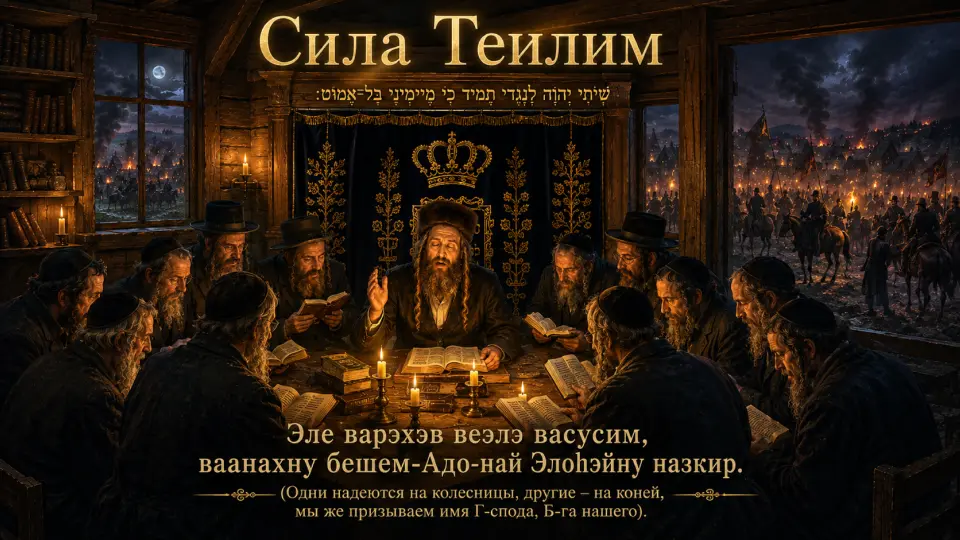
“Ele varechev ve'ele vasusim, va'anachnu beshem-Ado-nai Eloheinu nazkir” - (Some trust in chariots, and some in horses; But we will make mention of the name of the L-rd our G-d).
One must take care to utter the Name of G-d in holiness and purity – one should sanctify one’s speech to the point that it becomes an expression of the spirit of prophecy. Then his spirit will go forth and defeat those who rely on emptiness and vanity.
That is why the pasuk “beshem Ado-nai Eloheinu nazkir” יהוה אלהינו נזכיר בשם [whose first letters make up the word נביא “prophet”] is followed by the words: “They are bowed down and fallen”.
Tehillim 22:21
“Hatzila mecherev nafshi, miyad-kelev yechidati” - (Deliver my soul from the sword; mine only one from the power of the dog).
The rashei teivot of the first three words of this pasuk form the name “Haman” – the sworn enemy of the Jewish people. This psalm is connected with Esther, who cried out: “Save me from Haman”.
David mentions the sword because Haman was a descendant of Esav, of whom it is written: “By thy sword shalt thou live”. (Rabbi Chaim Vital, “Sha'ar HaPesukim”, Tehillim 22)
Tehillim 23:5
“Dishanta vashemen roshi, kosi revaya” - (Thou hast anointed my head with oil; my cup runneth over).
After the Jewish people sinned by listening to the slander of the 10 spies against the Holy Land, G-d said: “Vayómer Ado-nái: saláchti kidvarécha” - (And the L-rd said: I have pardoned according to thy word).
וַיֹּאמֶר יהו׳׳ה סָלַחְתִּי כִּדְבָרֶךָ׃
Rabbi Nachman points out that the initial letters of this verse in Hebrew spell כוסי (my cup). And the root of the word “kiDVaRecha” (according to thy word) is an acronym of the phrase “Dishanta Vashemen Roshi” – (Thou hast anointed my head with oil).
Tehillim 26:2
“Bechaneni Ado-nai venaseni, tzorfa chilyotai velibi” - (Examine me, O L-rd, and try me; test my reins and my heart).
When a person faces any spiritual test, he must understand that if he withstands the test, G-d will perform a miracle on his behalf. Rabbi Nachman reveals this through a secret in the word ונסני “venaseini” (try me) – it contains all the letters of the word נס (miracle).
Tehillim 27:4
“Lachazot beno'am-Ado-nai, ulevaker beheichalo” - (To behold the graciousness of the L-rd, and to visit early in His temple).
Rabbi Nachman teaches that the final letters of this pasuk
בנעם יהו׳׳ה ולבקר בהיכלו לחזות
form the word תרומה “truma” (offering).
Truma is equivalent to charity, which is the expression of a generous heart. Giving charity creates a vessel through which a person can receive G-d’s bounty, and this leads to the revelation of G-d’s glory.
Tehillim 27:13
“Lule he'emanti lir'ot betuv Ado-nai be'eretz chayim” - (If I had not believed to look upon the goodness of the L-rd In the land of the living!).
The word לולא (if not) has the same letters as the month אלול - Elul, the 12th month of the Jewish calendar.
Tehillim 29:2
“Havu la-Ado-nai kevod shemo, hishtachavu la-Ado-nai behadrat-kodesh” - (Ascribe unto the L-rd the glory due unto His name; Worship the L-rd in the beauty of holiness).
The rashei teivot of the last 4 words השתחוו ליהוה בהדרת קדש form the word קבלה “kabbala”, which corresponds to the Upper Unification.
Tehillim 31:16
“Beyadecha itotai, hatzileni miyad-oyevai umerodefai” – (My times are in Thy hand; Deliver me from the hand of mine enemies, and from them that persecute me).
The first 28 letters of the Torah, which describe “Ma'asei Bereishit” (the act of Creation), correspond to the 28 times in every person’s life, 14 of them bad and 14 good, as described in the Book of “Kohelet”.
The main rectification of these “times” comes through the quality of “emet” (truth).
The main thing is that at any “time”, whatever it may be, a person should fix his gaze on the truth and not deceive himself; for there is no time and no hour in which one cannot come out of darkness by means of the truth.
Tehillim 32:1
“Le-David maskil, ashrei nesui-pesha kesui chata'a” - ([A Psalm] of David. Maschil. Happy is he whose transgression is forgiven, whose sin is pardoned).
Rabbi Nachman teaches that the rashei teivot of the words נשוי פשע אשרי (happy is he whose transgression is forgiven) form the word “na'af” (adultery).
Tehillim 32:7
“Ata seter-li, mitzar titzreni, ronei falet tesoveveni sela” - (Thou art my hiding-place; Thou wilt preserve me from the adversary; With songs of deliverance Thou wilt compass me about. Selah).
Rabbi Nachman teaches that the rashei teivot of the phrase אתה סתר לי “Ata seter li” – (Thou art my hiding-place) – form the Holy Name סא׳׳ל. This Name is like a covering and a shelter that protects against a death sentence.
However, the letter מ, which is the first letter of the next word מצר “mi-tzar” (from trouble), is connected with the name of the angel סמ-אל, who prowls around this covering looking for a way to harm a person. If the letter מ “mem” joins the Divine Name, the result is the name of the Accusing angel סמ-אל.
Therefore, when reading this verse, one should pause between the words “ata seter-li” and “mitzar titzreni”, so as not to form the name of the Accusing angel.
Rabbi Nachman further teaches that when the letter מ is joined to the Divine Name סא׳׳ל, this Name becomes an acronym of the phrase סוף אדם למות – “sof adam le-mut” (the end of man is to die). (Likutei Moharan I, 213)
Tehillim 33:6
“Bidvar Ado-nai shamayim na'asu, uvruach piv kol-tzeva'am” - (By the word of the L-rd were the heavens made; And all the host of them by the breath of His mouth).
The rashei teivot of the phrase בדבר יהוה שמים נעשו form the word נביא “navi” (prophet). Prophecy is a means of prayer, which corresponds to the word of G-d.
Tehillim 34:10
“Yir'u et-Ado-nai kedoshav, ki ein machsor lirei'av” - (O fear the L-rd, ye His holy ones; For there is no want to them that fear Him).
Rabbi Nachman teaches that the rashei teivot of the phrase כי אין מחסור ליראיו form the word מלאך “malach” (angel). The spiritual root of this angel is holy fear, “yir'a”. The stronger the “yir'a”, the greater one’s chance of receiving the ability to prophesy. (Likutei Moharan II, 1:6).
Tehillim 35:1
“Le-David, riva Ado-nai et yerivai, lecham et-lochamai” – ([A Psalm] of David. Strive, O L-rd, with them that strive with me; Fight against them that fight against me).
Rabbi Nachman teaches, on the basis of a passage in the Zohar HaKadosh (III, 188b) where the Yenuka expounds the mystical aspects of eating, that through the strength and vitality we receive from the “bread with salt” we eat, we can defeat and destroy every obstacle on the way to the Holy Land.
By “lecham et-lochamai” (fight against them that fight against me) is meant that the word “lechem” (bread) is connected with the word “milchama” (war). A person’s main spiritual war is to reach the Land of Israel, the treasury of a Jew’s holiness. (Likutei Moharan I, 56:8)
Tehillim 35:10
“Kol atzmotai tomarna, Ado-nai mi chamocha, matzil ani mechazak mimenu, ve'ani ve'evyon migozlo” - (All my bones shall say: L-rd, who is like unto Thee, Who deliverest the poor from him that is too strong for him, Yea, the poor and the needy from him that spoileth him?).
Chazal teach that a person’s prayers correspond to the sacrifices offered in the Holy Temple. The Zohar adds that if a person’s prayer is found worthy, his “offering” is consumed by a lion of fire, and if not, his prayer is rejected and a klipa in the form of a dog descends to devour it. (Tikkunei Zohar 3, 188b).
Rabbi Nachman explains that when a person does not pray so intensely that “all his bones speak”, putting all his strength into the prayer, then “the dog descends to devour his offering”. But when he prays and tastes sweetness in the words of prayer, he reaches the level of “all my bones shall say”. However, he can reach this level only if he has rectified the sign of the Covenant (Tikkun HaBrit). For the stain of a sin against the Brit damages his essence (עצם), preventing him from praying in the aspect of “all my bones” (עצמותי). (Likutei Moharan I, 50)
Rebbe Nachman teaches that a person’s sins are imprinted on his bones, as it is written: “whose iniquities are upon their bones” (Yechezkel 32:27). Each sin has its own combination of letters. When a person commits a particular sin, its negative combination of letters is engraved on his bones.
But through confession the letters vanish from the bones on which they were engraved, for speech comes from the bones, as David HaMelech says: “All my bones shall say”. (Likutei Moharan I, 4:5)
Tehillim 37:7
“Dom la-Ado-nai vehitcholel lo, al-titchar bematzliach darko, be'ish ose mezimot” - (Resign thyself unto the L-rd, and wait patiently for Him; fret not thyself because of him who prospereth in his way, because of the man who bringeth wicked devices to pass).
In this psalm Rabbi Nachman reveals the idea of “bizyonot” (accepting humiliation and disgrace for the sake of Heaven). In Hebrew the words דום “dom” (silence) and דם “dam” (blood) share one root.
Be silent, “dom”, do not argue with Providence when “dam”, the blood, rushes to your face from shame. Even if you have to והתחולל “vehitcholel” (writhe with anguish of soul) – from the root חולה (sick) – still entrust your state to Him. And then salvation comes.
Tehillim 39:4
“Cham-libi bekirbi, bahagigi tiv'ar-esh, dibarti bilshoni” - (My heart waxed hot within me; while I was musing, the fire kindled; Then spoke I with my tongue).
Rabbi Nachman teaches that the rashei teivot of the phrase לבי חלל בקרבי (my heart is hollow within me) form the word חלב “chalav” (milk).
When a woman is modest and pure, the milk with which she feeds her child influences his innocence and purity. Conversely, the milk of an immodest woman engenders excessive desire in the infant’s heart, and such a child will be more susceptible to sexual temptation later on.
Remarkably, the “Pele Yoetz” reveals that encoded in the pasuk Tehillim 39:3, “ne'elamti dumiya hecheisheti”, is the word “nida” (the status of a ritually impure woman), while Rabbi Nachman reveals the word encoded in the next pasuk, “chalav” (milk), which confirms the deep connection between the spiritual influence of the mother, her ritual status, and the child. (A chidush of Silatehilim)
Tehillim 44:16
“Kol hayom kelimati negdi, uvoshet panai kisatni” – (All the day is my confusion before me, and the shame of my face hath covered me).
[See the note on Tehillim 37:7]
Tehillim 46:9
“Lechu-chazu mif'alot Ado-nai, asher-sam shamot ba'aretz” - (Come, behold the works of the L-rd, Who hath made desolations in the earth).
Rabbi Nachman, following the direction of the Sages, teaches that in this pasuk we should read not “shamot” (desolations) but “shemot” (names). For the word “shemot” is an acronym of the words of the prayer:
אַתָּה קִדַּשְׁתָּ אֶת יוֹם הַשְּׁבִיעִי לִשְׁמֶךָ, תַּכְלִית מַעֲשֵׂה שָׁמַיִם וָאָרֶץ
“tachlit ma'ase shamayim va-aretz” – (the ultimate purpose of the making of heaven and earth), from the 4th bracha of the Shabbat Amida.
And this is connected with the teaching that “the son of David (Mashiach) will not come until all the souls have descended” – meaning that all the souls destined to come down into this world from the heavenly treasury of souls called the “Guf” must pass through this lower world for their rectifications, and this is the ultimate purpose of the creation of Heaven and earth.
Moreover, the Talmud asks: how do we know that a person’s name influences his life?
From the verse: “asher-sam shamot ba'aretz” – do not read “shamot” (desolations) but read: “Who hath made names (shemot) in the earth”. It is G-d Himself who inspires parents with the name to give a child, in keeping with the Divine plan. (Berachot 7b).
Tehillim 47:2
“Kol ha'amim, tik'u chaf hari'u le-Elohim bekol rina” - (O clap your hands, all ye peoples; shout unto G-d with the voice of triumph).
Rabbi Nachman says that when we clap, we put the left hand into the right and the right into the left, so that the two palms become one whole. The right hand represents “Chesed”, whose gematria is 72. The left hand represents “Gevura”, whose gematria is 216. Together they make 288.
And since the left hand is included in the right and the right in the left, 288 is multiplied by two, giving 576. If we look at the gematria of the word תקעו “tik'u” (clap), we find the very same number. (Likutei Moharan I, 46:3)
Chassidut teaches that clapping the hands sweetens the judgements.
Tehillim 47:10
“Nedivei amim ne'esafu, am Elohei Avraham, ki le-Elohim maginei-eretz, me'od na'ala” - (The princes of the peoples are gathered together, the people of the G-d of Abraham; for unto G-d belong the shields of the earth; He is greatly exalted).
The rashei teivot of the expression
כִּ֣י לֵֽ֭אלֹהִים מָֽגִנֵּי־אֶ֗רֶץ מְאֹ֣ד נַעֲלָֽה
– “ki le-Elohim maginei-eretz” – form the word מלאך “malach” (angel). When the holy “shields of the earth”, by whom Rabbi Nachman means the tzadikim, stand firm against their desires, they rectify their imagination and merit Divine intellect, which is connected with tefillin. They then attain the kind of dream that our Sages call “one-sixtieth of prophecy”.
And by means of this dream they create an angel, as hinted by the expression “a dream conveyed through an angel”. (Likutei Moharan II, 5:9)
Tehillim 49:4
“Pi yedaber chochmot, vehagut libi tevunot” – (My mouth shall speak wisdom, and the meditation of my heart shall be understanding).
The rashei teivot of the 6 words: פִּ֭י יְדַבֵּ֣ר חָכְמ֑וֹת וְהָג֖וּת לִבִּ֣י תְבוּנֽוֹת
form the word חליפות “chalifot” (substitutions).
The main legacy a person leaves behind is true knowledge and the fear of Heaven. Even after a person departs this world, part of his spirit clothes itself in the teachings he passed on to others.
This is a kind of “substitute” for his presence, as though he still existed in this world. (Likutei Moharan II, 7:4)
Tehillim 50:1
“Mizmor le-Asaf, El Elohim Ado-nai diber vayikra-aretz” - (A Psalm of Asaph. G-d, G-d, the L-rd, hath spoken, and called the earth).
It is a great rarity for 3 Holy Names to stand together at the beginning of a psalm:
El – corresponds to the sefira of Chesed, and to prayer.
Elokim – corresponds to the sefira of Gevura, and to Torah.
Havaya – corresponds to the sefira of Tiferet and to the shidduch: “The thing proceedeth from Havaya” (the betrothal of Rivka; Bereishit 24:50), and “a prudent wife is from Havaya” (Mishlei 19:14).
Rabbi Nachman revealed something remarkable from the gematriot of this pasuk: the gematria of El is 31, Elokim 86, Havaya 26, diber 206. In all, 349. Adding the kolel (1) for each word gives 353, which is the gematria of the word “simcha” (353). By reading this psalm in simcha, one can attain what one seeks in prayer, in Torah and in a shidduch.
Tehillim 51:17
“Ado-nai, sefatai tiftach, ufi yagid tehilatecha” - (O L-rd, open Thou my lips; and my mouth shall declare Thy praise).
The Baal Shem Tov taught: “As soon as we say the words ‘O G-d, open my lips, that my mouth may declare Your praise’, the Shechina clothes itself in us and speaks through us.
When we sincerely believe this, awe takes hold of us. Then G-d envelops us and rests upon us.” (“Keter Shem Tov” 198). Speech is the very breath of G-d’s mouth.
The 27 letters of the Hebrew alphabet can be pronounced only with the 10 vowels, which correspond to the 10 sefirot.
10 times 27 makes 270, which is the gematria of the letters ר “reish” and ע “ayin”. The Divine Name used in this verse has the gematria of the letters ס “samech” and ה “hei”. Together these four letters – “reish”, “ayin”, “samech”, “hei” – form the word “se'ara” (storm). This stormy wind is the Great Accuser, from whom all accusations and all spiritual trials come forth (Likutei Moharan I, 38:2).
Tehillim 54:2
“Halo David mistater imanu” - (Doth not David hide himself with us?).
The abbreviation of this sentence הֲלֹ֥א דָ֝וִ֗ד מִסְתַּתֵּ֥ר עִמָּֽנוּ
– forms the word “amad” (to stand).
This hints at the principal prayer, the Amida (the standing prayer) – the same letters. Prayer was the life’s work of David, the ancestor of Mashiach, of whom it is said that his weapon is prayer.
Tehillim 54:5
“Ki zarim kamu alai” - (For strangers are risen up against me)
The abbreviation of this phrase in Hebrew כִּ֤י זָרִ֨ים קָ֤מוּ עָלַ֗י forms the word “za'ak” (to cry out). 10 key words are used to describe prayer, and of them the cry is the highest level
Tehillim 67:7
“Eretz natena yevula, yevarechenu Elohim, Eloheinu” – (The earth hath yielded her increase; May G-d, our own G-d, bless us).
The fruits of the earth fill prayer with their strength. And the produce of the earth corresponds to the return of all powers to their source. This is reflected in the fact that the word “yevula” (increase) is an abbreviation of the phrase: “Va-yetze Yitzchak lasuach ba-sade” - (And Isaac went out to meditate [to pray] in the field).(Bereishit 24:63)
וַיֵּצֵא יִצְחָק לָשׂוּחַ בַּשָּׂדֶ
The rashei teivot of this phrase form the word “yevul” (produce): the fruits of the field helped Yitzchak to meditate and pray. (Likutei Halachot, Chadash 3:15)
Tehillim 74:2
“Ga'alta shevet nachalatecha har Tziyon” – corresponds to – “Thou bringest them in, and plantest them in the mountain of Thine inheritance”.
גָּ֭אַלְתָּ שֵׁ֣בֶט נַחֲלָתֶ֑ךָ הַר־צִ֝יּ֗וֹן זֶ֤ה ׀ שָׁכַ֬נְתָּ בּֽוֹ- ג-ש-נ-ה
Encoded in the 2nd pasuk of Tehillim 74 is the secret of the Chanukah dreidel. The dreidel spins and turns one thing into another. Geula (redemption) is when the “upper ones” are below and the “lower ones” above (as it was when the Temple stood). That is why, when they came out of Egypt, they sang in Shirat HaYam: “Thou bringest them in, and plantest them in the mountain of Thine inheritance, The place, O L-rd, which Thou hast made for Thee to dwell in”.
When spun around, the phrase “Ga'alta shevet nachalatecha har Tziyon” corresponds to “Thou bringest them in, and plantest them in the mountain of Thine inheritance”. The first letters of the first 4 words are the first letters of the phrase “Nes Gadol Haya Sham” (a great miracle happened there), which are carved on the “sevivon” – the Chanukah dreidel. (“Conversations of Rabbi Nachman of Breslov”)
Tehillim 100:1
“Mizmor letoda, hari'u la-Ado-nai, kol-ha'aretz” - (A Psalm of thanksgiving. Shout unto the L-rd, all the earth).
The rashei teivot of the last 4 words הריעו ליהוה כל הארץ
form the word הלכה “halacha” (law), which corresponds to the Lower Unification.
Tehillim 139:13
“Ki-ata kanita chilyotai, tesukeni beveten imi” - (For Thou hast made my reins; Thou hast knit me together in my mother’s womb).
Rebbe Nachman connects this verse with the power of prayer. He explains that the sefira of Bina is connected with the womb, in which creation is conceived and formed.
Bina is also connected with the concept of Sukkah (סוכה), as it is written: “Thou hast covered me (תסכני) in my mother’s womb”.
When a person prays with deep concentration, putting all his strength into the words of prayer, such prayer is like a Sukkah, as the verse says: “Thou hast covered me (תסככני)… with bones and sinews”.