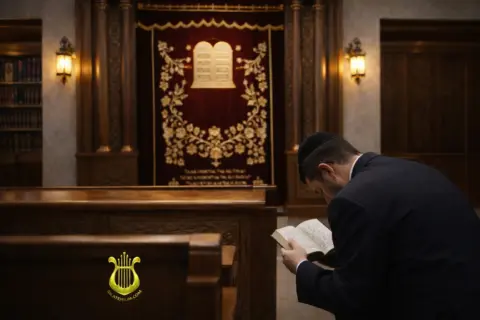
The Best Times for Prayer, or How to Befriend an Angel
The Torah teaches us that there are special times when our prayers are accepted without conditions or obstacles.
1. “Rega”
From Parashat Balak we learn that there is a time—a moment, an instant—in Hebrew,
“rega” רגע — lasting several seconds: a moment of strict judgment,
“Middat ha-Din”. It is the amount of time it takes to pronounce the word
“rega”.
The Talmud reveals that at this moment, a rooster’s comb changes from red to white and then becomes red again—this is that very instant.
Many sages wanted to know when this moment occurred, but were unsuccessful.
Bilaam knew when this moment would occur and wanted to curse (chas v’shalom) Am Yisrael at that time, because whatever is spoken at this instant is realized immediately. Bilaam tried to utter the word
כָּלֶם “kalem” (destroy) at that moment, but he was unable to curse them and instead blessed them three times.
The non-Jewish prophet Bilaam knew this time, while Moshe Rabbeinu did not. The reason is that Bilaam was 11 years older than Moshe Rabbeinu—this is the number separating kedushah (holiness) from tumah (impurity). Eleven is associated with tumah, the power of impurity; this is why the Ketoret contains 11 ingredients corresponding to the 11 kelipot of impurity.
Bilaam was a prophet on the level of Moshe Rabbeinu, but only from the side of impurity (the kelipot). Both were gilgulim of Hevel, but Moshe Rabbeinu was from the side of holiness, while Bilaam was from the negative side.
Ben Ish Chai teaches that if someone suddenly feels moved to bless you—even if that person is far from righteous—you should answer
“amen” to his berachah, because it is quite possible that this is the very moment of
“rega”. Likewise, if you suddenly feel the desire to bless someone or say a kind word, you should say it—it will be realized immediately.
“Rega” is an Et Ratzon (a time of Divine will, when words are accepted in Heaven).
The Zohar HaKadosh reveals that when Hashem created time, He divided it into two categories: time governed by
Chesed (kindness) and time governed by
Din (judgment).
Times governed by Chesed are the most auspicious times: prayers are accepted more readily, and the Heavens are open.
The Zohar HaKadosh identifies the times of Chesed.
2. The Year
According to the Torah, the beginning of the year—and every beginning is associated with Chesed—is the month of Nisan.
All rectifications begin in Nisan; it is the time when the sparks of holiness are elevated.
Nisan is the first month of spring, the time when nature comes back to life, and is a month of Chesed, kindness.
Pesach (the Festival of Liberation), the first 12 days of Nisan—the korbanot of the nesi’im (the offerings of the tribal leaders)—and the construction of the Mishkan all belong to this period.
Iyar—Chesed continues, with the mitzvah of counting the Omer each day.
Sivan—the giving of the Torah; Chesed continues.
After that come the difficult months, the months of Esav:
Tammuz and
Av (the first half of the month). We reclaimed from Esav the second half of Av, beginning on the 15th of Av, as well as the entire month of
Elul. The third month of Esav is
Tevet, the beginning of winter.
There are months of judgment in which the Heavens are nevertheless open to prayer:
Elul and
Tishrei. From Rosh Chodesh Elul until Hoshana Rabbah there are exactly
51 days—“HaMelech ba-Sadeh,” the King is in the field, meaning that He is accessible.
One who prays during these days has his prayers accepted without obstacles—especially if he goes to the Kotel or to the kivrei tzadikim.
3. The Month
The Jewish month is likewise divided between a time of Chesed and a time when Din prevails. The first half of the month, from Rosh Chodesh through the 15th, is when the moon is waxing; on the 15th of each month, the moon is full.
The moon’s period of growth is a time of Chesed.
From the 15th until the end of the month, the moon wanes, and during this time Middat ha-Din prevails.
4. The Week
There are seven days in a week. G-d created the world in seven days, and the lower world was created through seven forces—the seven sefirot:
- Yom Rishon (Sunday)—Chesed
- Yom Sheni (Monday)—Gevurah
- Yom Shlishi (Tuesday)—Tiferet
- Yom Revi’i (Wednesday)—Netzach
- Yom Chamishi (Thursday)— Hod
- Yom Shishi (Friday)— Yesod
- Shabbat (Saturday)— Malchut

The Sages teach that there are days when the Heavens are open—days of Chesed—but there are also days when Din predominates.
Monday and Thursday are days when Din predominates, and the full Tachanun is recited. Many people fast on these days because it is always beneficial to fast on days of judgment—it mitigates the judgments.
Prayer during days of Chesed is more effective.
Shabbat is the most auspicious time for prayer.
5. The Day
The day is also divided into:
Chesed —12 hours from
Chatzot Lailah (midnight) to
Chatzot ha-Yom (noon),
Gevurah —from
noon to
midnight (the second half of the day).
The most powerful time for prayer is at the very beginning of the day—midnight.
The Zohar HaKadosh says that one who remains awake and prays at this time has his prayers ascend directly; at this time, G-d visits Gan Eden and the righteous.
The prayer of
Tikkun Chatzot is especially powerful at this time.
All the children and grandchildren of the tzadik
Rav Baruch Toledano were great righteous people and talmidei chachamim. When he was asked how he merited this, he replied that every night throughout his life he prayed Tikkun Chatzot, and after this prayer he prayed for each of his children.
The second such time of day is
Ayelet HaShachar—the pre-dawn prayer, 72 minutes before Netz HaChamah (the appearance of the first rays of sunlight).
One who prays at this time is praying at an
Et Ratzon; the prayers ascend more effectively.
It is even better to sing
Shirot ve-Tishbachot at this time—to praise G-d. Through this, all judgments can be eased:
“Shirot ve-Tishbachot” for Ayelet HaShachar—a segula for sweetening judgments
6. The Beginning Is Always Chesed
Rosh Chodesh—the beginning of the month—is Chesed, but the Mekubalim teach that the time just before the actual beginning is even more powerful:
Erev Rosh Chodesh.
This is the moment of
“alah ba-machshavah”, when G-d conceived the desire to bring about Chesed—
Et Ratzon, a time of Divine will. This time is more powerful than the beginning of Chesed itself.
Since this is a time of G-d’s will, a person can also bring his own desire to fruition.
Erev Pesach is a powerful time; at this time we recite the prayer of
Rabbi Shimshon of Ostropoli.
Iggeret of Rabbi Shimshon of Ostropoli on Erev Pesach — a great segula
Erev Shabbat is also a powerful time. It is specifically then that we recite Shir HaShirim, in order to erase all sins.
Shir HaShirim on Erev Shabbat – Tikkun of Shlomo HaMelech According to the Sephardic Minhag
Seudat Shlishit—on Shabbat before Motza’ei Shabbat—is a powerful time, an Et Ratzon, because it is the time before Yom Rishon (Sunday), the first day and beginning of the week, the day of Chesed.
Mincha on Shabbat is the loftiest prayer, even higher than the prayer of Yom Kippur.
In the synagogue on Shabbat, especially during Mincha, when the Aron HaKodesh is opened, it is a powerful time to pray. At this time, according to the Arizal HaKadosh, two types of light emerge: Yesod de-Ima and Yesod de-Abba.
Likewise, when the Torah scroll is open—as is customary among Sephardim—it is the most powerful time for prayer.
The Zohar HaKadosh provides an Aramaic prayer for “Petichat Heichal”, the opening of the Aron HaKodesh, so that even the angels will not understand it and interfere with the ascent of the prayers. This prayer is “Berich Shemei de-Marei Alma”:
“Berich shemei de-Marei alma, berich kitrach ve-atrakh, yehei re’utakh im amakh Yisrael le-alam u-furkan yeminekh, achzei le-amakh be-veit mikdeshakh, u-le’amtuyei lana mi-tuv nehorakh, u-lekabalah tzelotana be-rachamei.
Yehei ra’ava kodamakh de-torich lan chayin be-tivutakh, ve-lehevei ana avdakh peki’da be-gav tzaddikaya, le-mircham alai u-le-mintar yati ve-yat kol di li ve-di le-amakh Yisrael. Ant Hu zan le-khola u-mefar nes le-khola, Ant Hu shalit al kola, Ant Hu de-shalit al malchaya u-malchuta dilakh hi. Ana avda de-Kudsha Berich Hu [bow]. De-sagidna kamei u-min kamei dika’rei Oraita be-chol idan ve-idan, la al enash rachitzna ve-la al bar elahin samichna ela be-Elaha di-shmaya, de-Hu Elaha ke-shot u-Oraita ke-shot, u-nevi’ohi ke-shot, u-masgei le-me’avad tavvan u-kshotei. Be-Anna rechitz, ve-lishmei yakira kadisha. Anna emar tushbechan. Yehei ra’ava kodamakh de-tiftach libbi be-Oraita, ve-teihav li benin dichrin de-avdin re’utakh, ve-tashlim mish’alin de-libai ve-libah de-khol amakh Yisrael le-tav ul-chayin ve-lishlam. Amen.”
Translation
Blessed is the Name of the Master of the universe! Blessed is Your royal crown and the place where You dwell! May You forever be gracious to Your people, Israel; and may You reveal to Your people the salvation brought by Your right hand, restoring Your Temple. Shine upon us with Your gracious light and graciously accept our prayers. May it be Your will to grant us long life and prosperity. May I be counted among the righteous, to merit Your mercy, and may You guard me, all that is mine, and everything belonging to Your people, Israel. You provide sustenance for all and provide everyone with all that is necessary. You rule over all; You rule over kings, and all royal power belongs to You. I am G-d’s servant, and I bow before Him and before the glory of His Torah. I do not rely on man, nor do I place my hopes in an angel, but only in G-d, the Ruler of the heavens, for He is the true G-d, His Torah is true, His prophets are true, and His great deeds are good and just. I yearn for Him and praise His glorious and holy Name. May it be Your will to open my heart to Torah, fulfill the desires of my heart and the hearts of all the children of Israel, and grant us prosperity, long life, and peace. Amen.
Erev Rosh Hashanah—this refers to the entire month of Elul and the final days of Elul. The 25th of Elul, the first day of Creation, is a powerful time for prayer.
7. Signs
Rabbi Chaim Palagi writes in the sefer
“Imtza Chaim” that sometimes a person suddenly feels the desire to do something good—to perform an act of kindness or a mitzvah. This is a sign that the Heavens are currently open to that person in particular; it is his personal Et Ratzon. Sometimes the opposite occurs: sadness and dejection set in. At such a moment, judgment is being directed at him, and he should pray to nullify the judgments.
8. How to Befriend an Angel
The Ohr HaChaim HaKadosh teaches that if a person wants his prayers always to be accepted, he should establish one fixed, precise time for prayer.
The secret is that an angel is appointed over each hour of the day (24 angels over the 24 hours). This angel governs that hour, serves during that time, and elevates the prayers. When a Jew begins praying at the same time each day, the angel of that hour recognizes him and becomes his friend—for the person provides it with daily work, and the angel elevates his prayers.
9. Kaddish After a Torah Class
After a Torah class in the synagogue, when there is a spiritual elevation, if the rabbi who delivered the class recites Kaddish and everyone responds “Amen, yehei shemei rabbah…”, this is a time of the greatest Et Ratzon—all sins are cleansed and all decrees (judgments) are annulled. The greatest mitzvah is studying Torah, especially in a synagogue and with a large number of people. Even after an ordinary Torah class, this is an appropriate time for prayer—how much more so after a class given for the community.
(Compiled from the classes of Rav Alexander Tzvi Sypkov and Rav Israel Yakobov)
Please note: some articles on our site contain the holy Names of the Almighty. If you print these articles, they may not be thrown away or destroyed. Please handle printed copies with care and respect.