Bowing in Jewish Prayer
Bereishit Rabbah (56:2) states that all the major events in the history of the Jewish people took place through the merit of bowing.
Rabbi Yitzchak said: “Everything was accomplished through the merit of bowing:
- Abraham returned safely from Mount Moriah through the merit of that bowing: “We will bow and return to you.”
- The Jewish people were forgiven after the sin of the Golden Calf through the merit of bowing: every time (to this day), during Selichot, on Rosh Hashanah, and on Yom Kippur, Am Yisrael recites: “Vaya'avor Ado-nai al panav…” while bowing, just as Moshe Rabbeinu did at Mount Sinai.
- [The children of] Israel were saved [from Egypt] only through the merit of bowing: “And the people believed. And they heard that the L-rd had remembered them, and they bowed and prostrated themselves.” (Shemot 4:31)
- The Torah was given only through the merit of bowing: “...and bow from afar.” (Shemot 24:1)
- The Temple was built only through the merit of bowing: “Exalt the L-rd our G-d and bow before His holy mountain.” (Tehillim 99:9)
- “Techiyat ha-metim” (the resurrection of the dead) will take place in the future only through the merit of bowing: “Come, let us bow and prostrate ourselves.” (Tehillim 95:6)
- Hannah was healed of infertility only through the merit of bowing: “...and he bowed before the L-rd there.” (I Samuel 1:28)
- The exiles will be gathered only through the merit of bowing: “And it shall come to pass on that day: a great shofar shall be sounded... and they will bow before the L-rd on the holy mountain in Jerusalem.” (Isaiah 27:13)
Secrets of Bowing in Prayer
1. Bowing in the Akeidat Yitzchak- “Ve-nishtachaveh ve-nashuv aleichem” - (we will bow and return to you) Abraham said to the young men.
The Sages teach that Abraham returned safely from Mount Moriah through the merit of that bowing. (Bereishit Rabbah 56:2)
The root of the word “nishtachaveh” (we will bow) is ח.ו.ה. and this hints at Chavah, “the mother of all living,” the source of life, “chiyut” (vitality).
The Mekubalim teach us to read “nishtachaveh” not as “we will bow,” but as “we will return to the source of all life.”
2. The Prayer “Va-Yevarech David”- “U-tzeva ha-Shamayim lecha mishtachavim” - (and the heavenly host bows before You).
Rabbi Nachman of Breslov teaches that when, during Shacharit in “Va-Yevarech David,” we recite the phrase “u-tzeva ha-Shamayim lecha mishtachavim” (the heavenly host bows before You) from Nehemiah (9:6), this is the most appropriate time to add a personal prayer.
One should bow and have the following kavanah, according to Kitzur Likutei Moharan (I, 231):
“[At this moment] one may pray for anything, because at this time all the angels bow and prostrate themselves before the Holy One, blessed be He. Therefore, it is good to ask that the L-rd command them to do what you are asking for, and if it is healing, one should have the kavanah that the L-rd command [the angels] to infuse bread and water with the spiritual forces of healing, and so on.” (“Weekly Breslov Customs,” p. 62)
3. Four Bows in the Amidah
The Sages ordained that one bow during the Amidah in four places:
Twice when reciting the first blessing, and twice when reciting the eighteenth. (Berachot 34a)
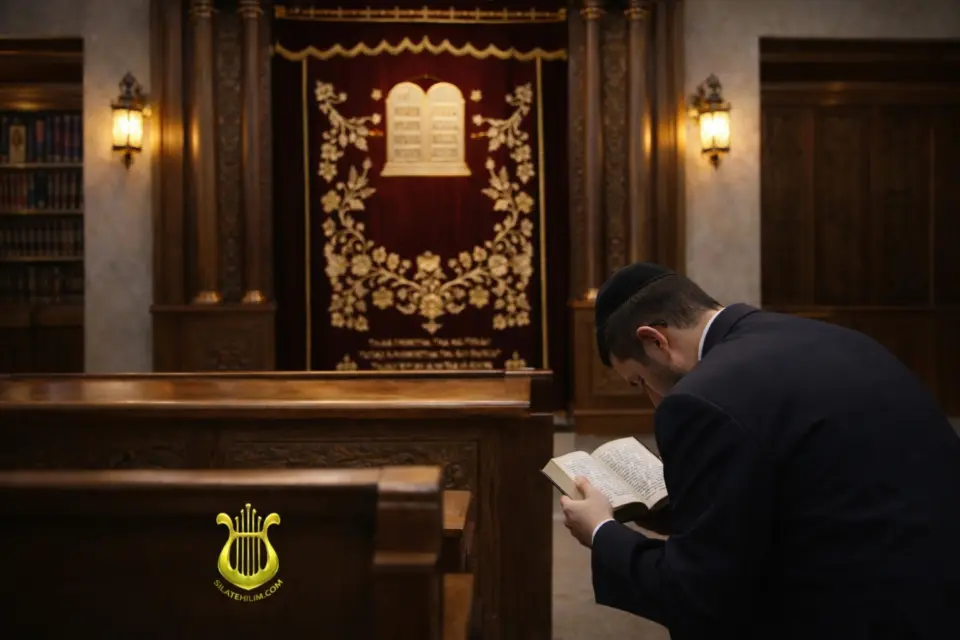
According to the holy Zohar, each bow should consist of three stages: at the word “Baruch”—we slightly bend our knees; at the word “Atah”—we straighten our knees and bend forward; and at the word “Ado-nai”—we straighten up.
This form of bowing is practiced today in all Jewish communities without exception. However, at the end of the prayer, as well as in the eighteenth blessing, when saying “Modim anachnu lach”—one simply bows forward. In all these cases, one bows deeply enough for the vertebrae to become visible along the back. When we straighten up at the word “L-rd,” we testify, as it were, that He straightens those who are bowed down.
4. Bowing in the Concluding Prayer “Aleinu Leshabe'ach”- “Va'anachnu mishtachavim lifnei Melech malchei hamelachim” - (but we bow before the King of kings, the King of all kings) - one bows (during Musaf on Rosh Hashanah, one kneels, as was done in the Temple).
When saying the words “Va'anachnu mishtachavim,” we bow.
The Mekubalim say that it is precisely at this moment that the “hagurat Or Makif le-olamot ve-ze hagurat shmira” descends—the encompassing belt of the Surrounding Light, Or Makif. As we lower our heads while praying and bowing simultaneously, we should have the kavanah that the belt of the great Light that saves and protects is now descending.
5. When Reciting the Thirteen Attributes of the Mercy of the Holy One, Blessed Be He During Selichot, on Rosh Hashanah, and on Yom Kippur, all of Am Yisrael recites: “Va-ya'avor Ado-nai al-panav…” while bowing, just as Moshe Rabbeinu recited it at Mount Sinai. The Ben Ish Chai writes that he inquired of the custom of the Kabbalists’ yeshivah “Beit El” in the Holy City of Jerusalem, from the Gaon Rabbi Eliyahu Mani, regarding the proper way to recite the Thirteen Attributes of the Holy One, blessed be He: “This is our custom: to bow at the words “Va-ya'avor Ado-nai al-panav”—(the L-rd passed before him), and then to raise one's head at the word “Va-yikra”—(and [Moshe] called out). And to straighten up when reciting the Name: “Ado-nai, Ado-nai, El rachum ve-chanun”—(the L-rd, the L-rd, a merciful and gracious G-d). At the words “Ado-nai, Ado-nai”—one should rise onto one's toes, and this contains profound meanings”. (“Shiurei Berachah” 138, “Shalmei Tzibbur” (149:1), the Gaon Rabbi Eliyahu Mani)The Negative Aspect of Bowing
On the Ninth of Av, Yaakov Avinu bowed seven times to Esau, and this gave him strength. Therefore, the Ninth of Av is filled with negative influences because of this “grip” of the klipah. All eleven brothers also bowed to Esau. Bowing—or, more precisely in this case, falling prostrate—causes Divine power to descend from Above. By prostrating themselves before Esau, the brothers transferred this power to him and thereby established his dominion over the attribute of Netzach.
Regarding Yaakov himself, the holy Zohar asks how it was possible for him to bow before the wicked Esau.
It answers that during this encounter, the presence of the Shechinah was revealed, and it was before Her that he bowed seven times. But the brothers bowed directly before Esau.
Only Benjamin did not take part in this, as he had not yet been born at that time.
The power to subdue Esau in the person of his descendant Amalek passed to King Saul, a descendant of Benjamin, and then to their descendant Mordechai. He refused at all costs to bow to Haman, a descendant of Esau and Amalek.
The holy Zohar says that when Mordechai encountered Haman, he even showed him his thigh, telling him that victory would belong to the Jews and that nothing would destroy the Jews’ connection with G-d. This is precisely why, of all the tribes, only the tribe of Benjamin is not subject to the influence of Esau.