Challah Offering
Challah Offering
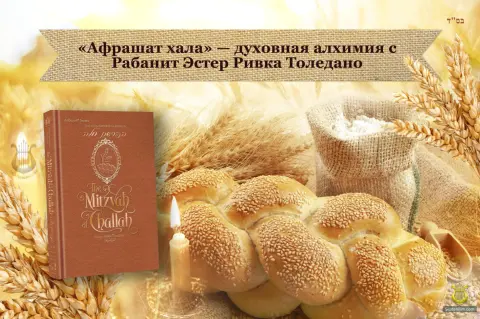
I have been leading a religious lifestyle for 18 years. Three months ago, a woman began giving lectures near our home on the mitzvah of challah separation. In the Torah, the Creator commands us that upon entering the Land of Israel, we bake bread and separate a small piece from the prepared dough. This is one of the three mitzvot traditionally performed specifically by women.
I am far removed from the practical wisdom of everyday life and had never gone to the trouble of baking bread. But I enjoyed watching our baker do it.
Sometimes my husband and I baked bread together for Shabbat—he says that kneading the dough gives his fingers a workout. I simply recite the blessing and separate the challah. But attend a ten-week course devoted to a single mitzvah? That was not for me.
When a friend asked me why I had not enrolled in the course, I replied lightheartedly that air was my natural element, and that I had no inclination toward a purely earthbound craft.
My friend could hardly believe her ears. “What, you don’t know that the blessing of material abundance descends into this world specifically through observing the mitzvah of challah separation? Besides, this mitzvah has fourteen healing properties.”
I gave in, trying to imagine what one could possibly say about a single mitzvah for ten whole weeks.
“In its scope, the mitzvah of challah separation is truly cosmic,” our teacher announced in the very first lesson. And as, day after day, she revealed more and more aspects of the mitzvah to us, my jaw dropped lower and lower.
One day she said that the following week a rabbi would come and explain the specific requirements that Jewish law sets for fulfilling this mitzvah. His lecture would last two hours.
Two hours? I could not imagine how he intended to fill all that time. And, naturally, I already knew exactly how to perform this mitzvah. Nevertheless, I attended the class. And I discovered that I had been separating the challah incorrectly.
Afterward, our teacher announced that the following week she would demonstrate exactly how challah should be prepared. I went to the class absolutely certain that I would be wasting my time, since my husband knew the recipe for the best whole-wheat challah in the world.
The demonstration organized by our teacher changed my life.
Now, once a month, I perform the challah offering, which has become the culmination of my spiritual work. I begin by turning off my phone and forbidding anyone from entering the kitchen until I am finished. Fulfilling this mitzvah requires absolute concentration.
Then I set aside money for charity so that all my prayers will be favorably received. After that, I recite a chapter of Tehillim, which helps me open the Gates of Heaven.
As I sift the flour, I sing, because joy is the key to success in every spiritual endeavor. I add each ingredient with complete mindfulness: sugar—for the sweetness I would like to experience in my family life; yeast—so that every member of my family will grow and gain wisdom; water—as a symbol of the Torah. As I measure out the necessary amount of salt, symbolizing admonishment, I fill two teaspoons and then pour some back into the salt shaker, because we should always admonish others less than we think they deserve. Slowly adding the oil, I “anoint” each member of my family, calling each one by name and praying that the Almighty grant them whatever they need.
Kneading the dough is a time for prayer. My daughter and I do it together. While one of us kneads, the other thinks about the people for whom we want to pray. By name. For single friends, that they may find their partners; for childless relatives, that they may know the joy of motherhood and fatherhood; for the sick and victims of terror, asking for their speedy recovery; for acquaintances in need, asking that they achieve financial well-being. My daughter asks me to mention Israeli soldiers who are missing in action. And we knead and knead the dough. And we pray—with such concentration and intensity that the air in the kitchen literally crackles with spiritual tension.
Now the dough is ready for challah separation. Yet the spiritual work involved in fulfilling the mitzvah properly is not over. Reading a prayer from a laminated sheet prepared and distributed by two of my Israeli sisters, I pray fervently that fulfilling this mitzvah will help rectify the sin of the first woman on Earth, Chavah. She brought death into the world, while I will bring life, nullifying death and wiping away the tears from every face.
Now I am ready to perform the mitzvah. I separate a small piece of dough, recite the blessing, lift it above my head with both hands, and say: “This is challah!”
My hands tremble from the intensity of my emotions. Without lowering them, I recite two more blessings: in one, I ask that this challah be accepted as though I had brought an offering in the Temple, an offering that would cleanse me of all my transgressions and help me be born anew; in the other, I pray for the final redemption of the entire world.
Performing this one mitzvah takes me more than an hour. I experience such spiritual elevation as I had previously achieved only after many hours of meditation.
For seventeen whole years, I fulfilled this mitzvah irregularly—and incorrectly—without the slightest understanding of its depth or spiritual potential. I recited the blessing and separated a piece of dough, feeling absolutely nothing. Challah did not bring me closer to the Creator—except perhaps on the most primitive level.
The problem was not with the mitzvah. Nor was it with our tradition. The problem was with me.
The mitzvot are an unprecedented feast for the spirit. Most Jews have only a vague idea of the delicacies we are privileged to taste at this feast. Gourmets know the difference between food and a feast. A feast takes time, and in order to savor every dish, one must focus on all the nuances of its flavor. A gourmet dining at a first-class restaurant would never complain about having to wait while the kitchen prepares the dishes he ordered. Nor would how quickly or how much he managed to fill his stomach play any role in assessing the quality and refinement of the food.
Judaism is not a “fast-service” religion. In order to connect with the Almighty through fulfilling the mitzvot, we need time, a constant expansion of our store of knowledge, and a willingness to go farther and farther.
My dear sister Laura, I suggest that you try once more. The Creator loves you so deeply that He has given you His mitzvot, each one a radiant path of His love.
Please, Sister Laura, come to Jerusalem and bake challah with me…
(Rabbanit Sarah Yocheved Rigler - http://www.evrey.com/sitep/psychology/arkhiv.php3?menu=300)
Was this helpful?
100% of readers found this article helpful (4 votes).
Please note: some articles on our site contain the holy Names of the Almighty. If you print these articles, they may not be thrown away or destroyed. Please handle printed copies with care and respect.
Tags: Hafrashat Challah, Meal Offering, Rabbanit Sara Yocheved Rigler, Challah — the bread offering for the Kohanim