Tehillim During the War of Gog and Magog and the Nigun of Mashiach
Tehillim During the War of Gog and Magog and the Nigun of Mashiach
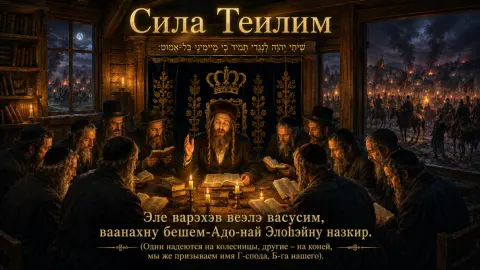
During the era of Gog and Magog, Chazal draw our attention to the recitation of Tehillim 2, 47, and 118.
Tehillim 2
This psalm was sung by the Levites at the coronation of the King, and it will likewise be sung at the coronation of King Mashiach. Therefore, David HaMelech begins the psalm with the words:
“Lamah ragshu goyim” (Tehillim 2:1)—(why are the nations agitated?).
The Midrash HaGadol (Shemot 1:16) states that Gog from the land of Magog will come and say:
“All those who came before me were fools, since they waged war against Israel. Did they not know that they have a Protector in Heaven? But I will not act as foolishly as they did; I will wage war against their Protector”:
“Yityatzvu malchei eretz, v'roznim nosdu yachad” (Tehillim 2:2)—(the kings and nobles of the earth gather and conspire together against G-d and His anointed one), and he—Gog—will gather the nations (70) around himself.
The Holy Zohar comments on Tehillim 2 as follows:
“Rabbi Abba said in the name of Rabbi Yossi Saba—so said Rabbi Shimon bar Yochai—that in the future Ha-Shem will revive (through gilgul) all the kings who waged war against Jerusalem: the emperor Hadrianus, Lupinus, Nebuchadnezzar, Sennacherib, and all those who fought against Jerusalem. He will give them authority, hold them accountable, and the Almighty will reveal His power. Then:
“Yoshev ba-Shamayim yischak”— (He Who sits in Heaven laughs)—this alludes to Yitzchak (the left side); it also alludes to wine, which initially brings joy but later intoxicates and weakens.
“Rabbi Yitzchak said: In the future, the heavenly hosts (the angels of the 70 nations) will gather and assemble people from the 70 nations, and they will approach Jerusalem in order to conquer it and thwart the counsel of the Holy King.
They will rise up against the Protector (Ha-Shem), against the Holy Nation, and against the Sanctuary of the Almighty.
But “Yoshev ba-Shamayim yischak, Ado-nai yilag lamo”— (He Who sits in Heaven laughs; G-d mocks them).
He will destroy them from this world, and in those days there will be a magefah (plague) with which He will strike all the nations that come against Jerusalem. (Zechariah, chapter 14)
—“Az yedaber eleimo ve-apo” (Tehillim 2:5)— (when He speaks to them in His anger). This is the way of the wicked: first Ha-Shem shines upon them in this world and rewards them, like wine that initially brings them joy but later intoxicates and weakens them. He waits for them to repent, and if they do not, He strikes them and removes them from both this world and the World to Come.
Tehillim 47
This song will be sung on the day King Mashiach is enthroned, when the entire earth will be filled with His glory:
“Kol ha-amim tik'u khaf, hari'u le-Elohim bekol rinah”— (Clap your hands, all you nations; greet G-d with joyful voices).
Tehillim 118
The Sages call Psalm 118 a song of thanksgiving prepared for the victory of Mashiach.
The great Rashi writes that this psalm concerns the time of the war of Gog and Magog, for all the nations will take part in it:
“Kol goyim sevavuni—be-Shem Ado-nai ki amilam”— (all the nations surrounded me; relying on the Name of G-d, I will crush them).
Tehillim 126—The Nigun of Mashiach
Gaon Rabbi Yitzchak Batzri said in a lesson given in light of recent events that Psalm 126 should be recited daily. There is a tradition that this is the “Nigun of Mashiach,” and that it is revealed through the verse:
“Az yimale sechok pinu, u-leshonenu rinah”— (at that time our mouths will be filled with laughter, and our tongues with joy).
Very soon, we will see how:
“Halokh yelekh u-vakho nose meshekh ha-zara, bo yavo ve-rinah nose alumotav”— (he goes forth weeping, carrying a sack of seed, but he will return with joy, carrying his sheaves).
(SilaTehilim, based on a lesson by Gaon Rabbi Yitzchak Batzri about the war of Gog and Magog)
Source:(По комментариям к книге Теилим под редакцией Рава Баруха Малаева, по уроку Гаона Ицхака Бацри, по уроку Александра Цви Сыпкова)
Was this helpful?
99% of readers found this article helpful (84 votes).
Please note: some articles on our site contain the holy Names of the Almighty. If you print these articles, they may not be thrown away or destroyed. Please handle printed copies with care and respect.
Material from our site may be copied for the purpose of spreading Torah, provided a link to Silatehilim.com is included. Any use of the site's material in print publications or for commercial purposes is prohibited without the rights holder's consent.