Tehillim 42 and the Great Mystery of Water
Tehillim 42 and the Great Mystery of Water
- «Tehom el tehom kore le-kol tzinorecha» - (Deep calls to deep at the sound of Your waterfalls.)
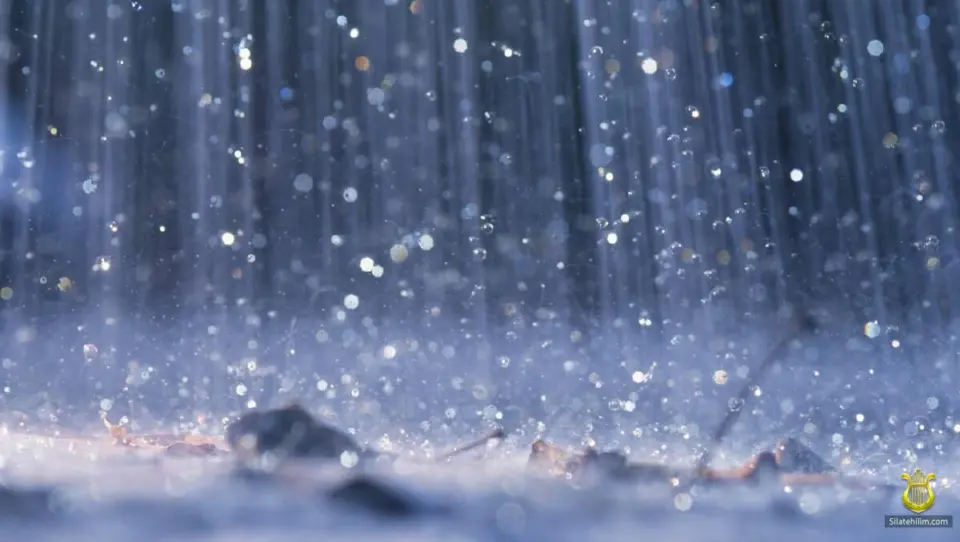
What does it mean that deep calls to deep? When it rains, the rain falls from above. The upper waters call to the lower waters.
Rabbi Ben Zion Mutzafi offers a unique explanation that reveals the great mystery of water. The Book of Formation teaches that in the beginning, water was created. On the first day, the entire universe was filled with water. In the beginning, there was nothing. The beginning of everything was water.
In other words, the foundation of this world is water. Then G-d took from beneath the Throne of Glory - "Kisei HaKavod" a tiny stone (more precisely, a speck of dust or grain of sand), and cast it into these waters; from this stone, the earth was formed. This is the Western Wall – the Kotel HaMa'aravi, and that same Even HaShetiyah, the Foundation Stone, which is mentioned in Job 38:6: «or who laid its cornerstone?»
Even HaShetiyah - we see this enormous rock at the boundary of the Western Wall (the Kotel HaMa'aravi) when we complete our route through the tunnels of the Temple Mount (Minharot HaKotel); the entire Temple Mount, approximately one square kilometer in area, was built upon and rests on the Even HaShetiyah – here lies the mystery of our existence.
“On the second day of Creation [that is, Monday], G-d said: "Let the waters gather into one place, and let the dry land become visible! And it was so; ... and He separated the waters beneath the firmament from the waters above the firmament. And it was so".
G-d divided the waters, creating the upper waters [the atmosphere] and the lower waters [which fill the seas and oceans].
Let us return to the verse: "deep calls to deep". When it rains, the rain falls from above. When we recite a blessing for “rain of blessing and prosperity”, known in Hebrew as “gishmei bracha ve-gishmei mazal”, the world becomes fertile and full of life.
When the first rain begins to fall, it merely moistens and smooths the earth slightly. But when the second rain begins, falling in abundance, the water that comes into contact with the earth has not yet had time to be absorbed by it. The second waters are called “revi'ah shniyah” (the second quarter) – this is called “gishmei bracha”.
It is important to bear in mind that one of the forbidden principles is machloket - (dispute, conflict). For regarding the great act of Creation it is said: “ki tov” - (that it was good), but on the second day, Monday, it does not say “ki tov”. This is because discord was created on that day. On the second day, machloket - disharmony - was created. Everything was water. In order for the earth to exist and dry land to be visible upon it, G-d had to separate the upper waters there from the lower waters here. Then the earth's solid ground appeared.
All this was done for the sake of creating the world. But nevertheless, why was it not said then that it was “ki tov” - good? Because these waters had been “guf echad” - a single substance - and were later separated and torn apart. Rav Mutzafi explains that there is no greater pain in the world than the pain of parting. The separation between the waters was extremely difficult.
the Babylonian Talmud (Tractate Taanit, 7b) says that the day of rain is great, for when it arrives, salvation comes into the world; the day of rain is great, like the day of the revival of the dead; the day of rain is great, just like the day on which Heaven and Earth were created.
“The day of rain is great, like the day of the revival of the dead” - when it rains, they return and reunite, the upper (masculine) waters with the lower (feminine) waters. So when is rain considered blessed? When the “lower waters” rise to the surface of the earth - “deep calls to deep,” and they reunite with the waters descending from above.
(Rabbi Ben Zion Mutzafi, compiled by Ilana (Magaseeva) Tserlin)
Was this helpful?
100% of readers found this article helpful (39 votes).
Please note: some articles on our site contain the holy Names of the Almighty. If you print these articles, they may not be thrown away or destroyed. Please handle printed copies with care and respect.
Tags: Rabbi Ben Zion Mutzafi, Tehillim 42, Tehillim 42 and the Great Mystery of the Waters, Water, The Secret of the Waters, Upper and Lower Waters, Which Rain Is a Blessing?