Tehillim 37:37
- “Shemor tam ur'eh yashar” - שמר תם וראה ישר - (guard the blameless and observe the upright).
In this psalm, the word “tam” תם (blameless) alludes to Rabbeinu Tam, while “yashar” ישר (upright), when its letters are rearranged, forms the name Rashi.
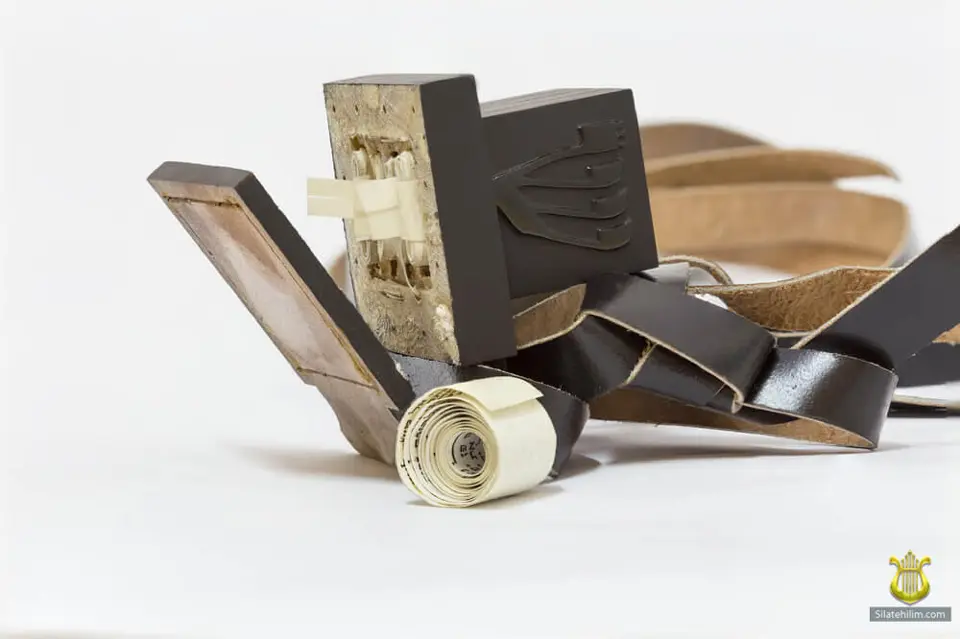
There are two types of tefillin—those of Rashi and those of his grandson, Rabbeinu Tam.
Four passages from the Torah are placed inside the tefillin. The difference between these two types of tefillin lies in the order in which the parchments are arranged.
At first, everyone assumed that this was merely an ordinary disagreement between the Sages, in which one opinion is rejected and the other accepted as authoritative.
But the Ari HaKadosh, of blessed memory, came and transmitted teachings received from Eliyahu HaNavi, explaining that both opinions are true.
From the time of Moshe Rabbeinu until the era of the Geonim, people wore two pairs of tefillin. Thus the Gemara says: “There is enough room on the head to put on two pairs of tefillin” (Eruvin, folio 95).
The Zohar HaKadosh says: “Some put on two pairs because of uncertainty, for they do not know the secret that both pairs are necessary” (Zohar 77).
Nevertheless, the customary practice follows the order of Rashi.
The author of Ha-Levush, the Gaon Rabbi Mordechai Jaffe, wrote that once the bimah above the grave of the prophet Ezekiel collapsed, and ancient tefillin were found there whose order corresponded to the opinion of Rashi.
There is also a difference of opinion regarding the blessing recited over the tefillin shel rosh.
Ashkenazim recite a separate blessing, in accordance with the opinion of the Geonim.
Sephardim recite a blessing only over the tefillin shel yad, relying on the opinion of the Rif.
There is a well-known story about Rabbeinu Yaakov of Troyes—Rabbeinu Tam, who appealed to Heaven regarding this matter. He was answered: “And I shall establish My covenant with Isaac” (Bereishit 17:21)—an allusion to the Rif, Rabbi Yitzchak Alfasi. The books Pri Etz Chaim and Olat Tamid speak of one blessing, leading to the conclusion that the Ari, too, inclined toward the Sephardic custom.
The custom of the Arizal was to put on two pairs of tefillin during Shacharit—those of Rashi and those of Rabbeinu Tam—and during Mincha, those of Rabbeinu Tam. Later, however, he made for himself tefillin according to Rashi that conformed to the view expressed in the book “Shimushah Rabbah”, namely, “etzba'im al etzba'im” (with sides measuring two thumbs), and explained that these tefillin possess a level of holiness equal to both versions combined. Therefore, their size is “etzba'im” (the measure of two thumbs). This is discussed in detail in “Sha'ar HaKavanot.”(Ben Ish Chai, “Code of Torah Law by the Weekly Torah Portions”—Bereishit)
Was this helpful?
100% of readers found this article helpful (26 votes).
Please note: some articles on our site contain the holy Names of the Almighty. If you print these articles, they may not be thrown away or destroyed. Please handle printed copies with care and respect.
Material from our site may be copied for the purpose of spreading Torah, provided a link to Silatehilim.com is included. Any use of the site's material in print publications or for commercial purposes is prohibited without the rights holder's consent.