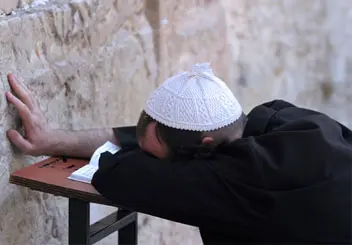
Tehillim 25 - Nefilat Apayim (Falling on One's Face)
Tehillim 25 - Nefilat Apayim (Falling on One's Face)
- "LeDavid Elecha Ad-nai Nafshi Esa" - (To You, L-rd, I lift up my soul).
This psalm is called "Nefilat Apayim" (Falling on One's Face). When reciting it, one should bow with one's face resting on the left forearm, not the palm, and cover one's face. The laws of "Nefilat Apayim" must be observed meticulously both during Shacharit and Mincha. The book "Shaar HaKavanot" sets forth the profound intentions with which one should imbue oneself during "falling on one's face": one sends one's soul to the place ruled by death, into the realm of the kelipot, intending to retrieve and elevate the sparks of holiness from there.
Great is the reward of one who merits performing "Nefilat Apayim" properly, in accordance with all the regulations. His enemies will be vanquished before him. However, because of our grave transgressions, we do not possess all the knowledge and abilities necessary for this.
The Holy Zohar (Bamidbar 121:1) teaches: "Woe to one who says: "To You, L-rd, I lift up my soul," while in his heart and thoughts he is distant from the Almighty. This causes a person to be banished from the world. Therefore, everyone must cleave to his Master with his soul and will, and recite the words of this psalm with joy and delight, understanding the meaning of the words that issue from his lips".
Nowadays, this psalm is recited without resting one's face on the forearm, as with the other psalms. Some explain that the meaning contained in "Nefilat Apayim" is very profound, and it is therefore impossible to recite this passage by heart while leaning on one's arm, without looking into the siddur.
Nefilat Apayim may not be performed at night.
(Ben Ish Chai, Shemot, Torah Code of Jewish Law by the Weekly Torah Portions)
This psalm is recited with one's face resting on the right hand during the morning prayer, because the left hand bears the Tefillin; during Mincha, one rests one's face on the left hand. This prayer is called Nefilat Apayim ("Falling on One's Face"). This is also done in remembrance of the ancient Beit HaMikdash, where worshippers would customarily prostrate themselves in prayer.
Rabbi Bahya explains that "falling on one's face" has three meanings:
1) It expresses awe and reverence in the presence of the Shechinah;
2) it also expresses remorse and repentance;
3) it symbolizes complete submission to G-d, to the point of total self-abnegation and self-sacrifice, as though all sensations and feelings had ceased to exist. In this way, a person symbolically gives his life in a surge of repentance for having rebelled against G-d. Indeed, there are sins, such as chilul Hashem (the desecration of G-d's Name), whose only atonement is death.
But G-d accepts the intention of self-sacrifice as though it were an actual sacrifice and forgives all sins, including those that could otherwise be atoned for only through death.
The Zohar and the Ari HaKadosh emphasize the importance of this kavanah (intention), namely: Nefilat Apayim expresses the worshipper's readiness to give his soul for the sanctification of G-d's Name, in addition to the intention of atoning for sin.
The Zohar says: "After reciting the prayer, (the Amidah) and repenting for one's sins (Ashamnu), one must now regard oneself as having given one's life to one's Master willingly and lovingly, while saying: "To You, Eternal One, I lift up my soul..." And G-d lovingly considers this as though He had actually taken the worshipper's soul to Himself. Therefore, the worshipper must fall on his face like a dead person falling to the ground. For there are sins that can be atoned for only through death... and now, since it is considered as though G-d is taking the soul that the worshipper is prepared to sacrifice to G-d, those sins are forgiven at that moment... ".
Psalm 25 is arranged alphabetically, with each verse beginning with one of the letters of the Hebrew alphabet. In content, it is connected to the idea of the Thirteen Attributes of Mercy, after which this psalm is recited, for in this psalm King David, the sweet singer of Israel, calls out: "G-d is compassionate and gracious" and that "All the ways of the Eternal One are kindness and truth".
In this psalm, King David expresses on behalf of all Israel the sincere feelings of a repentant and yearning soul: "Redeem, O Eternal One, Israel from all its troubles". Another verse is added to this: "And He will redeem Israel from all its sins."
(Nissan Mendel, "My Prayer")
Was this helpful?
100% of readers found this article helpful (29 votes).
Please note: some articles on our site contain the holy Names of the Almighty. If you print these articles, they may not be thrown away or destroyed. Please handle printed copies with care and respect.
Tags: The Hidden Meaning of Tehillim, Ben Ish Chai, Nefilat Apayim, Tehillim 25, Tehillim 25 - Nefilat Apayim (prostration)