Tehillim 150 and 10 Ancient Hebrew Musical Instruments
King David played 70 instruments.
In Psalm 150, he mentions only nine musical instruments, one from each group associated with a particular Kabbalistic sefirah.
Each of these instruments awakens one of the human senses needed to purify and free the soul, and to enable a person to use their spiritual potential and fulfill their purpose in the world.
The Psalmist David says that Hashem should be praised with the following instruments:
1. Shofar (ram's horn)
2. Nevel (lute)
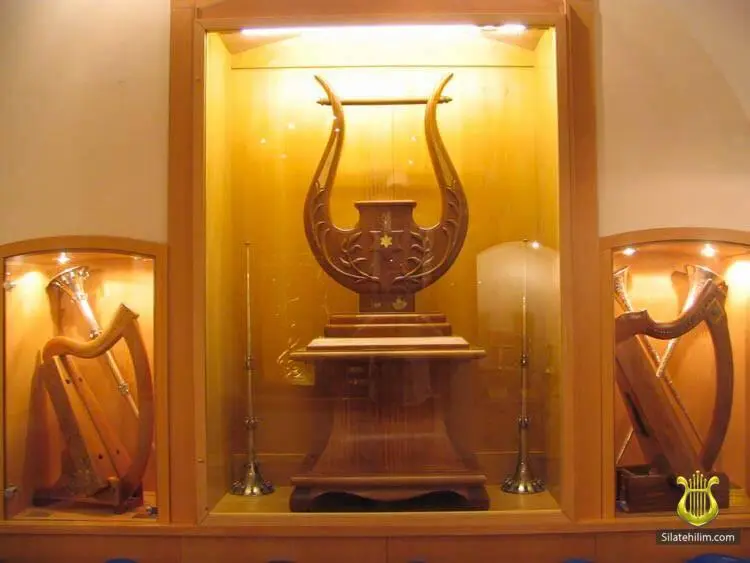
3. Kinnor (harp)
4. Tof (drum)
5. Machol (castanets)
6. Minim (organ)
7. Ugav (flute)
8. Tziltzelei Shama (kettledrums)
9. Tziltzelei Teruah (the sound of trumpets)
10. Kol (voice)
1. Shofar – possesses tremendous power. The word שופר consists of two parts: ש פר
The word פר (par – bull) indicates strength. The letter ש represents Light and Glory.
In the days of the prophet Joshua, when the Jews conquered the city of Jericho, it was precisely the power of the shofar—spiritual and physical—that brought down the city's walls.
Jericho was a center of idolatry. Each of the seven nations inhabiting the Land of Israel had representatives there. The walls of Jericho (the kelipot) were destroyed, and the spirit was freed. If, in the word שופר, the interchangeable letter
פ is changed to ב, the word שובר - “to break” is formed. The shofar has the power to break the kelipot (the impure shell) and evil forces.
2. Nevel – King David's lute – was the forerunner of the harp and lyre. The nevel leads a person toward wisdom. The reduced gematria of the word nevel is 10 (נבל); this number can be reduced to “one”—1. One is a symbol of the One G-d, the Only One.
The word “nevel” consists of the same letters as “Lavan” (white). The disease tzaraat is identified by the color white. Jacob's father-in-law, Lavan, is a model of hypocrisy. Although white is a combination of all colors, white is also the complete absence of color.
There is also an interesting connection between the words “nevel” and “naval” (coarse, uncultured). Our Sages teach that the nevel is such a refined instrument that it causes the other instruments to feel ashamed.
This idea develops further: when the letter ב in the word “nevel” (נבל) is replaced with פ (both are labial letters), the word “nafal” (fallen) is formed. Thus, we see Lavan (white) and nafal (fallen) in a negative, destructive sense.
The instrument itself, the nevel, is constructive. The L-rd created everything in this way—one thing opposite another.
3. Kinnor – resembled a heart (because of the instrument's close connection with the human soul and heart). The word “kinnor” כנור contains the word ner (candle) נר and כו (the number 26). The candle represents the human soul, while the number 26 represents the ineffable Name of the Creator!
The gematria of kinnor is 276. Its reduced gematria is 15, equivalent to 6. 15 (1+5) = 6—the gematria of G-d's Name יה. The letter י corresponds to Chochmah, and the letter ה to Binah.
The connection between the kinnor and the attribute of Binah can be seen in Psalm 49:
4) “My mouth shall speak wisdom, and the meditation of my heart shall be understanding”—meaningful thought.
Here, Chochmah precedes Binah.
5) “I will incline my ear to a parable; I will open my riddle with the kinnor”—(I will turn my ear to a parable and solve my riddle with my harp).
This shows that the kinnor can help resolve problems, because it promotes understanding. The nevel (lute) and kinnor (harp) frequently appear in Tehillim: 57:9, 108:3.
Nevel corresponds to the attribute of Chochmah and is represented in the Creator's Name by the letter “yud,” while kinnor corresponds to Binah and is represented by the letter “hei.” Together they form an inseparable pair: נבל + כנור = 358. We know that Mashiach = 358. This indicates that in the days of Mashiach, Chochmah and Binah will unite: “The earth will be filled with knowledge of G-d as the waters cover the sea.”
4. Tof – תוף – the fourth musical instrument, representing Chesed (kindness). The word ha-tof (tambourine) – התף – consists of the same letters as patah (enticed) – פתה. If the guttural letter ה is replaced with ח, the word patuach – פתוח (open) – is formed.
Patuach is the positive aspect connecting the tof with Chesed (the open, giving hand). Patah, by contrast, represents the negative aspect—temptation, the evil inclination, and enticement.
The gematria of the root תף, tof, is 480. 48 is the gematria of the word chom (heat) חם. This signifies powerful temptation (480 = 10 times 48). The Book of Exodus says: “Miriam the prophetess took the tof in her hand, and all the women followed her with tofim and macholot.” The expression “she took the tof in her hand” signifies subjugating and controlling the evil forces.
480 is also the gematria of the word Talmud (תלמוד)—and it is precisely the Talmud that teaches that
G-d created the evil inclination in man and gave him its remedy—Torah study, the Talmud (the Oral Torah).
5. Machol – was a special instrument associated with dancing. Targum Onkelos (the Aramaic translation of the Torah) and the Septuagint (the Greek translation of the Torah) translated this word as dance. The Mekhilta and Pirkei deRabbi Eliezer discuss it as a musical instrument. Other sources describe it as a percussion instrument, such as a tambourine or castanets.
Machol corresponds to the planet Mars and the sefirah of Gevurah.
Mars symbolizes war. The word milchamah מלחמה—war—is spelled with the same letters as machol. Chazal understood human nature perfectly and held that, to overcome their sinful nature, a person must wage a genuine war against themselves; then they will receive forgiveness, מחילה mechilah, and the forgiven person can break into a machol dance.
Machol has the same root letters as lechem – לחם. The gematria of lechem is 78. The word melach (salt) has the same root letters and the same gematria, 78. On Shabbat, we recite the blessing over two loaves of lechem mishneh (recalling the double portion of manna before Shabbat): 78+78=156. Lechem + melach also equals 156.
156 is the gematria of the expression Ohel Moed—(the Tent of Meeting)—and of the word Zion.
6. Minim – Rabbi Samson Raphael Hirsch believes that minim was an instrument intended for quiet music-making at home. Minim corresponds to the sefirah of Tiferet (harmony, beauty), situated in the center of the Tree of the Sefirot. The central sefirah represents harmony among forces, harmony of structures, and harmony in music. The word minim מינים also means a variety of kinds—it is the plural of min מין (kind).
7. Ugav – The instrument ugav corresponds to the planet Venus and the sefirah of Netzach (eternity). The gematria of ugav is 81. This is also the gematria of kise (chair, throne), associated with the phrase Kisei HaKavod (Throne of Glory). (Ezekiel 1:26; Isaiah 6:1) The word kise כסא can in fact be divided into the word kes כס (covering) and the letter א,\u00a0 which symbolizes the Creator. This points to the nature of טבע teva, which also has a gematria of 81.
8. Tziltzilei Shama – The word shama (to hear) corresponds to the planet Mercury and is connected with the sefirah of Binah (understanding). Therefore, the word shama also means “to understand.” In the context of “Shema Yisrael” (from the word shama)..., it means “Listen” (understand). Tziltzilei Shama is a musical instrument corresponding to Mercury and associated with a rapid tempo. Mercury has the smallest orbit and, accordingly, the shortest period of revolution around the sun. A year on Mercury lasts 88 days (compared with 365 on Earth)—one year on Mercury equals 40 days on Earth (acceleration).
9. Tziltzelei Teruah – this instrument is connected with the sefirah of Yesod (foundation). The words teruah תרועה and re'ut רעות (friendly relations) consist of the same letters. Tziltzelei Teruah supports friendship and peace. Peace is the culmination of the Priestly Blessing:
“May G-d bless you and protect you; may G-d shine His countenance upon you and be gracious to you; may G-d turn His countenance toward you and grant you peace.”
While the Levites sang praises to the Almighty and played musical instruments during the Temple service, establishing harmony in the universe, the Kohanim blessed the people with peace.
10. Kol – voice – קול – corresponds to the fifth and highest, unique part of each person's soul—the yechidah.
The three letters following the letters of the word voice קול are ר ז מ, forming the word זמר (song). In this sense, the voice is the potential, while song is its actualization.
Kabbalah teaches that the shape of the letters in the word קול is connected with its meaning: the leg of the letter ק descends below the line, the second letter ו is exactly in the middle of the line, while the head of the letter ל rises above the line. This teaches that a person should ascend to ever-higher letters, using the voice for song and prayer. The gematria of kol equals that of sulam (ladder): 136.
By using their voice, a person ascends ever higher toward holiness—as on a ladder.
The word kol, written without the vav, קל, means the rung of the Nukvah without the Light of Chasadim, and this is why the Amidah is accepted when it is recited “without a voice.”
The final verse of Psalm 150: “Let every (kol) soul praise G-d, Halleluyah!”
The word kol (all) alludes to the word voice (kol), since the letters bet and kuf are interchangeable. The human voice is the most versatile musical instrument.
(Rabbi M. Glazerson, “Music and Kabbalah”)
Tehillim 150 and 10 Ancient Hebrew Musical Instruments
Was this helpful?
100% of readers found this article helpful (30 votes).
Please note: some articles on our site contain the holy Names of the Almighty. If you print these articles, they may not be thrown away or destroyed. Please handle printed copies with care and respect.
Tags: The Hidden Meaning of Tehillim, Tehillim 150, Ancient Hebrew Instruments, Tehillim 150 and 10 Ancient Hebrew Musical Instruments, 10 Ancient Hebrew Musical Instruments, Jewish musical instruments