The sages relate in the Midrash that David was granted everything by G-d—except a sufficient lifespan on earth. His soul was destined to remain on earth for only three hours. When the first man, Adam, learned of this, he asked G-d for permission to give the future Jewish king 70 of the 1,000 years allotted to him. Adam made this decision before the sin, when his soul was perfect. That is why the soul of King David was clothed in a garment free of sin. This explains the miraculous power of the Book of Tehillim!
The Hebrew word «Tehillim» means “praise” or “song of praise.”
This was King David’s guiding principle—to praise G-d no matter what!
King David gathered and included in his book the songs composed at various times by ten great righteous men:
Adam, Malki-Tzedek, Abraham, Moses, Heman, Jeduthun, Asaph, and the three sons of Korah: Assir, Elkanah, and Abiasaph.
How David selected these psalms is a mystery, but he identified their authors by name.
One of the sages taught that David wrote his psalms while playing the harp and listening to the symphony of the worlds. This is why this book is so powerful: each of its 150 psalms is connected with one of the 150 galaxies involved in governing our Universe. That is why, after engaging with Tehillim, one is left with the feeling that this book is still filled with mysteries and wonders.
Rabbi Shimon Hasid taught: “A harp hung above King David’s bed. At midnight, the north wind would blow, and the harp would begin to play. King David would immediately rise from his bed and study Torah until sunrise. When dawn broke, the sages of the Jewish people would enter and say, ‘Our master, the king, the people of Israel need sustenance.’ He would answer them, ‘Let one receive sustenance from another.’ ‘Can a lion be fed with a handful?’ the sages would ask. King David would reply, ‘Prepare the troops.’ The sages would immediately go to the adviser Ahithophel to ask how to prepare the country for war. Then they would turn to the Sanhedrin for permission… Then they would consult the Urim VeTumim…” (Rabbi Eliyahu Essas)
The great Ramban, during his famous Disputation, cited the following arguments:
“Now listen to me. David was the sweet singer of Israel, composing psalms through Divine inspiration. He composed them so that they would be sung before G-d’s altar. He did not sing them himself, nor was he permitted to do so according to Torah law. He passed the psalms on to the Levites to sing. This is stated explicitly in Chronicles. Therefore, he had to compose each psalm in such a way that the Levites could recite it. If he had said, ‘The L-rd said to me: Sit at My right hand…,’ the Levite could not have recited it, since it would not refer to him.
The Levite should say: ‘The L-rd said to my master, David: Sit at My right hand…’
Our sages taught: “Whoever longs for his soul to cleave to Him, blessed be He, and to His glory, should become familiar with the Book of Tehillim.”
Our sages say that David prayed for his songs to be read in synagogues and in the Batei HaMikdash. For we have nothing greater than the Book of Tehillim.
“Since the main purpose of reading Tehillim is to destroy all the ‘accusers,’ so that the prayer may ascend peacefully, it is desirable to read Tehillim before the morning prayer, in order to ‘cut down the oppressors’ and trim the thorns and prickles surrounding the Heavenly Rose, before prayer, so that the prayer may ascend and be accepted by G-d. This is why our sages instituted the recitation of the ‘verses of song’ (Pesukei DeZimra) between ‘Baruch She’amar’ and ‘Yishtabach’—to destroy the ‘kelipot’ and the ‘accusers,’ so that the prayer may ascend peacefully.” “Levush”
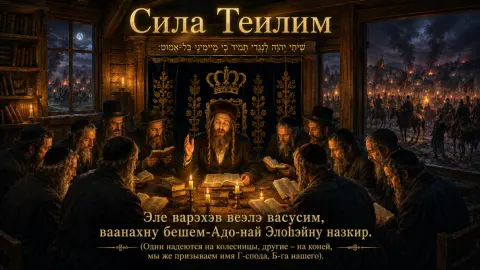
For nearly 28 centuries, the Book of Tehillim has protected our people from calamity and suffering, from difficult situations that seem hopeless—when dark clouds gathered over the entire nation, over an individual community, or over a single Jew. It is customary among Jews to open the Book of Tehillim, read chapters addressed to the Creator, and ask for mercy and help.
King David possessed such a level of ruach ha-kodesh (Divine inspiration) that no one could compare with him in this regard. None of the books of Tanakh is read as frequently as this one.
When special help from Above is needed, it is customary to read a particularly large number of psalms.
In editions of Tehillim, prayers are usually printed at the beginning and end—prayers recited before and after reading the psalms. They mention that the first and last letters of the words of Tehillim form the Names of G-d—Names known only to Kabbalists.
Thus, when these words are recited, even without understanding their meaning, one invokes G-d through His hidden Names—and He responds!
This is what ruach ha-kodesh means: David created a text that is not only unique in its poetic perfection, but also contains the deepest secrets of Kabbalah!
When the Jewish people read Tehillim with a broken heart, G-d forgives all their sins. (Mayim Rabim)
When our ancestors brought a korban (sacrifice) to G-d, they had to bring a flawless, young, beautiful animal—the very best available. Now that we do not have the Holy Temple, we follow the words of the prophet Hosea: “Let our lips take the place of bulls.” Our prayers, our words of praise and glorification, now serve as a substitute for our korbanot to G-d.
The pure and holy words of Tehillim are choice korbanot that we can offer to G-d. Reciting Tehillim can purify and transform us.
One who reads Tehillim every day can be confident that he has secured a place for himself in Olam Ha-Ba (the World to Come).
The holy Baba Sali (zechuto yagen aleinu) said that every Jew is obligated to complete Sefer Tehillim at least once a month, and that there is a special power in the words of David HaMelech—they can work wonders.
A weapon against the Yetzer Hara is to recite Sefer Tehillim three times in a single day—like a sword and spear against the Yetzer Hara. (Rabbi Menachem Mendel of Rimanov)
One who reads Tehillim with kavanah is redeemed from all kinds of natural disasters and tragedies. Perhaps this is why David HaMelech composed the Book of Tehillim with 150 psalms—150 is the gematria of the word פדיון (pidyon). Through studying and reading Tehillim with kavanah, one can redeem oneself from all kinds of troubles.
There is a beautiful tradition of reading the Psalm corresponding to one’s age, following the instruction of the Alter Rebbe (Ba'al HaTanya), who received it from his Rebbe, the Maggid of Mezeritch, who received it from his teacher, the Baal Shem Tov, who received it from his teacher, the prophet Ahijah the Shilonite: one should read the psalm corresponding to one’s age, adding one year, and study that chapter with Rashi’s commentary on each Rosh Chodesh.
When King Solomon wished to open the gates of the Temple, he could not, because they had fused shut. He recited 24 different prayers, but none helped. Yet as soon as he recalled the merit of his father David, the gates opened.
Then King Solomon recited (Tehillim 24:9): “Lift up your heads, O gates; rise higher, entrances of the Temple, so that the King of Glory may enter.” The gates did not open in response to King Solomon’s 24 prayers because the Jewish people were not perfect. King Solomon understood this and invoked the merit of David HaMelech.
The Book of Tehillim is like a guide for responding to various situations in life. Tehillim teaches us that we can rise much higher. The gates opened for King Solomon after the holy words of Tehillim, in the merit of David HaMelech, ascended to Heaven.
(based on an article by Rabbi Zeev Smason)