Seder of Prayers “Mi-Yom Le-Yom” by Rabbi Yeshayahu Pinto
It is written in
Tehillim 96:2
“Shiru la-Adonai, bar’chu shemo,
basru mi-yom le-yom yeshuato”—(Sing to the L-rd, bless His Name,
proclaim His salvation day by day).
The
Shuva Israel organization, under the leadership of
Gaon Yeshayahu Pinto (shlita), has compiled a
Seder of Study and Prayers for daily reading.
This collection of Special Prayers for daily reading,
Mi-Yom Le-Yom, is intended to bring protection and salvation in these difficult times, day by day, from every misfortune. The idea is drawn from Tehillim:
“Basru mi-yom le-yom yeshuot”—(Proclaim
day by day the salvation sent by Him).
- Shabbat—“Sefer Devarim”;
- Yom Rishon (Sunday)—“Perek Shirah”;
- Yom Sheni (Monday)—“Ma’aseh Ha-Nissim” (the miracles of Eliyahu Ha-Navi and Elisha Ha-Navi);
- Yom Shlishi (Tuesday)—“Parashat Balak”;
- Yom Revi’i (Wednesday)—“Eizehu Mekoman” (describing all the sacrifices);
- Yom Chamishi (Thursday)—“The 42 Journeys”;
- Yom Shishi (Friday)—“Shir Ha-Shirim”.
[You will find all the prayers in the “PDF Library” on our website]
Why these particular prayers?
1. Yom Rishon (Sunday)
—“Perek Shirah”;
The writings of the holy
Arizal state that the angels in Heaven who follow all of creation cannot begin singing praise to the Holy One, blessed be He, until people on earth begin reciting
Perek Shirah.
Therefore, every time we recite
Perek Shirah, we give the angels in Heaven the strength to sing. In essence, we possess tremendous power through this.
We also return our gratitude to all of creation—to the wild animals, livestock, birds, and so forth—for giving us strength at the time of Creation, when each of them offered their goodness to man, the crown of creation.
Moreover, man is called the emissary of the community of all creation. Thus, within him lies a part of every created thing. When a person sanctifies and purifies himself, he elevates and raises all of creation, bringing it to truly exalted and elevated places.
Accordingly, in these days and at a time when a person faces many conflicts and difficult wars, he should recite
Perek Shirah in holiness. Then others, too, merit singing this song.
In this way, he receives great strength to stand against difficult conflicts.
[The complete text is here:
Perek Shira - Shirat HaBriah (Song of Creation)]
2. Yom Sheni (Monday)
—“Ma’aseh Ha-Nissim” (the miracles of Eliyahu Ha-Navi and Elisha Ha-Navi)
Ma’aseh Nissim
Reciting these pesukim possesses great power to draw an influence of salvation and good fortune from the wellspring dug by Eliyahu Ha-Navi and Elisha Ha-Navi—two great prophets about whom many more miracles are related than those performed by all the prophets who served among the people of Israel.
Every miracle and salvation has a place in this wellspring dug by these two prophets.
Whatever salvation a person needs, in any area and in any circumstance, he can receive through reading the miracles that occurred to them. When a person envisions in his soul the salvation he requires, he will find it among those miracles, thereby drawing upon himself a great influence from Heaven.
Our Sages related that before Eliyahu Ha-Navi ascended to Heaven in a storm, his disciple Elisha asked him to bless him so that he could receive a double portion of the strength that rested upon Eliyahu himself.
Eliyahu replied: “What you ask I cannot give you, because a person can give only what he possesses, while what he does not possess he cannot give” (meaning that he could not give another person twice as much strength as he himself possessed).
Elisha continued to insist firmly on his request. Eliyahu replied:
“If you see me when I am taken from you, ascending to Heaven in a storm, you will be able to receive what you ask and merit a double portion of the strength that I possess.”
In explanation of these words, it is written in the book of the prophet Yeshayahu (30:20):
“Your eyes shall see your teacher.”
That is, when a person sees his teacher and his eyes are constantly directed toward him, the teacher’s influence upon him is also doubled and redoubled, even when he is not physically present.
Thus, we can understand the miracles that occurred to Eliyahu and Elisha and contemplate how the influence came about and how the order of creation was transformed. When we also place before our eyes and imagine the troubles and problems we face within those miracles and salvations, we receive a double salvation, joy, and great help from Heaven.
[The complete text is here:
Ma'aseh HaNissim — Miracles of Eliyahu HaNavi and Elisha HaNavi]
3. Yom Shlishi (Tuesday)
Parashat Balak
Our teachers have taught that reciting the portion of Balak possesses tremendous power. Whenever someone plots against a person to harm him or his fellow, while he remains unaware of it, reading the portion of Balak nullifies the evil counsel and scheme.
One who reads the portion of Balak merits that if, G-d forbid, someone wishes to speak evil of him, the Holy One, blessed be He, will turn that person’s tongue, and no evil utterance will emerge from his mouth.
We live in tense times, when the attribute of judgment is active in Heaven and, G-d forbid, even a single improper word can cause harm. The power of the portion of Balak nullifies these harsh things.
It also has the power to awaken the reward credited to a person for a mitzvah he performs for his own sake. Furthermore, when a person reads the portion of Balak, if there is someone speaking words that could bring harm upon him, everything is annulled in the merit of the reading.
We must understand well that this segula is intended for everyone who is concerned about such matters, and that one should also encourage others to read it, so that they may merit, with G-d’s help, abundant goodness and blessing.
As for how many salvations and miracles this
Seder of Prayers has brought, that is a question for Israelis who themselves experienced the power of these prayers and simply made them available to Russian-speaking users as well, Baruch Hashem.
[The complete text is here:
"Parashat Balak" with introductory and concluding prayers according to the book "Korban Nataniel" by Rabbi Nataniel Weil]
4. Yom Revi’i (Wednesday)
—“Eizehu Mekoman” (describing all the sacrifices)
We read the chapter
“Eizehu Mekoman”—“In which place were the offerings brought?”—the only chapter among the six orders of the Talmud that contains no disputes among the Sages.
Reading this chapter possesses a special power: if, G-d forbid, Midat Ha-Din (the attribute of judgment) brings an accuser or strife against a person in Heaven or on earth, this chapter annuls it, sweetens the judgment instead, and brings him great influence from Above.
[The complete text is here:
“Eizehu Mekoman” – the chapter on sacrifices]
5. Yom Chamishi (Thursday)
—The 42 journeys in the wilderness
Rabbi Shimshon of Ostropoli, may Hashem avenge his blood, said that every person passes through
42 masa’ot (journeys) during his lifetime. If a person does not complete all the rectifications associated with the stations he is meant to pass through in life, he will have to return to the world in a new gilgul in order to complete them. However, through the power of reading the segula of these 42 masa’ot (journeys), a person merits all the rectifications he must make and is purified through them.
[The complete text is here:
42 Encampments in the Wilderness — the Segula of Rabbi Shimshon of Ostropol]
6. Yom Shishi (Friday)
—Shir Ha-Shirim
All the healing that exists in the world is alluded to and contained in Shir Ha-Shirim. It helps anyone in need of healing or any other salvation, and through reading Shir Ha-Shirim, he will be visited by the blessing of salvation and mercy.
[The complete text is here:
Song of Songs – Transliteration]
7. Shabbat (Saturday)
—“Sefer Devarim”;
Sefer Devarim
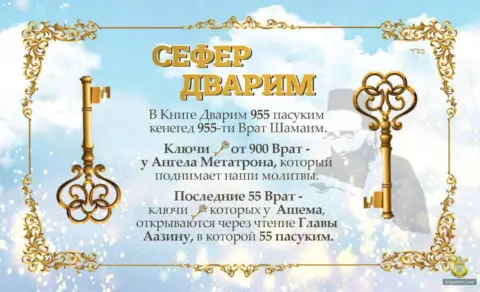
One who is meticulous about reading the Book of Devarim on Shabbat receives tremendous and exalted benefit. The Ben Ish Chai says that every hour of Torah study on Shabbat is equal to one hundred hours of study on the other days of the week. The Book of Devarim was written by Moshe Rabbeinu. Thirty-six days before his passing from this world, he asked the Holy One, blessed be He, to open the gates of Heaven for the people of Israel; instead of what he requested, he was given the power to write the Book of Devarim. Moshe Rabbeinu recorded 955 pesukim in the Book of Devarim. We have 955 firmaments, and each pasuk has the power to open one of the gates of Heaven. Through reading all the pesukim, a person opens additional gates.
We know that at times a person becomes “stuck” and does not succeed with his requests because they cannot pass through the gates of Heaven. But when he reads the Book of Devarim week after week, he can open the gates of Heaven and receive what he has asked for.
The angel Matat, who is the Prince of the Divine Presence in Heaven, has permission to ascend to the 900th firmament, while ascending through the additional 55 firmaments requires special permission from the Holy One, blessed be He. When a person reads the Book of Devarim and all 955 of its pesukim, he receives keys that even the angel Matat does not possess.
These are difficult days, when we lack the tools to withstand the trials that come upon us. We have no one on whom to rely except our Father in Heaven. On the one hand, there is much Torah among the people of Israel. On the other hand, the evil inclination wages an exceedingly fierce war to cool and weaken faith. There is nothing truly dependable in life, but when a person reads the Book of Devarim, he draws closer to the Holy One, blessed be He, and sweetens the judgments.
And who among us, reading His book—the Book of Devarim—is as great as Moshe Rabbeinu? This book was written during the final days of his life, like his testament to all generations.
It is known that difficult things have befallen us, especially in recent years. Yet the very thing that harms us also gives us the strength to stand against and overcome every hardship: the daily study of the portion of Balak, the chapter “In Which Place Were the Offerings Brought?”, the chapter about the miracles of Eliyahu and Elisha, and reading the Book of Devarim on holy Shabbat.
At especially difficult times, we pledge before the Holy One, blessed be He, to give our very souls for these words. Thank G-d, tens of thousands of people are strengthened and inspired by these words day after day, receiving the tools to withstand the difficult trials of our generation.
Let us all strive to give our very souls for these words, rising and elevating ourselves and meriting a true bond with the Holy One, blessed be He. We ask and pray for everyone that through our prayers we may merit complete healing—health of body and soul.
“The Torah that Moshe commanded us is the heritage of the congregation of Yaakov.” (Devarim 33:4)
The
Ma’aseh Rokeach (in the section Ve-Etchanan) presents a great and wondrous teaching explaining the pasuk from the portion of Ha’azinu: “See now that I, I am He, and there is no god with Me; I kill and I give life, I wound and I heal, and none can save from My hand” (Devarim 32:39).
We must explain what is meant by the words: “See now that I, I am He.” How can they see specifically “now, at this moment”?
This can be explained through the words of the Midrash (Devarim Rabbah 11:8): “When the time came for Moshe to leave this world… Moshe said: Master of the Universe! I ask one thing of You before my death—that I may pass through and break through all the gates of Heaven and the depths, and see that there is none besides You.” We must understand where we find that the Holy One, blessed be He, heard the request of Moshe Rabbeinu, peace be upon him. The Ma’aseh Rokeach explains this according to what is written in
Be-Kol Bochim by the kabbalist
Rabbi Avraham Galanti (Eichah 2:21):
There are
955 firmaments (the numerical value of the word “heavens”—ha-shamayim, with the final mem counted as 600 according to the Aik Bekhar system). Through them, the angel Matat raises the prayers of Israel. However, he has permission to ascend only through
900 firmaments. He has no permission to ascend through the higher
55 firmaments. Concerning this it is written: “For the L-rd your G-d—He is the heavens and the highest heavens, the earth and everything in it” (Devarim 10:14). That is, of the
955 firmaments,
55 firmaments are “of the L-rd your G-d” (55 being the numerical value of the word “for”), and therefore no angel or seraph has permission to ascend there.
The Gemara in tractate Chagigah (15a) relates that when Elisha ben Avuyah entered Pardes, he “cut down the shoots” (that is, he became an apostate) because he saw the angel Matat, who was permitted to sit and record the merits of Israel. Elisha ben Avuyah said: “Perhaps, G-d forbid, there are two authorities in Heaven.” Thus, because the angel Matat is permitted to traverse
900 firmaments, there may be concern that a person might err, G-d forbid, and believe in two authorities in Heaven. But in the higher
55 firmaments, to which he has no permission to ascend, the unity of the Holy One is revealed in the words: “For the L-rd your G-d—He is the heavens and the highest heavens.”
The Mishneh Torah (the Book of Devarim) contains exactly
955 pesukim. Accordingly, the Ma’aseh Rokeach presents the novel teaching that Moshe Rabbeinu broke through one firmament with each pasuk in the Book of Devarim. This is why the book contains exactly
955 pesukim—to break through all
955 firmaments and see that there is no deity besides the Blessed One.
Before the pasuk “See now that I, I am He,” there are
900 pesukim. From this pasuk onward, through the end of the Torah, there are
55 pesukim, corresponding to the higher
55 firmaments. It is known that the angel Matat is sometimes called “Elokim.” This explains the words of the pasuk: “See now”—in this pasuk, which is the first of the higher
55 firmaments—“that I, I am He,” One in these firmaments, “and there is no god (Elokim) besides Me”—even the angel Matat, who is sometimes called “Elokim,” has no permission to be “with Me” in these
55 firmaments.
Thus, reading the Book of Devarim possesses tremendous power to break through all the firmaments in Heaven. Each pasuk opens one gate and then another. Therefore, in this orphaned generation, it is every Jew’s obligation and mitzvah to scrupulously observe the practice of reading each day from the Mishneh Torah (the Book of Devarim). By completing it through repeated readings every day or every week, a person will draw abundant blessing upon himself, as it is written: “The blessing of the L-rd—it enriches, and He adds no sorrow to it” (Mishlei 10:22).
The first four books—Bereishit, Shemot, Vayikra, and Bamidbar—correspond to the four exiles. Our teachers of blessed memory explain and cite in the book Megaleh Amukot (at the beginning of the section Matot-Masei), commenting on the pasuk: “These are the journeys of the children of Israel who went forth from the land of Egypt according to their hosts, under the leadership of Moshe and Aharon” (Bamidbar 33:1), that it contains an allusion to all four exiles into which Israel was exiled after Egypt. The words “These are the journeys of the children of Israel” (Eleh masei bnei Yisrael) have initials alluding to Edom, Madai (Persia), Bavel, and Yavan (Greece).
The author of
Megaleh Amukot (in the section Va’era) further comments on the pasuk: “The L-rd appeared to him in the plains of Mamre” (Bereishit 18:1), explaining that these four exiles are alluded to in the first blessing of the Amidah: “And He brings a redeemer to their children’s children for the sake of His Name, with love.” The word
“mevi” (who brings) is an acronym for
Madai,
Edom,
Bavel, and
Yavan, from which the Holy One, blessed be He, will redeem their descendants for the sake of His Name, with love.
The author of Megaleh Amukot also adds and teaches about the pasuk: “Zion shall be redeemed through justice, and those who return to her through righteousness” (Yeshayahu 1:27). Regarding justice, Mishlei (29:4) states: “By justice a king establishes the land” (
Melech
ba-mishpat
yaamid
aretz)—the initials correspond to
Madai, Bavel, Yavan, and Edom. Regarding righteousness, it is written: “A gift given in secret subdues anger” (
Matan
ba-seter
yikpe
af) (Mishlei 21:14)—the initials likewise correspond to
Madai, Bavel, Yavan, and Edom.
Therefore, our forefather Avraham scrupulously observed the mitzvot of charity and justice, as the Holy One, blessed be He, testified: “For I have chosen him so that he may command his children and his household after him to keep the way of the L-rd, doing charity and justice” (Bereishit 18:19). Through this, the Holy One, blessed be He, revealed to him that in the future He would redeem his descendants through his merit. This is alluded to in the pasuk: “The L-rd appeared to him in the plains of Mamre” (
Va-era
elav HaShem
be-elonei
Mamre) (Bereishit 18:1)—an acronym for
Edom, Yavan, Bavel, and Madai.
Thus,
Bereishit, Shemot, Vayikra,
and Bamidbar correspond to the four exiles—
Bavel, Madai, Yavan, and Edom. The light of the Torah in each of these four books breaks and weakens the power of impurity of one of the four exiles, protecting the children of Israel so that they do not become entangled in their impurity and, G-d forbid, lose the ability to emerge from it. Israel’s existence during the period of redemption is due to the merit of the light of the Torah and the Book of Devarim, which Moshe Rabbeinu revealed to us through the Holy Spirit.
The book of
Bereishit corresponds to the exile of
Bavel. The light of the Torah and of the Book of Bereishit breaks and weakens the impurity of the Babylonian exile, so that the children of Israel do not become entangled in it. In the Book of Bereishit, in the portion of Noach, we find that the generation of the Tower rebelled against the Holy One in Bavel, until the Holy One, blessed be He, descended and scattered them across the face of the earth. For this reason the city was called Bavel, as it is written (Bereishit 11:8–9): “The L-rd scattered them from there over the face of the whole earth, and they ceased building the city. Therefore it was called Bavel, because there the L-rd confused the language of the whole earth, and from there the L-rd scattered them over the face of the whole earth.”
The Book of
Shemot corresponds to the
Persian exile (Madai). That is, the light of the Torah and of the Book of Shemot breaks and weakens the impurity of the Madai exile, enabling the children of Israel to strengthen themselves in holiness. We can support this with what we find in the Book of Shemot, in the portion of Yitro, concerning the standing at Mount Sinai at the giving of the Torah: “They stood at the foot of the mountain” (Shemot 19:17). The Gemara (Shabbat 88a) explains that the Holy One, blessed be He, compelled them and held the mountain over them like a basin, saying: “If you accept the Torah, good; and if not, there will be your burial.” Rava said: “Nevertheless, they accepted the Torah in the days of Achashverosh,” as it is written: “The Jews confirmed and accepted” (Esther 9:27)—they confirmed what they had already accepted. Thus, through the acceptance of the Torah described in the Book of Shemot and completed (confirmed) in the days of Achashverosh, the klipah of Madai is broken.
The Book of
Vayikra corresponds to the
Greek exile (Yavan). That is, the light of the Torah and of the Book of Vayikra breaks and weakens the impurity of the Yavan exile through the miracle of Chanukah. Just as the services and sacrifices described in the Book of Vayikra are performed by kohanim, so too the victory in the war and the miracle of Chanukah came through kohanim, as we say in the piyut “These Candles”: “For the miracles, the wonders, the salvations, and the victories in the battles that You performed for our ancestors in those days, at this time, through Your holy kohanim.” We know the words of one of the Ba’alei Tosafot (the commentators on the Talmud), the author of the Rokeach (Hilchot Chanukah, siman 225), that the miracle of Chanukah is alluded to in the Book of Vayikra, in the portion of Emor. The Bnei Yissaschar cites him: “The rabbi and author of the Rokeach writes words of Kabbalah, which he received from Eliyahu, may he be remembered for good. These are his words: In the portion of Emor, concerning the kohanim, the discussion begins with Shabbat and the festivals—Pesach and Shavuot, Rosh Hashanah and Yom Kippur, and Sukkot—with the words: ‘Moshe declared the festivals of the L-rd to the children of Israel’ (Vayikra 23:44). Immediately afterward it says: ‘Command the children of Israel to bring you pure olive oil, crushed, for illumination’ (Vayikra 24:2)—an allusion to Chanukah: the mitzvah of olive oil is to take the finest oil (Shabbat 23a).”
The Book of
Bamidbar corresponds to the
Roman exile (Edom). That is, the light of the Torah and of the Book of Bamidbar breaks and weakens the impurity of the Roman exile, protecting the children of Israel so that they do not become entangled in it. It seems necessary to support this with what is written in the portion of Chukat (Bamidbar 20:14–21): “Moshe sent messengers from Kadesh to the king of Edom… Let us pass through your land; we will not pass through fields or vineyards, nor drink water from wells; we will travel along the king’s road and not turn to the right or left until we have crossed your border. But Edom said to him: You shall not pass through me, lest I go out against you with the sword… Edom refused to allow Israel to cross through his territory, and Israel turned away from him.” Thus, the Book of Bamidbar sweetens the power of Edom.
Let us summarize the words of our holy teachers: The power of the books of Bereishit, Shemot, Vayikra, and Bamidbar sweetens the exile. This is what King David said in Tehillim (126:1): “A Song of Ascents. When the L-rd returns the exiles of Zion, we will be like dreamers.” “When He returns” (
Be-shuv) is an acronym for
Bereishit,
Shemot,
Vayikra, and
Bamidbar.
Moshe Rabbeinu, however, who saw that further exiles still lay ahead and would continue, gave the people of Israel the Book of Devarim, also called Mishneh Torah. It sweetens this exile and opens all the gates of Heaven. In this holy book, Moshe Rabbeinu mentioned to Israel the Ten Statements and every aspect of the giving of the Torah. He brought the pasuk that would be the foundation of the people of Israel: “Hear, O Israel! The L-rd is our G-d, the L-rd is One!” (Devarim 6:4); as well as the pasuk “And you shall love the L-rd your G-d,” in which we are commanded to love the Holy One, blessed be He; and the portion of Ha’azinu, about which great segulot are taught; and the portion of Ve-Zot HaBrachah, in which Moshe Rabbeinu blessed each of the tribes.
We find a distinction and a similarity in the tefillin. The head tefillin is divided into four sections: “Sanctify to Me,” “And it shall be when He brings you,” “Hear, O Israel,” and “And it shall be if you obey.” These same sections are written in the hand tefillin, but in a single text on one piece of parchment. Our Sages explained this distinction by saying that the Book of Mishneh Torah has the quality of the hand tefillin, while the other four books of the Torah have the quality of the head tefillin. Thus, the Book of Mishneh Torah brings a person closer to the Holy One, blessed be He, because it is like the hand tefillin, opposite the heart, while the four books are opposite the head.
The Midrash Rabbah (Bereishit Rabbah 6:9) relates: “Rabbi Shimon ben Yochai said: The Book of Mishneh Torah was a sign for Yehoshua bin Nun. When the Holy One, blessed be He, appeared to him, He found him sitting with the Book of Mishneh Torah in his hands. He said to him: Strengthen yourself, Yehoshua! Be courageous, Yehoshua! Let this Book of the Torah not depart from your mouth. He took it, showed it to the orbit of the sun, and said to it: ‘I have not been silent from this book, and you be silent before it.’ Immediately, the sun became silent and the moon stood still.”
Let us, too, strengthen ourselves and be courageous in this orphaned generation, which contains many trials, and enable many people to ensure that this Book of Torah does not depart from our mouths. May great and supernatural salvations come to everyone who engages in this holy and exalted work.
[With gratitude for the idea and material—to L. P.; for the transliteration and translation of the prayers—to Alexander Tzvi Sypkov]
Please note: some articles on our site contain the holy Names of the Almighty. If you print these articles, they may not be thrown away or destroyed. Please handle printed copies with care and respect.