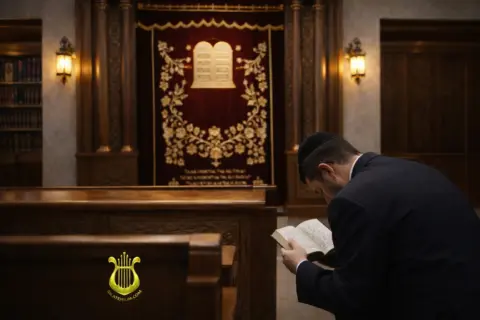
Prayer for Rain — Why Rainfall in Israel Depends on Prayer
Rainfall in Israel Depends on Prayer
The power of rain is the power of existence and renewal.
Water gives life, and through it everything grows. Just as water descends from the higher worlds to the lower worlds, so too both material and spiritual blessings descend: “When rain falls, buying and selling are blessed… and even the fish are blessed. See how great rain is!
When it rained, Rabbi Yehudah bar Yechezkel would offer this blessing:
“May the Name of the One Who spoke and brought the world into being be beautified and exalted; He assigns thousands upon thousands and millions of angels to every drop.”(Tanna Devei Eliyahu)“Even a small coin in one’s pocket is blessed when it rains.”(Ta’anit 8)
Such is the spiritual effect of rain. Eliyahu Ki Tov writes that on Sukkot it is decided whether the rains of the coming year will be abundant. Until Shemini Atzeret, Jews do not pray for rain. Why?
Our Sages said: “Dew is always a blessing for the world, and therefore we pray for it to fall even on the festival days. But rain is a blessing only when it falls at the proper time, while rain on Sukkot is a curse rather than a blessing, since it drives us out of the sukkah. Rain falling on Sukkot is as if it informs us that our service is displeasing to the Almighty, and that we need not fulfill the greatest mitzvah!”“What is rain on Sukkot comparable to? To a servant who wishes to fill his master’s cup with wine, but instead pours the wine over his head.”(Sukkah 28)
We begin praying for rain only on the 7th of Cheshvan, because by then the pilgrims who came to Jerusalem for the festivals have had time to return home, and we do not want the rain to catch them on the road.
“Rabbi Avahu said: The day of rain is greater than the revival of the dead;Rabbi Yehudah said: The day of rain is as great as the day on which the Torah was given, as it is said: ‘My teaching shall drop as the rain’;“As great as the day on which Heaven and Earth were created”;“As great as the day of the ingathering of the exiles”;And the revival of the dead will take place through the dew of the Torah.”
The Sages also said that there are four forms of longing:
- a wife’s longing only for her husband, as it is said: “And your longing shall be for your husband”;
- the rain’s longing only for the earth: “You remembered the earth (with rain) and turned its longing toward it”;
- the Almighty’s longing only for Israel: “I belong to my Israel, and its longing is toward Me.”
The Maharal of Prague explains: “the rain’s longing for the earth,” because rain has an effect, and cannot exist without something to receive it. Therefore, it needs a recipient—the earth.”
The Pirkei de-Rabbi Eliezer states that when Israel, through its worthy deeds, unites Heaven and earth, it brings down rain from above. But if it does not, the rains cease.
For six days—until the creation of man—the Almighty did not send rain. Since there was not yet a human being to work the land or to understand the benefit of rain, there was no rain. When man came and understood that rain was necessary for the world, he prayed for it, and rain fell, and grasses and trees grew.
“For the higher and lower realms had not yet been joined, so that the higher realms could send rain downward, until man, who stands between the higher and lower realms, brought rain through prayer.” (Maharal)
Chazal teach that rain is a blessing only when it falls at the proper time.
Prayer for Rain
“Our God and God of our fathers, remember our forefather Abraham, who followed You like a stream of water. You blessed him so that he would be like a tree planted beside streams of water.
You guarded him and saved him from fire and water. You appeared to him when he was sowing beside every body of water.
Congregation: — For his sake, do not withhold water!
Remember Isaac, whose announcement of birth was
spoken with the words: ‘Let a little water be brought.’ You commanded his father to slaughter him and spill
his blood like water;
He was ready to pour out his soul like water; he dug and found springs of water.
Congregation: — For his merit, grant us an abundance of water!
Remember Jacob, who took a staff and crossed the waters of the Jordan; who gathered his strength and rolled away the stone from the opening of the well;
Who wrestled with an angel created from fire and water. Why, then, did You promise to be with him through fire and water?
Congregation: — For his sake, do not withhold water!
Remember Moses, who was drawn from the water in a papyrus ark;
Of whom it was said: ‘He drew water and gave the sheep to drink’; when Your beloved ones languished from thirst, he struck the rock and water flowed.
Congregation: — For his merit, grant us an abundance of water!
Remember the Temple priest, who immersed five times in the waters of the mikveh;
Who purified himself and washed his hands with holy water;
Who, proclaiming the ordinance, sprinkled purifying water; who secluded himself from the people, swift as water.
Congregation: — For his sake, do not withhold water!
Remember the twelve tribes, whom You led through the divided waters; for whom You sweetened the bitterness of the water; whose descendants shed their blood for You like water; O, turn Your gaze upon us: calamities overwhelm us like divided waters;
Congregation: — For their merit, grant us an abundance of water!
Chazzan: For You are the eternal God, our God, Who sends the wind and grants rain!
Congregation:
For blessing, and not for a curse! Amen!
For life, and not for death! Amen!
For abundance, and not for deprivation! Amen!”
Rabbi Galanti’s Prayer for Rain
In the holy city of Jerusalem, the month of Shevat was already drawing to an end, but the rains had not begun. The earth had hardened like metal, while the heavens seemed to have turned into a copper curtain. Then all the inhabitants of Jerusalem, including Muslims and Christians, turned to Rabbi Galanti, who was known to everyone as a miracle worker, asking him to bring the rains back to the Holy Land.
The Rabbi summoned ten of his students and asked them to put on winter clothing, take umbrellas, and pay no attention to the blazing sun. The students fulfilled his request and went out with him through the Nablus Gate.
When all the Jews saw the Rabbi and his students, they did the same and set out after them. Together they came to the grave of Shimon HaTzadik, where Rabbi Galanti first turned to the Almighty with a request, and then prayed the afternoon prayer, Mincha, together with everyone.
Suddenly, to everyone’s surprise, the sky became covered with heavy clouds, and then the heaviest downpour began. When the Jews were returning through the Nablus Gate, the Muslims lifted Rabbi Galanti onto their shoulders and began dancing, paying no attention to the torrential rain. In this way they carried him all the way to his home. It was a true miracle for all the inhabitants of Jerusalem.
Rabbi Tanhuma’s Prayer for Rain
Rabbi Abba said: “If tomorrow a year of drought comes, and people show mercy to one another, then the Holy One, blessed be He, will likewise be filled with mercy for them.”
In the days of Rabbi Tanhuma, Israel needed a fast.
They came to him and said: “Teacher, declare a fast!” He declared a fast for the first day, the second day, and the third day—but no rain fell. He came and began to teach them.
He said to them:
“My children, show mercy to one another, and the Holy One, blessed be He, will be filled with mercy for you.
And then, as they were distributing charity to the poor, they saw a man giving money to his divorced wife. They came to him (to Rabbi Tanhuma) and said:
- Why are we sitting here, when the sin is over there?
He said to them:
- What did you see?
They said to him:
- We saw such-and-such a man giving money to his divorced wife.
He sent for them, and when they came, he said to him (the husband):
- Why did you give money to your divorced wife?
He said to him:
- I saw her in great distress and was filled with compassion for her.
Rabbi Tanhuma turned his face heavenward and said:
- “Master of all worlds! This man, who was not obligated to provide her with sustenance, saw her in distress and was filled with compassion for her;
You, of Whom it is written: ‘Compassionate and gracious is the L-rd’ (Tehillim 103:8), and we are Your children, the sons of Your friends, the sons of Abraham, Isaac, and Jacob—surely You should be filled with compassion for us as well!”
Immediately, rain poured down, and prosperity came to the world.
Rabbi Honi HaMe’agel’s Prayer for Rain
The Talmud, in tractate Ta’anit, relates:
“It happened that the month of Adar was coming to an end, but there was still no rain. They sent [students] to Honi HaMe’agel to pray, and rain fell. He prayed, but no rain fell. [Then] he drew a circle on the ground and stood inside it.
He said: “Master of all worlds! Your children have turned to me, regarding me as though I were a member of Your household. I swear by Your Great Name that I will not move from this place until You have mercy upon Your children.”
A light rain began to fall.
His students said to him: “Teacher! We have seen you, and we will not die. But it seems to us that this rain is falling only to release you from your oath.”
He exclaimed: “I did not ask for this, but [I asked] for rain to [fill] the wells, canals, and [underground] caves.” Then a terrible thunderstorm broke out, and such abundant rain fell that every drop filled a barrel.
His students said to him: “Teacher! We have seen you, and we will not die. But it seems to us that this rain is falling to destroy the world.”
He exclaimed again: “I did not ask for this, but I asked for rain that would be pleasing, beneficial, and generous!”
The rain he had requested began to fall, and it continued for a very long time, until the entire people went up to the Temple Mount [to escape] the rain (and flooding).
They said to him: “Teacher, you prayed for rain to fall. Pray that the rain should stop.”
He said: “I was taught that one does not pray for the cessation of an exceedingly great blessing. Therefore, bring me a bull for a thanksgiving offering.”
They brought him a bull. He placed both hands upon it and said: “Master of the universe! Israel, Your people, whom You brought out of Egypt, can endure neither great blessing nor great misfortune. When You become angry with them, they cannot endure it; when You shower them with abundant goodness, they likewise cannot endure it. May it be Your will that the rains cease and the clouds disperse from above the world!”.
At that moment, a wind began to blow, the clouds dispersed, and the sun shone. The people went out into the fields, where they gathered truffles and [other] mushrooms.
Shimon ben Shetach, the Nasi, sent a message to Honi:
“Were you not Honi, I would excommunicate you. But what can I do to you, when you behave presumptuously before the Almighty and He fulfills your wishes? It is like a son who behaves presumptuously before his father, and the father fulfills all his whims. Concerning you, the Torah (Mishlei) says: ‘Let your father and mother rejoice; let her who bore you exult.’ (Mishnah Ta’anit, III, 8; Babylonian Talmud, Ta’anit 23a)
Rabbi Honi’s grandsons—Abba Hilkiah and Hanan HaNehba—were also beloved by the people and known for their ability to bring rain.
(Based on Bereishit Rabbah 33:3, Babylonian Talmud—Ta’anit, and Eliyahu Ki Tov)
Was this helpful?
100% of readers found this article helpful (13 votes).
Please note: some articles on our site contain the holy Names of the Almighty. If you print these articles, they may not be thrown away or destroyed. Please handle printed copies with care and respect.
Material from our site may be copied for the purpose of spreading Torah, provided a link to Silatehilim.com is included. Any use of the site's material in print publications or for commercial purposes is prohibited without the rights holder's consent.