The Final Exile—the Exile of Ishmael
The Holy Zohar says that “...there is no exile more difficult for the People of Israel than the exile of Ishmael.”
What is the essence of Ishmael?
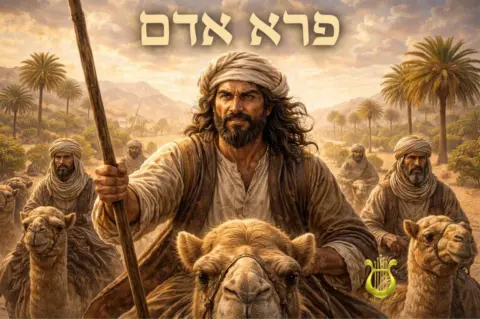
The Torah says of him (Genesis 16:12): “And he shall be a פרא אדם “para adam” (a wild man).”
Every word whose root contains the letters “פר” denotes separation and going beyond boundaries. “פרא” is one who does not submit to boundaries and is devoid of any prescribed form of conduct. The essence of Ishmael is “פרא” (wildness) in human form.
Our father Avraham was a man “great among giants.” To be human means to resemble Avraham. Avraham’s defining quality was that he was the father of faith, and through his faithfulness to G-d he became a truly great man.
It is written in Genesis (2:4): “These are the generations of heaven and earth when they were created.”
From the word “בהברם” (“when they were created,” with the הִ written smaller than usual), the Sages derived: “בעבור אברהם”—“for the sake of Avraham.” For he can serve as the foundation of all creation. Regarding him it is said (Song of Songs 8:9): “If she is a wall, we will build upon her a silver turret.”
The Ishmaelites are strong in their faith and self-sacrifice. This reflects their kinship with Avraham, because the seed of faith planted by Avraham still continues to grow among them.
It is written (Genesis 21:14): “And he took bread and a skin of water, and gave them to Hagar, placing them on her shoulder.” The Zohar explains: “placing it on her shoulder” means placing upon her shoulders, as an additional burden, the yoke of faith. It is likewise written in Pirkei de-Rabbi Eliezer: “By virtue of Avraham, the water did not run out; but when she reached the wilderness, she began wandering among the idols of her father’s household, and immediately the water ran out.” As long as she held fast to faith, the water did not run out.
Faith is the human element within Ishmael.
However, his faith transcends all boundaries and becomes “פרא” faith—wild faith, allowing them to believe in a prophecy supposedly from G-d that ordinary reason cannot accept. A person created in the image of G-d resembles the Almighty and lives with Him.
A wild man is one whose faith is arbitrary, with each action standing on its own.
A wild man is a combination of two opposites, “man” and “wild” (אדם ו פרא). It means taking faith in the Creator, who wisely created an infinite world, and focusing on deriving pleasure from each moment separately.
Their entire existence (that of the Ishmaelites) is worthless, and it is as though the Almighty “regrets” having created them.
Ishmael “blocks” the possibility of the world existing within the boundaries established by the Almighty. Regarding him it is said (Genesis 16:12): “His hand shall be against everyone, and everyone’s hand shall be against him.”
Whatever he lays his hand upon oversteps its boundaries, becoming an instrument of the wild man (פרא). The Sages foretold that the descendants of Ishmael would cause the Jews much suffering. One feature of this suffering is its unpredictability.
One can avoid misfortunes that follow a discernible pattern.
But when they have no order or sequence, there is no escape from them. In such a situation, when a person has no way out, all that remains is to pray.
“One who sees Ishmael in a dream—his prayer has been heard,” because such “visions” lead to prayer, which the Creator hears.
Our Sages, of blessed memory, foresaw what could be expected from Ishmael—and that he would be the one to lead us to complete, sincere prayer.
Therefore, it is clear that it is better for us to engage in complete prayer, so that their “assistance” will not be necessary. Every complete prayer can take the place of a sea of blood that they may shed, G-d forbid. This is what is demanded and requested of our people at the end of the exile—for the sake of our salvation. Exile leads us to complete prayer, so that the Almighty will hear us and answer.
(Rabbi Moshe Shapiro)
The Holy Zohar on Ishmael
“There is no exile more difficult for the People of Israel than the exile of Ishmael,” and furthermore, the Zohar (on the portion of Va'eira) says:
“...the descendants of Ishmael will continue to prevent the return of the Children of Israel to the Land of Israel, until the merit of Ishmael’s circumcision, performed long ago, loses its significance....”
This will happen when we truly undertake to fulfill the Will of the Creator—that is, when the essence of the sefirah of Yesod, through our spiritual work, begins to manifest itself unmistakably in the world....
The Holy Zohar says: “For 400 years, behold, the angel of Ishmael, Rahav, stood before the Almighty and pleaded with Him. He said to Him: “Does one who is circumcised have a portion in Your Name?”
The Almighty answered him: “Yes, he does.”
The angel said: “But Ishmael is circumcised. Why does he not have a portion in You, like Isaac?”
The Creator answered him: “Isaac was circumcised properly, as prescribed in the Torah, whereas the other was not.”
And not only that. These (the Jews) cleave to Him properly, on the eighth day, while those are far from Him.
The angel said to Him: “Nevertheless, can one who is circumcised not receive a good reward for this?”
Woe to the time when Ishmael was born into the world and circumcised.
What did the Almighty do in response to the claims of Ishmael’s angel?
He deprived the Ishmaelites of the higher attachment—that is, the World to Come—but granted them a portion below, in the Holy Land, in the merit of their circumcision.
But their dominion will not be complete, just as their circumcision is not complete. Therefore, it is possible for a situation to arise in which the Arabs will do everything they can to prevent the Jews from returning to their land. This will continue until their right to the Land of Israel comes to an end. (Zohar, Va'eira)
Since their circumcision is meaningless (not in accordance with Torah law), the Arabs have the right to settle in Israel only when the land is empty and not inhabited by Jews.
As a reward for their circumcision, they have the right to build a house on the Temple Mount.
The settlement of Israel by Jews and their observance of the Torah’s laws in the Holy Land automatically annul the Arabs’ right to settle in the Land of Israel.
Ishmael, the son of Avraham, although he did not inherit his father’s “Jewish essence,” voluntarily agreed to undergo circumcision. Circumcision symbolizes the revelation of the process of realizing the Creator’s Plan. Therefore, despite the fact that Ishmael himself and his descendants have no part in this process, they remain for us, as it were, a “reproach” for delaying (as Jews) the process of fulfilling the Almighty’s Design.
And since the process of fulfilling His Plan is the meaning of everything’s existence in the world, the “exile of Ishmael” is the most difficult for us.