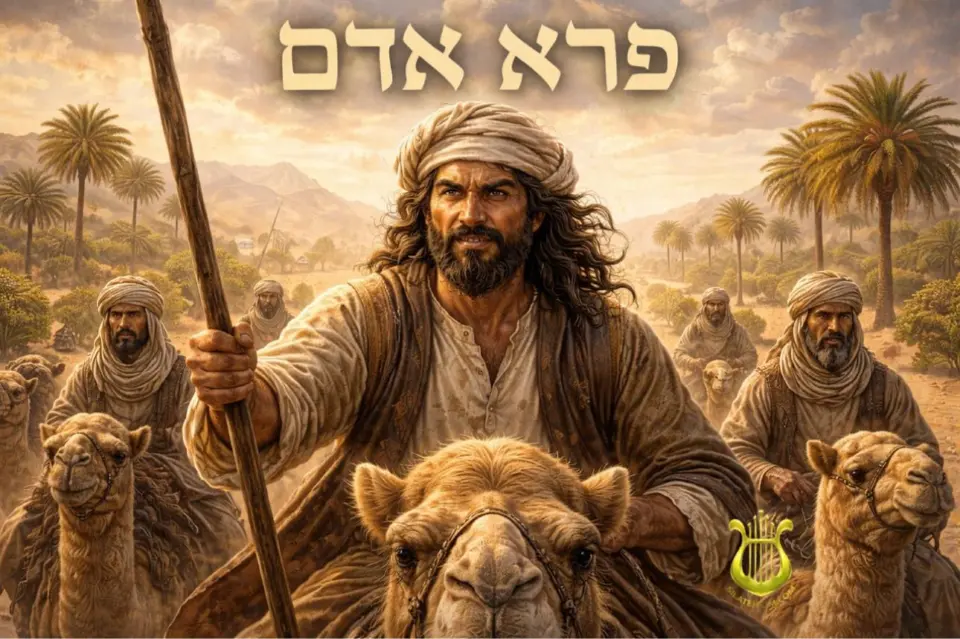
The Torah says about Ishmael: “And he shall be פרא אדם—a wild man.” (Bereishit 16:12)Any word whose root contains the letters “פר” denotes separation and going beyond boundaries.“פרא” refers to one who does not submit to boundaries and is devoid of any prescribed form of behavior. The essence of Ishmael is “פרא” in human form.Our forefather Abraham was a man “great among giants.” To be a human being means to resemble Abraham. Abraham’s primary characteristic was that he was the founder of faith, and through his faithfulness to G-d he became a great man.It is written in Bereishit (2:4): “Eleh toldot hashamayim veha'aretz behibare'am”—“These are the generations of the heavens and the earth when they were created.”From the word “בהברם” (“when they were created”), in which the letter הִ is written smaller than usual, the Sages taught: “בעבור אברהם”—“for the sake of Abraham.” For he can serve as the foundation of all creation. It is said of him (Shir HaShirim 8:9): “If she is a wall, we will build upon her a silver castle.”The Ishmaelites are strong in their faith and self-sacrifice. This reflects their kinship with Abraham, because the sapling of faith planted by Abraham still continues to grow among them.It is written (Bereishit 21:14): “And he took bread and a flask of water and gave it to Hagar, placing it on her shoulder.” The Zohar explains: “placing it on her shoulder”—he placed upon her shoulders, as an added burden, the yoke of faith. It is similarly written in Pirkei de-Rabbi Eliezer: “In Abraham’s merit, the water did not run out; but when she reached the wilderness, she began wandering among the idols of her father’s household, and immediately the water ran out.” As long as she held fast to her faith, the water did not run out.Faith is the human element within Ishmael.However, his faith goes beyond all boundaries and becomes the faith of “פרא”—a wild faith that allows them to believe in a prophecy supposedly from G-d, which ordinary reason cannot accept. A person created in the image of G-d resembles the Almighty and lives together with Him. A wild man is one whose faith is arbitrary, with each action standing on its own.The wild man is a combination of two opposites, “man” and “wild” (אדם ו פרא). This means taking faith in the Creator, who wisely created an infinite world, and focusing on deriving pleasure from each moment separately.The entire existence of the Ishmaelites is such that the Almighty, as it were, “regrets” having created them. Ishmael “blocks” the possibility of the world’s existing within the boundaries established by the Almighty.It is said of him (Bereishit 16:12): “His hand shall be against everyone, and everyone’s hand shall be against him.” Whatever he lays his hand upon goes beyond its boundaries, becoming an instrument of the wild man (פרא).The Sages foretold that the descendants of Ishmael would cause the Jewish people much suffering. One characteristic of this suffering is its unpredictability. It is possible to avoid troubles that follow a discernible pattern.But when they lack any consistency, there is no escape from them. In such circumstances, when a person has no way out, all that remains is to pray.“One who sees Ishmael in a dream—his prayer has been heard,” because such “visions” lead to prayer, which the Creator hears. Our Sages, of blessed memory, foresaw what could be expected from Ishmael—and that he would ultimately lead us to complete and sincere prayer.It is therefore clear that it is better for us to engage in complete prayer, so that their “assistance” will not be necessary. Every complete prayer can avert a sea of blood that they may spill, G-d forbid. This is what is demanded and requested of our people at the end of the exile—for the sake of our salvation. Exile leads us to complete prayer, so that the Almighty will hear and respond.The Zohar HaKadosh on IshmaelThe Zohar HaKadosh says in Parashat Shemot: “...there is no exile more difficult for the people of Israel than the exile of Ishmael.”Moreover, the Zohar says in Parashat Va'era: “...the descendants of Ishmael will continually prevent the return of the children of Israel to Eretz Yisrael, until the merit of Ishmael’s circumcision, performed in his time, loses its significance...”The Holy Zohar says:“Behold, for 400 years the angel of Ishmael, Rahav, stood before the Almighty and pleaded with Him. He said to Him: ‘Does one who is circumcised have a share in Your Name?’The Almighty answered him: ‘Yes, he does.’The angel said: ‘But Ishmael is circumcised. Why, then, does he not have a share in You, like Isaac?’The Creator answered him: ‘Isaac was circumcised properly, as prescribed in the Torah, but that one was not. And not only that: these ones cleave to Me properly on the eighth day, whereas those are far from Him.’The angel said to Him: ‘Even so, can one who is circumcised not receive a good reward for it?’”Woe to the time when Ishmael was born into the world and was circumcised.What did the Almighty do in response to the claim of Ishmael’s angel? He deprived the Ishmaelites of the higher attachment—that is, of the World to Come—but granted them a share below, in the Holy Land, in merit of their circumcision.But their dominion will not be complete, just as their circumcision is incomplete. Therefore, it is possible that they will in every way hinder the Jews from returning to their land. This will continue until their claim to the Land of Israel comes to an end. (Zohar, Va'era)Since their circumcision does not conform to the law of the Torah, they have the right to settle the Land of Israel only when it is desolate and not inhabited by Jews.As a reward for their circumcision, they have the right to build a house on the Temple Mount.The settlement of the Land of Israel by Jews and their observance of the laws of the Torah in the Holy Land automatically nullify their right to settle Eretz Yisrael.Ishmael, the son of Abraham, although he did not inherit his father’s “Jewish essence,” willingly agreed to undergo circumcision. Circumcision symbolizes the revelation of the process by which the Creator’s Plan is brought to fruition. Therefore, despite the fact that Ishmael and his descendants themselves have no connection to this process, they remain a “silent reproach”—a reminder that we are delaying the fulfillment of the Almighty’s Plan. And when we properly undertake to fulfill the Creator’s Will, through our spiritual work, the essence of the sefirah of Yesod will begin to manifest itself in this world with complete clarity.(based on the teachings of Rabbi Moshe Shapiro in Moscow and Rabbi Zvi Nissanzon)
Was this helpful?
98% of readers found this article helpful (61 votes).
Please note: some articles on our site contain the holy Names of the Almighty. If you print these articles, they may not be thrown away or destroyed. Please handle printed copies with care and respect.
Material from our site may be copied for the purpose of spreading Torah, provided a link to Silatehilim.com is included. Any use of the site's material in print publications or for commercial purposes is prohibited without the rights holder's consent.