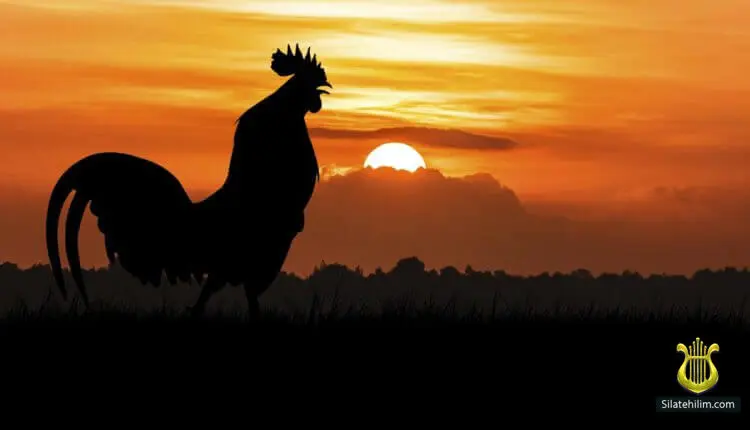
The Zohar Ha-Kadosh explains that after midnight, a flame emerges from the pillar of Isaac and strikes the Rooster (Gabriel), who resembles the pillar of Isaac. Since the flame strikes this gever (Gabriel), he cries out six times, and all of his cries are filled with understanding.
When the angel Gabriel cries out, the call of all the roosters in the world is heard. Another flame erupts from him and bursts beneath their wings, and they raise their own rooster cries.
What does Gabriel cry out?
This is revealed in Tehillim 29.
During the first hour of the night, he proclaims:
“The voice of the Almighty is in strength; the voice of the Almighty is in splendor”; (Tehillim 29:4)
During the second hour, he proclaims:
“The voice of the Almighty breaks the cedars”; (Tehillim 29:5)
During the third hour, he proclaims:
“The voice of the Almighty hews out flames of fire”; (Tehillim 29:7)
During the fourth hour, he proclaims:
“At the voice of the Almighty, the wilderness trembles”; (Tehillim 29:8)
During the fifth hour, he proclaims:
“The voice of the L-rd is over the waters”; (Tehillim 29:3)
During the sixth hour, he proclaims:
“At the voice of the Almighty, the does writhe”; (Tehillim 29:9)
Then he cries out and says:
“The voice speaks, proclaims, and says what I will read.”
What does he read?
He reads a description of all people's deeds, for all the judgments, records, and letters are entrusted to him. A special quill for writing is attached to his thigh, and he records the deeds of all people every day. At night, after completing all the “proclamations,” he reads everything he recorded during the day.
Morning and the Rooster The rooster crows at sunrise, when it becomes time to perform all the mitzvot associated with daylight. The rooster awakens a person so that he will perform all these mitzvot. The first blessing that the Sages ordained to be recited in the morning is: “Blessed are You, L-rd our G-d, King of the universe, who has given the rooster understanding to distinguish between day and night!” According to Kabbalah, everything that comes first serves as an introduction, a door, and even a key to what follows it. Unlike other creatures, the Rooster distinguishes between day and night not through physical light or darkness. When it is still completely dark all around, when every living creature in the world is still convinced that it is night, the rooster is granted from Above the ability to see and sense the arrival of day. The light of the still-invisible morning is so bright and evident to the rooster that it awakens him from sleep. The rooster not only wakes up himself, but awakens all those who sleep, calling upon them not to trust their eyes, but to know that the light of morning is already pouring forth its living warmth. And that means it is time to begin serving the L-rd. According to Kabbalah, each species of animal and bird embodies a particular set of qualities. Man, the crown of Creation, is a composite of all the qualities of all animals together—for good or otherwise, depending on the person. The Rooster is the living embodiment of the angel whose quality is “courage”! One of the names by which the Angel Gabriel is known in the spiritual worlds is the Great Rooster. Overcoming the heaviness of morning after sleep, the Rooster, scarcely awake, immediately begins to serve the L-rd. As a reward for its courageous service, the Rooster is granted from Above the ability of wondrous clairvoyance. Anyone who wishes to acquire clairvoyance—the ability to clearly recognize a tzadik even beneath a black garment—should learn from the Rooster. The Rooster cries out whenever the Creator opens the gates of Subtle Intellectual Perception in the world to the greatest degree (Eden, in Hebrew, means “finely structured”). Possessing powerful clairvoyance—so powerful that it is sometimes the very reason for its night blindness—the Rooster appropriately informs all who wish to know when the most auspicious time is for grasping the Mysteries of Creation. For it is known that when the Creator reveals Himself to the righteous in Gan Eden, this manifests in the physical world as a special intellectual inspiration. There are many breeds of roosters and hens. Depending on the breed’s Spiritual Root, representatives of different breeds crow for different reasons. Some crow when the Creator reveals Himself in one Hall of the Spiritual Worlds, while others do so when He reveals Himself in another. The spiritual level of a breed is reflected in the rooster’s coloring. The black rooster is most attuned to the revelation of the Creator in Gan Eden (the world of Beriah). The rooster’s blackness testifies to its origin in a level that is above the division into colors. The blacker the rooster, the higher its level. It is known that the development of a chicken embryo in an egg takes 21 days. This corresponds to the number of letters from Bet, with which all material things begin, to Tav, the final letter of the alphabet of the Holy Tongue, reflecting the Rooster’s complete development. One day corresponds to the number of letters in the alphabet. (Rabbi Shmuel Fortman Ha-Partzi, translated by Viktoria Shekhurdin)