A Moth with Hebrew Wings and Its Connection to Esau
A Moth with Hebrew Wings and Its Connection to Esau
A Parable about a Moth and the Letter “Nun”
When the Torah was given, there was an intense, even frightening radiance, together with smoke and thunder.
There was no doubt that the Almighty was present. It was this radiance that was reflected on Moshe’s face.
And so it happened that when Moshe received the Torah on the mountain, there was no other person there. It was there that G-d revealed His Presence. It was there that Moshe basked in the Divine glory. Nevertheless, he was not permitted to see the face of the Almighty.
But there was one creature on the mountain that followed the light (since it is in its nature to fly toward light) and saw everything. It was a small moth.
The Almighty saw the moth, a creature that had been created even before Adam.
The moth trembled, grew frightened, and said: “O Master of the Universe, what will become of me now that I have seen Your face? I did not intend to do this. I am only a poor moth—please have mercy on me!”
The Almighty answered: “Little creature, do not be afraid; I will bless you as well. I see that you are an ordinary moth, and perhaps My angels hurriedly forgot to give you some distinguishing mark, as We did with many other moths and butterflies that can fly like My angels. You moths and butterflies already possess the miracle of transforming from a caterpillar into what you are, but you will also receive another miracle from Me.From this time onward, you will bear a sign that you saw Me, and it will be testimony to My power for all the nations.On your back there will be a mark signifying the great event of which you were a witness.I will also bring you out of the dry desert into fertile lands, where you will thrive among many green plants and trees.”
Suddenly, the letter “nun” appeared on the moth’s wing. The Hebrew word “nes”—miracle—begins with this letter.
To this day, more than 3,000 years later, the moth bears the sign of the great miracle of which it was a witness.
And now, not a parable but a reality.
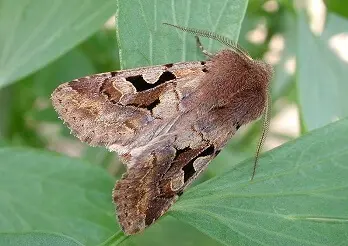
There is a species of moth in the world called Hebrew character (Orthosia gothica), a moth from the Noctuidae family. This species was first described by Carl Linnaeus in Systema Naturae in 1758. Its forewings range from grayish to reddish-brown. The edges of the wings are generally marked with a black symbol shaped like the Hebrew letter “nun” — נ- (in the photograph).(Wikipedia)Rabbi Moshe David Valle revealed another aspect of the moth in one of his lessons.
He cited the Book of Job, which says: “Can a man be righteous before G-d? Can a man be pure before his Maker? Behold, He does not trust His servants, and He charges His angels with imperfection. How much less those who dwell in houses of clay, whose foundation is in the dust—they will be crushed sooner than a moth.”Rabbi Moshe David Valle states in Megaleh Amukot that this pasuk refers to Esau, who is symbolized by the moth.
The Hebrew word for “moth” is עש - (ash), which carries a negative connotation when compared with its homonym—אש (esh)—fire.
The gematria of the word “moth” is 370, signifying the 370 forces of impurity.
The 370 forces of impurity require a separate explanation: Rabbi Neta Natan Shapiro, in his book Megaleh Amukot, writes in his commentary on Balak that there are 370 radiances of holiness and 370 kelipot that draw sustenance from them. As support, he cites a rather strange story from the Talmud, tractate Shabbat, concerning the grave of Rabbi Aha bar Yoshia:
When gravediggers were digging on Rabbi Nachman’s property, Rabbi Ahai bar Yoshia (who was buried there) began rebuking them.
They went and told Rabbi Nachman: “A man from one of the graves is rebuking us!”
(Rabbi Nachman) went and said: “Who are you, sir?” He answered: “I am Ahai bar Yoshia.”
(Rabbi Nachman) said to him: “But did Rabbi Mari not say that even the righteous will turn to dust?” He answered: “Who is this Rabbi Mari? I do not know him.” (Rabbi Nachman) said to him: “But does the verse not say: ‘And the dust returns to the earth as it was’?” He answered: “The one who taught you the Book of Kohelet did not teach you the Book of Mishlei, where it is written—‘The rottenness of the bones is envy.’Whoever has envy in his heart—his bones rot; but whoever has no envy in his heart—his bones do not rot.”
It is no coincidence that 370 is also the sum of the gematriot of the first letters of the phrase: “The rottenness of the bones is envy”—“resh” (200) + “ayin” (70) + “kuf” (100) = 370. And in this case, envy is equivalent to rot: both consume things and reduce them to dust.
What Esau and the moth have in common is that “moth” (עש - “ash”) is part of Esau’s name (עשו). However, the moth represents the 370 forces of impurity, while Esau is the head of these forces, as Rabbi Valle explains.
Esau’s name can be understood as a partial homonym of the phrase “Ash-av”—father-moth, meaning the chief moth—or the additional letter “vav,” the conjunction “and,” may indicate something greater than a moth.
The real “moth” feeds on our clothing and makes holes in it. The supernatural one does the same thing, making holes in the spiritual reality that we try to create by performing mitzvot. (Alexander Tzvi Sypkov)
And one more question: Why do moths fly toward the light? Since there is a principle that impurity draws sustenance from purity, it is in the nature of the moth (עש - “ash”) to be drawn toward its opposite—אש (esh)—fire. (Chiddush “Silatehilim”)
Was this helpful?
100% of readers found this article helpful (31 votes).
Please note: some articles on our site contain the holy Names of the Almighty. If you print these articles, they may not be thrown away or destroyed. Please handle printed copies with care and respect.
Material from our site may be copied for the purpose of spreading Torah, provided a link to Silatehilim.com is included. Any use of the site's material in print publications or for commercial purposes is prohibited without the rights holder's consent.