The Power of the Uv'khen Prayer—the Power of Esther to Emerge from Dead Ends and Impossible Situations
Prayer
ובכן “Uv'khen,” yitkadesh shimcha Ado-nai Elo-heinu, al Yisrael amecha; ve'al Yerushalayim irecha, ve'al Tzion Mishkan kevodecha, ve'al Malchut Beit David meshichecha, ve'al me'onacha, ve'heichalecha.”
(And then, may the sanctity of Your Name, G-d our L-rd, rest upon Your people Israel, and upon Jerusalem, Your city, and upon Zion, the dwelling place of Your glory, and upon the kingdom of David, Your anointed one, and upon Your abode and Your Temple.)
ובכן “Uv'khen,” ten pachdecha Ado-nai Elo-heinu al kol ma'asecha, ve'eimatecha al kol mah shebarata, veyira'ucha kol hama'aseim, veyishtachavu lefanecha kol haberu'im, veye'asu kulam agudah achat, la'asot retzonecha belevav shalem. Sheyadanu Ado-nai Elo-heinu, shehasholtan lefanecha, oz beyadecha, ugevurah biminecha, veshimcha nora al kol mah shebarata.”
(And then, instill fear of Yourself in all Your creations, [teach] all that You have made to fear You; may all whom You have created tremble before You, and may all creatures prostrate themselves before You and unite as one to do Your will wholeheartedly. For we know, G-d our L-rd, that dominion is Yours, strength is in Your hand, might is in Your right hand, and Your awesome Name is over all that You have created.)
ובכן “Uv'khen,” ten kavod Ado-nai le'amecha, tehillah lire'echa, vetikvah tovah ledorshecha, ufitchon peh lameyachalim lach, simchah le'artzecha, vesason le'irecha, utzemichat keren leDavid avdecha, va'arichat ner leven Yishai meshichecha, bimherah beyameinu.”
(And then, L-rd, magnify Your people, glorify those who fear You, grant hope to those who call upon You, and vindicate those who trust in You. May Your land rejoice, Your city be glad, may the might of David Your servant grow, and may You kindle the light of Your anointed one, the descendant of Jesse, speedily in our days.)
ובכן “Uv'khen,” tzaddikim yir'u veyismechu, veyesharim ya'alozu, vachasidim berinah yagilu, ve'olatah tikpotz piha, veharish'ah kulah be'ashan tichleh, ki ta'avir memshelet zadon min ha'aretz.”
(And then, the righteous will see and rejoice, the upright will exult, those who love You will celebrate with song, all wickedness will be silenced, and all evil will vanish like smoke, when You remove the dominion of evil from the face of the earth.)
“Vetimloch atah hu Ado-nai Elo-heinu levadecha al kol ma'asecha, behar Tzion mishkan kevodecha, uvYerushalayim ir kodshecha, kakatuv bedivrei kodshecha: ‘Yimloch Ado-nai le'olam, Elohayich Tzion ledor vador, Halleluyah.’”
(And You alone will reign, G-d our L-rd, over all Your creations, on Mount Zion, the dwelling place of Your glory, and in Jerusalem, Your holy city, as it is written in Your sacred Scriptures: “The L-rd will reign forever; your G-d, O Zion, from generation to generation. Halleluyah!”)
The Power of the Uv'khen Prayer
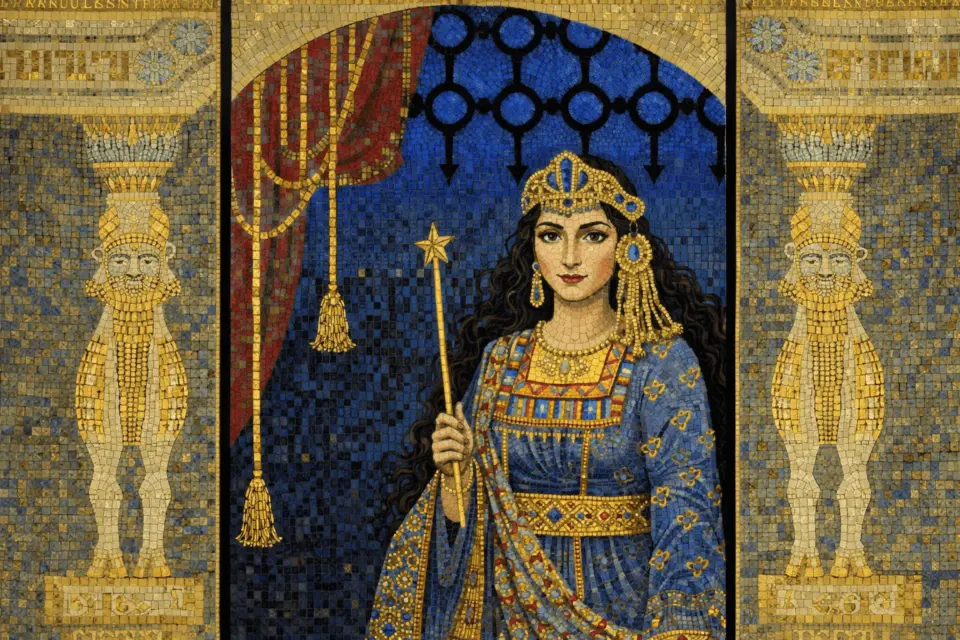
The word “Uv'khen” is repeated most often in the prayers of Rosh Hashanah. According to Chacham Avadraham, the reason is that through these words we recall Esther, for it was with these words that Esther addressed Mordechai when she heard of Haman’s decree to destroy the Jewish people and decided to go to the king despite the risks involved: “Uvikhen avo el hamelech asher lo kadata, vekha'asher avadeti, avadeti”—(and therefore I will go to the king, although it is against the law; and if I am destined to perish, then I shall perish). (Megillat Esther 4:16) Likewise, on Rosh Hashanah we stand before the King despite our lack of merits; therefore, we experience the feelings Esther experienced by using the word “Uv'khen.” Chazal teach that genuine change requires courage. Like Esther, who went before the king in order to annul the decree, we must stand before the King—the Almighty—and share our feelings with Him. The Zohar HaKadosh says that the gematria of the word ובכן—“Uv'khen”—is 78: namely, 72 (the Name of the Almighty) plus 6, the letter “vav.” This letter “vav” refers to the sixth millennium, when the complete, long-awaited Redemption from all troubles will arrive. (Zohar HaKadosh, 7:106) Seventy-eight is also the gematria of the four-letter Name of the Almighty (26) multiplied by three. The word “Uv'khen”, repeated four times, has a gematria of 312. 312 is also the gematria of words such as שבי—“shevi”—(captivity) and שואה—“Shoah”—(catastrophe). Through the “Uv'khen” prayer, these concepts can be annulled and one can reach the state of חדש—“chadash” (new), which also has a gematria of 312.“Uv'khen ten pachdecha”
The holy Rabbi Naftali of Ropshitz was very sharp-witted and outspoken.
Once, he said: “Even when they pray and say ‘Uv'khen ten pachdecha,’ they mean money, ‘gelt,’ because the gematria of ‘pachdecha’ and ‘gelt’ is the same.”
Stories of the Tzadikim—A Segula for Protection from Danger: Rabbi Zusha of Anipoli The town of Anipoli was ruled by a noble count. The town was his private estate, so the count could administer justice there as he pleased. One day, a major theft took place in his palace. All attempts to find the stolen property failed, and his advisers managed to convince him that, as was usually the case, the Jews were responsible. The count ordered an announcement to be made in the streets of Anipoli: if the Jews did not return what had been stolen within a specified period, he would revoke their right to live in the town and drive them from their homes. The Jews came to the tzadik with their troubles. After hearing them out, Rabbi Zusha instructed them to summon a wealthy Jew who had connections at the count’s court and was trusted there. The rabbi told him to go to the count and promise in Rabbi Zusha’s name that, if the count agreed to wait exactly one year, Rabbi Zusha himself would return the stolen money at the end of that period. “And who will guarantee that I will actually receive my money back in a year?” the count asked. “I will be your guarantor, and if you do not receive the money, I will pay it from my own pocket,” the Jew assured him. The nobleman agreed and postponed his decree for a year. Time passed, month after month, but nothing happened. The wealthy man expected Rabbi Zusha to begin traveling and collecting donations to raise the necessary sum, but the tzadik calmly remained at home, as always, occupied with his affairs. The deadline drew closer, and the wealthy man began seriously to fear that he would ultimately have to pay the enormous sum. He decided to go to Rabbi Zusha to remind him about the theft. “Do not worry,” the Rebbe said. “You will not have to pay a penny.” Several days before the deadline, Rabbi Zusha asked the wealthy man to go to the count and tell him that, on the appointed day and at a specified hour, all the palace servants without exception should be lined up in the courtyard. Rabbi Zusha would come there personally and, with G-d’s help, perform a miracle. On the appointed day, all the servants were lined up in rows in the courtyard. The count himself, together with his family, entourage, and friends, was also there. Everyone waited impatiently to see what would happen. Rabbi Zusha, leaning on a cane, entered the courtyard and began carefully inspecting the rows of servants. Then he turned to the count and said that one of the servants was missing. They began investigating who was absent and where he was. It turned out that one of the serfs, who was occupied cleaning the stable’s cesspits, had not appeared. They sent for him. When everyone was finally present, Rabbi Zusha began loudly and fervently reciting a verse from the Amidah of Rosh Hashanah and Yom Kippur: וּבְכֵן תֵּן פַּחְדְּךָ ה׳ אֱלֹהֵינוּ עַל כָּל מַעֲשֶׂיךָ, וְאֵימָתְךָ עַל כָּל מַה שֶּׁבָּרָאתָ, וְיִירָאוּךָ כָּל הַמַּעֲשִׂים. — “Uv'khen, ten pachdecha Ado-nai Elo-heinu al kol ma'asecha, ve'eimatecha al kol mah shebarata, veyira'ucha kol hama'aseim” — (And then instill fear of Yourself, G-d our L-rd, in all Your creations; [teach] all that You have made to fear You.) He spoke with ever-increasing inspiration, more and more powerfully, and fear seized the serf who cleaned the cesspit. After Rabbi Zusha recited the verse for the third time, the man began trembling all over, his teeth chattering. He fell to his knees and begged the rabbi to stop reciting his prayers, promising that he would bring everything himself immediately. Trembling, the serf ran to the stable, where he pulled a money box from a hiding place. The stolen money inside was completely untouched. Even the count was forced to admit that the Jews have a G-d. A similar incident occurred when soldiers from a military unit arrived in the town and, after getting drunk at an inn, began rioting and smashing everything around them and beating passersby, threatening to turn the incident into a pogrom. Hearing what was happening, Rabbi Zusha ran to the inn where the soldiers were creating a disturbance and began shouting the words of the prayer: — “Uv'khen, ten pachdecha Ado-nai Elo-heinu al kol ma'asecha, ve'eimatecha al kol mah shebarata, veyira'ucha kol hama'aseim” — (And then instill fear of Yourself, G-d our L-rd, in all Your creations; [teach] all that You have made to fear You). He repeated these words three times, after which such fear seized the soldiers that they abandoned their belongings and weapons and fled the town in panic. It was with great difficulty that their flight was stopped. The authorities punished the soldiers and even paid for the damage they had caused. This verse, recited three times, has saved the Jewish people throughout the generations. Rabbi Zusha of Anipol – Segulot for Protection from Danger (Based on the Siddur “Machzor for Rosh Hashanah,” Shacharit, Amidah; Yeshiva “Kisei Rachamim”—Yura Plishtiev, transliteration by Zoya Haya Tigai)