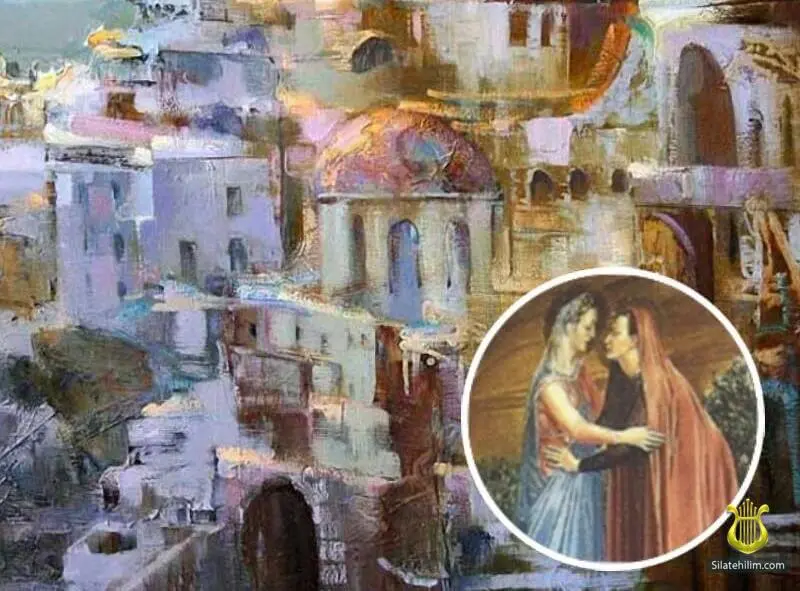
Nitzavet bat Adael—who stands behind every psalm of King David
Chazal teach that one must be especially careful with people who have endured tzarot—
“tzarah” (trouble and oppression).
This is in addition to widows and orphans, about whom the Torah speaks explicitly: “You shall not mistreat any widow or orphan… If you mistreat them…! For if they cry out to Me, I will surely hear their cry; My anger shall blaze forth, and I will put you to the sword, and your wives shall become widows and your children orphans.” (Shemot 22:21–23)
The Sages cite stories about childless women (such as Hannah and Peninnah), women abandoned by their husbands (Nitzavet bat Adael), and people who suffered loss (Job and his friends)—and in all these stories, the Holy One, blessed be He, rewards those who endured tzarot and punishes their oppressors.
All these examples reveal that the trials sent to us in this world come from the Holy One, blessed be He, and that it is impossible to understand or see the chain of cause and effect behind them. Indeed, the question of “why does the righteous suffer while the wicked prosper?” runs like a refrain throughout the Torah and remains unanswered, yet it teaches us much.
Nitzavet bat Adael
David’s father, Yishai, was the grandson of Boaz and Ruth.
After several years of marriage to Nitzavet and the birth of seven sons, Yishai began to have doubts about his lineage. He was a member of the Sanhedrin and the leading Torah authority of his time, but his grandmother Ruth had been a Moabite.
The Torah prohibits Israelites from marrying Moabites. When doubt seized the heart of Yishai, an honest and responsible man, he decided to separate from his wife. Yishai’s children knew about this separation.
Yishai’s wife—Nitzavet bat Adael—was a righteous woman and suffered terribly from her husband’s decision to leave her.
Because Yishai was a righteous man, he knew that the Holy One, blessed be He, had created the world not to remain desolate, but to be inhabited, and that a man should therefore not live without a wife. After several years of living alone, he chose one of the non-Jewish maidservants who lived in his home and said to her: “I am freeing you on this condition: if I am a fully Jewish man, then your emancipation is complete, and I will take you as my wife in accordance with the laws of the Torah given to us through Moshe. But if I am not, then you are not freed and remain in your former status, and therefore you have the right to marry even a Moabite.”
The maidservant proved loyal to her mistress and acted as our matriarchs Rachel and Leah had acted—Nitzavet took her place.
Three months later, Nitzavet’s pregnancy became apparent, and her sons, suspecting their mother of adultery, decided to kill her. Yishai ordered his sons not to touch her.
“Do not kill her! Instead, let the child who will be born be regarded as a mamzer.”
The Talmud (Shabbat 55b) names Yishai as one of four righteous men who died solely because of the sin of Adam and Eve, and not because of their own sins.
When David was born, the family greeted his birth with complete scorn and contempt: “I have become a stranger to my brothers, and a foreigner to my mother’s sons.” (Tehillim 69:9)
David was not permitted to eat with the other members of his family; he had a separate table in the corner.
They made him a shepherd, hoping that a wild animal would come and kill him while he was out in the fields.
The only one who suffered because of David and felt a deep bond and love for the child was his mother, Nitzavet bat Adael, who felt the pain and rejection of her youngest child as her own.
Humiliated and despised, Nitzavet shed rivers of tears, waiting for justice to be restored. She endured many years of
“bizyonot” (humiliation)—28 years of attacks, suffering, and pain. Twenty-eight years of tzarot.
Nitzavet chose a vow of silence. And, like Tamar, Nitzavet would be rewarded for her silence with a child destined for a great future, who would become the ancestor of Mashiach.
The Midrash relates that when Shmuel HaNavi anointed David, crying was heard from outside the great hall.
It was the voice of Nitzavet, David’s sole supporter and only source of comfort.
Her 28 long years of silence in the face of humiliation had finally come to an end. At last, everyone would see that the lineage of her youngest son was pure, untainted by any defect.
Although David HaMelech would be called ben Yishai, it was from his mother that he absorbed the strength of spirit and courage to stand up with dignity to his opponents.
Her patient faith in the Creator—that justice would be restored—gave David the strength to withstand the trials of his life.
She also taught him to show courage at the right moment—to take personal risks. Without her brave actions in taking the maidservant’s place on that fateful night, the great soul of her youngest child, David, the ancestor of Mashiach, would never have descended into this world.
The heart-rending psalms of David HaMelech, uttered by him in his most difficult moments, help us as well—his descendants—and seem to have been written especially for us.
Behind every psalm stands David HaMelech’s mother, who endured so much tzarot for his sake, yet lived to see her son anointed.
A segula using the name of David HaMelech’s mother, Nitzavet bat Adael
There is a special segula: to recite the name of David HaMelech’s mother—
Nitzavet bat Adael—
17 times.
The Kabbalist
Rabbi Yaakov Culi—“Me’am Lo’ez”—wrote about it 250 years ago, and another great Kabbalist,
Rabbi Chaim Palaggi, used it daily 150 years ago.
What is the meaning of this segula, and how does it work?
The special feature of this segula is that after it is recited, it becomes
“patachat et ha-tefilah”—the key that opens the Gates of Prayer—and transforms the moment of prayer into
“Et Ratzon”—a time of Divine favor, when our requests are accepted.
Rabbi Chaim Palaggi teaches, based on what is written in the
Zohar HaKadosh, that whoever recites the name of King David’s mother immediately after Birkot HaShachar will receive more than he deserves—
“mi she-zakai yekabel yoter”.
The secret is that reciting
17 times Nitzavet bat Adael is
“al pi ha-sod”—good.
Rabbi Yaakov Culi reveals in “Me’am Lo’ez” that the first person to recite the name of King David’s mother 17 times was Hannah, the mother of Shmuel HaNavi, when she came to Shiloh to the Mishkan. She knew the secret that
Nitzavet ניצבת consists of the same letters as
“Nitzbet” ניצבת—the name of the angel mentioned in connection with Shmuel HaNavi.
Rabbi Emanuel Mizrachi emphasizes that it is especially beneficial to recite the name of David HaMelech’s mother in the morning on Rosh Hashanah and Yom Kippur—immediately after Birkot HaShachar.
Tehillim 82, or where David HaMelech encoded his mother’s name
Tehillim 82, or Where David HaMelech Encoded His Mother's Name
(from Rabbi Meir Mazuz’s “Kise Rachamim” Yeshiva—Yura Plishtiev, based on a lesson by the Gaon Rabbi Bentzion Mutzafi)
Please note: some articles on our site contain the holy Names of the Almighty. If you print these articles, they may not be thrown away or destroyed. Please handle printed copies with care and respect.