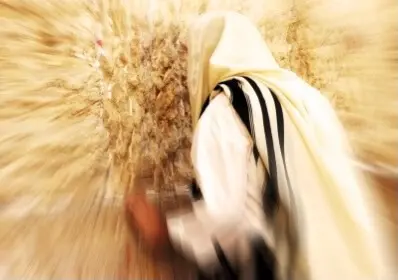
Kavanot and Segulot of the Amidah
Our Sages established the central prayer,
the Amidah (the 18 blessings), following the structure of Psalm 29, in which the Name of Ha-Shem is repeated 18 times, symbolizing Rahamim (Mercy).
Praying in a whisper
Many of the laws governing the
Amidah were established on the basis of
Hannah’s prayer. Her prayer was accepted, and she merited giving birth to the prophet Samuel, the greatest prophet of Israel after Moshe Rabbeinu. As it is written (Melachim I, 1:13):
- “Hannah spoke in her heart; only her lips moved, but her voice was not heard.”
- “She spoke in her heart” — from here we learn that one who prays must direct his heart (have kavanah).
- “Only her lips moved” — from here we learn that one who prays must articulate the words.
- “Her voice was not heard” — from here we learn that one may not raise his voice during prayer. (Berachot 31a).
3 steps backward
The
Tikunei Zohar (26:1) states that after completing the prayer, a person passes from the sacred to the mundane. At the time of the Giving of the Torah, the Jews were overcome with fear and retreated three steps backward. When Moshe Rabbeinu approached the Almighty, he passed through “darkness, cloud, and thick darkness.” Likewise, the Kohanim in the Temple, when offering sacrifices, would step three steps backward. Today we do the same: we take three steps backward and then three steps forward, bringing our feet together like the angels: “Their legs are a straight leg” (Yechezkel 1:7).
Bowing
The Sages prescribed bowing during the Amidah in four places: twice when reciting the first blessing and twice when reciting the 18th. (Berachot 34a.)
According to the holy Zohar, each bow consists of three elements:
at the word
“Baruch” — we bend our knees slightly,
at the word
“Atah” — we straighten our knees and bend forward,
and at the word
“Adonai” — we straighten up.
This form of bowing is practiced today in all Jewish communities without exception. However, at the end of the prayer, as well as in the 18th blessing, when saying
“Modim anachnu lach,” one bows simply forward. In all these cases, one bows so that the vertebrae become visible along the back. When we straighten up at the word
“G-d,” we are, as it were, testifying that He straightens those who are bowed down.
The number 18
The
Amidah contains 18 blessings (and one additional blessing). The bows in the central Jewish prayer, the
Amidah (literally, “standing”), have great significance.
In the Talmud it is stated that the original 18 blessings of the
Amidah correspond to the 18 vertebrae of the back and neck; the 19th blessing, added later, corresponds to the coccyx, the small bone at the base of the spine.
The spine is the channel through which the energy received through the
Amidah prayer spreads.
During the
Amidah, a person should bow, unlike Eastern meditations involving the circulation of energy along the spine (the so-called kundalini meditations), in which one remains completely upright.
This difference is highly significant: in Eastern “kundalini meditations,” one seeks to raise energy from the base of the spine to the head, whereas in the
Amidah, a Jew does the opposite, spreading energy from the brain throughout the body.
The Talmud states that if someone does not bow during the blessing of thanksgiving, his spine will “turn into a snake.”
Elsewhere it explains that the correspondence between the number of blessings and the number of vertebrae is intended to teach us that one should bow deeply enough for each vertebra to be separated from its neighbor. The Talmud also teaches that one should bend straight “like a rod” and straighten up “like a snake”—first raising the head and then the body.
In detail here:
Jewish Psychosomatics – 18 Vertebrae
1st Berachah (Avoteinu)
The first blessing corresponds to the Patriarch Abraham. At the words
“Magen Avraham”, we should have in mind that the word
מגן “magen” (protector) is an acronym formed from the names of the three angels who protected Abraham and the entire Jewish people: Michael, Gabriel, and Nuriel.
2nd Berachah (Atah Gibor le-Olam)
In this blessing, we should have kavanah regarding the Name of Ha-Shem:
אגלא
This Name is an acronym formed from the first letters of the opening words of the blessing: “
Atah
Gibor
Le-olam
Adonai.” It expresses the might of the Creator.
- “Morid ha-geshem, mechalkel chayim be-chesed, mechayeh metim be-rachamim rabim” — here one should have in mind that
“the keys to three things the Almighty kept in His own hands: rain, human sustenance, and the revival of the dead.”
4th Berachah (Atah chonen le-adam da’at)
The Sages teach that the first three blessings are praise of the Almighty, while the final three are thanksgiving for having heard us. Requests begin with the fourth blessing. How wisely, then, did the Sages act in making our first request a
request for wisdom, understanding, and knowledge—just as King Solomon asked the Almighty for wisdom, and was rewarded with all the other blessings as well: wealth, honor, and health. Since it is so important to ask correctly, we should have kavanah for receiving wisdom and understanding.
5th Berachah (Hashiveinu)
Kavanah for doing teshuvah
This segulah was composed by
the Arizal (may his merit protect us) at the request of
Rabbi Moshe Alshich. It happened that Rabbi Alshich’s son had abandoned observance, causing his father great anguish, and he wished for his son to do teshuvah. The yichudim composed by the Arizal were effective, and Rabbi Alshich’s son returned to the faith of the people of Israel.
The following insertion should be made in the fifth blessing:
Hashiveinu, Avinu, le-Toratecha, ve-karveinu, Malkeinu, la-avodatecha, ve-hachazireinu bi-teshuvah sheleimah lefanecha.
Yehi ratzon milfanecha, Adonai Eloheinu ve-Elohei avoteinu, she-tachator chatirah mi-tachat Kisei Kevodecha le-hachazir bi-teshuvah sheleimah lefanecha kol poshei Yisrael u-vi-chelalom tachazir et [Ploni ben Plonit] bi-teshuvah sheleimah, Adonai
יֵהֵוֵהֵ ki yemincha peshutah, Adonai
יֶהֶוֶהֶ peshutah lekabel shavim. Baruch Atah, Adonai
יֵהֵוֵהֵ ha-rotzeh bi-teshuvah.
Translation
Return us, our Father, to Your Torah, and bring us near, our King, so that we may serve You, and return us in complete repentance before You. May it be Your will, G-d, our G-d and the G-d of our fathers, that You tunnel beneath Your Throne of Glory in order to return all the sinners of Israel to complete repentance before You, and together with them return [son’s name, mother’s name] to complete repentance. G-d יֵהֵוֵהֵ, for Your right hand is outstretched; G-d יֵהֵוֵהֵ, outstretched to receive those who return. Blessed are You, Lord יֵהֵוֵהֵ, Who desires our return!
When saying the word
“yemincha” (Your right hand), have in mind Chesed, because Chesed is called the right hand of the Almighty. It is also represented by the Name Havayah vocalized with segol:
יֶהֶוֶהֶ
When saying the word
“bi-teshuvah” (in repentance), have in mind Binah, because Binah is called repentance. It is also represented by the Name Havayah vocalized with tzeirei:
יֵהֵוֵהֵ
8th Berachah (Refa’einu)
The
Arizal explains that when Adam Ha-Rishon sinned, he caused 288 sparks of holiness, the
“Rapach Nitzotzot,” to be lost. Tradition relates that the
Arizal once came to his student,
Rabbi Moshe Achi, in a dream to reveal the secret of the
“Refa’einu” blessing in the
Amidah.
The gematria of the word
“rofe” (physician) is
288 (with the kolel). The cause of all illnesses is the
“Rapach Nitzotzot”—the 288 sparks of holiness that fell into the kelipot.
When reciting the blessing, one should silently ask G-d, in His role as Physician, to sweeten the 288 sparks of holiness; this will aid the healing of the sick person.
The Arizal teaches that the number
288 is encoded in the blessing
“Refa’einu” in another place as well. The first letters of the words “
Rofeh
Cholei
Amo
Yisrael” (Who heals the sick of His people Israel) also equal
288.
All illnesses of the Jewish people stem from those
288 sparks that Adam Ha-Rishon lost and that fell under the control of impurity. The forces of impurity draw nourishment from the holiness of these sparks, and this is why the Jewish people suffer illness. When we pray, we ask that these 288 sparks of holiness be purified and that impurity be removed from them. Then there will be neither illness nor death.
9th Berachah (Barecheinu)
The word
מים “mayim” (water) is, in Judaism, a symbol of life and of Ha-Shem’s Mercy.
In
“Barech Aleinu” (the winter blessing), the word
“mayim” (water) forms an acronym in the following pesukim:
וּ
מַלֵּא
יָדֵינוּ
מִבִּרְכוֹתֶיךָ —
“umalei yadeinu mi-birchotecha”
—
(fill our hands with Your blessings);
וּ
מֵעֹשֶׁר
מַתְּנוֹת
יָדֶיךָ —
“ume-osher matanot yadecha” —
(and enrich us with the gifts of Your hand).
We should have kavanah that shefa (abundance) flow down from Heaven like water—in abundance.
Segulah during the days between Rosh Hashanah and Yom Kippur — a segulah for success and parnasah
The
Sefer Zechirah cites a segulah that may be used on the weekdays between Rosh Hashanah and Yom Kippur—the 3rd, 4th, 5th, 6th, 7th, and 8th of Tishrei (except Shabbat): to make a special insertion in the ninth blessing of the Amidah,
“Barech Aleinu…” (Who blesses the years).
“Barech aleinu, Adonai Eloheinu, et ha-shanah ha-zot ve-et kol minei tevuatah le-tovah ve-ten
<ba-kayitz> Berachah
<ba-choref> Tal u-matar li-vrachah al penei ha-adamah. Ve-sabeinu mi-tuvah. U-varech shenateinu ka-shanim ha-tovot li-vrachah. Ki El tov u-metiv Atah u-Mevarech ha-shanim.
Yehi ratzon milfanecha, Adonai Elohai ve-Elohei avotai, she-titen li u-li-vnei beiti u-le-chol ha-mesuvim al shulchani be-chol yom va-yom mezonoteinu u-farnasateinu be-chavod bi-zchut Shemcha ha-Gadol
D ikarnusa (דיקרנוסא) ha-memunah al parnasah ve-al tatzrichenu li-yedei matnat basar va-dam, ki im be-Shemcha choneinu u-me-otzar matnat chinam techalkelenu ve-tashpieinu. Amen, Selah. Baruch Atah, Adonai, Mevarech ha-Shanim.”
(Bless for us, G-d, our Lord, this year and all kinds of its produce for the good, and grant
(in summer, beginning with Pesach, say): Blessing,
(in winter, say): Dew and rain for blessing [for us],
upon the earth, and satisfy us with Your goodness; bless this year for our good, like the good years, for You are a good and benevolent G-d, and You bless the years.
May it be Your will, G-d, my Lord and the G-d of my fathers, that You grant me, my household, and all those seated at my table our sustenance and livelihood each day, with dignity, in the merit of Your great Name—Dikarnusa (דיקרנוסא), which rules over livelihood. Sustain us not through flesh and blood (not through people), but through Your Name have mercy on us, and from Your treasury provide for us and grant us abundance. Amen, Selah.
Blessed are You, G-d, Who blesses the years).
16th Berachah (Shema Koleinu)
A prayer for sustenance, recited on weekdays before the pasuk:
“Ki Atah Shome’a tefilat…”.
“Attah Hu Adonai ha-Elohim, ha-zan u-mefarnes u-mechalkel mi-karnei re’eimim ad beitzei kinim. Ve-ametzei li u-le-chol bnei beiti mezonotai kodem she-etzta’rech lahem. Be-nachat ve-lo be-tza’ar. Be-heter ve-lo be-isur. Be-chavod ve-lo be-vizayon. Le-chayim u-le-shalom. Mi-shefa berachah ve-hatzlachah. Mi-shefa berachah elyonah. Kedei she-uchal la-asot retzonecha. Ve-la’asok be-Toratecha. U-le-kayem mitzvotecha. Ve-al tatzricheni li-yedei matanat basar va-adam. Ve-yikuyam bi mikra she-katuv: ‘Pote’ach et yadecha u-masbia le-chol chai ratzon.’
Translation
G-d, You are the G-d Who nourishes, feeds, and sustains all—from the greatest to the smallest. Grant me the bread allotted to me. Before the need arises, provide me and all my household with sustenance, so that we may be fed with pleasure and not suffering, through permission and not prohibitions, with dignity and not shame; with life and peace, abundance, blessing, and success, from the abundance of supreme blessing. Enable me to fulfill Your will, study Your Torah, and observe Your commandments. Do not make me dependent on human assistance; rather, let the verse written for me be fulfilled: “You open Your hand and satisfy every living thing according to its desire.”
18th Berachah (Modim Anachnu Lach)
Kavanah for salvation from tzarot (troubles)
Rabbi Chaim Palagi (may his merit protect us) teaches that to be saved from troubles, one should have kavanah in the
“Modim Anachnu Lach” blessing regarding the Name of Ha-Shem formed by the final letters of the final three words:
“Baruch Atah Adonai, ha-tov Shimcha u-lecha na’eh lehodot”—the Name
כהת. This is the eighth Name of Ha-Shem among the 72 Names. One should look at the letters of the Name and have kavanah for
“Le-hatzil mi-tzarot”—salvation from troubles.
19th Berachah
1. Kavanah that the Jewish people complete their rectification “be-Shalom”
288 sparks of holiness that fell into the kelipot reached Egypt.
(Details here
The Cause of Illness—Why Jews Become Ill)
Moshe Rabbeinu came and brought the Jews out of Egypt, together with the
“erev rav” (the mixed multitude).
The gematria of
“rav” is
202, meaning that Moshe Rabbeinu rectified
202 holy sparks out of
288. There remained
86—the gematria of the Name
“Elohim,” representing what the Jews still had to rectify.
In the final blessing of the Amidah: “
המברך
את -
עמו
ישראל” — (
hamevarech
et
amo
Yisrael
be-Shalom)—the initial letters of the blessing equal
86. Thus, the essence of the blessing is that the Jewish people will elevate the 86 sparks
be-Shalom—in peace:
“86 be-Shalom.”
2. Tikkun Middot
A personal prayer composed by the Amora
Rabbi Mara son of Ravina follows. It is called
Tikkun Middot, and one should have kavanah for rectifying one’s character traits. The
Gaon of Vilna explains precisely what we must rectify.
- “Elohai. Netzor leshoni me-ra u-sfatai mi-daber mirmah” -
(My G-d! Guard my tongue from evil and my lips from speaking deceit).
[Here, have kavanah that all our good and elevated words, such as
“Baruch Ha-Shem,” “Be-ezrat Ha-Shem,” be sincere and reflect our thoughts.]
- “Ve-limkalelai nafshi tidom” - (Before those who curse me, may my soul be silent).
[Have kavanah to distance yourself from pride—
“ga’avah.” A sign that a person has pride is his reaction to hurt and insults. Recall the story of David Ha-Melech and Shimi ben Gera.]
- “Ve-nafshi ke-afar la-kol tihyeh” - (May my soul be like dust before all).
[Have kavanah for deliverance from arrogance and the desire to feel more important than others.]
- “Petach libi be-Toratecha” - (Open my heart to Your Torah).
[Have kavanah for deliverance from the trait of
“ta’avah”—lust for the pleasures of this world that contain no holiness.]
- “Ve-acharei mitzvotecha tirdof nafshi” - (May my soul pursue Your commandments).
[Have kavanah for deliverance from the pursuit of vanity.]
- “Ve-chol ha-kamim ve-ha-choshevim alai le-ra’ah meherah afer atzatam ve-kalkel machashavtam” -
(As for all who rise against me, plotting evil, swiftly frustrate their plan and foil their designs).
[Have kavanah that Ha-Shem not allow either people with evil designs or accusing angels created by our sins to interfere with our mitzvot and spiritual elevation.]
3. Kavanah to merit the presence of the Shechinah
For one who recites these pesukim with kavanah, the Gates of Prayer open and the prayer is accepted by the Almighty:
- “Aseh le-ma’an Shemecha”
[We ask that He govern this world in such a way that the Name of the Almighty will not be desecrated.]
- “Aseh le-ma’an Yeminecha”
[We pray that everyone discover Ha-Shem’s boundless Mercy.]
- “Aseh le-ma’an Toratecha”
[We pray that nothing hinder the study and observance of the Torah.]
- “Aseh le-ma’an Kedushatecha”
[That all recognize the Holiness of the Almighty, which is incompatible with even the slightest sin or disregard for Him.]
In these words, we feel Ha-Shem as a participant in everything that happens. He is with us; our trouble is His trouble—and this opens the Gates of Prayer.
4. Segulah for remembering one’s name on the Day of Judgment
The Shelah Ha-Kadosh (may his merit protect us) teaches that every Jew must remember his name when standing before the Heavenly Court, and he presents a segulah for doing so.
Every day, after completing the Amidah, before the first verse of
“Yihyu le-ratzon”, one should say a verse from Tanakh that begins with the first letter of one’s name and ends with the final letter of one’s name. It should be the name by which the person is called to the Torah.
According to Sephardic siddurim, one recites one’s name during the Shabbat and Yom Tov Amidah after the words:
- “Aseh le-ma’an Kedushatecha” before the verse:
“Lema’an yechaletzun yedidecha.”
How to pronounce the name
If someone is named
Yitzchak, he should find a verse in Tanakh (the Torah, Prophets, Writings, Tehillim, and so on) beginning with the letter
“Yud” and ending with the letter
“Kaf.”
For example, in
Tehillim 107:14:
Yotzi’em me-choshech ve-tzalmavet, u-mosroteihem yinatek
k — (He brought them out of darkness and the shadow of death, and broke their bonds)—the first and last letters of this pasuk form the name
Yitzchak.
In detail here:
The Segula of the Shlah HaKadosh in the Amidah — Remembering One's Name on Judgment Day
5. Kavanah to bring “Nachat Ruach” to Ha-Shem
- “Yihyu le-ratzon imrei fi ve-hegyon libi lefanecha A-donai tzuri ve-go’ali” -
(May the words of my mouth and the thoughts of my heart find favor before You, G-d, my Rock and Redeemer).
The
“Seder Ha-Yom” states that this is a special pasuk.
It begins with the letter
י “yud” and ends with it.
It contains exactly 10 words with 10
י “yud” letters. It has 42 letters, corresponding to the full Name of the Almighty, at whose utterance by the High Priest on Yom Kippur the Jews would prostrate themselves.
The
“Seder Ha-Yom” states that one who recites this pasuk with kavanah will have his prayer accepted favorably. When saying these words, we should strive to bring
“Nachat Ruach” to Ha-Shem, for this is the highest form of service to the Almighty: having no desire other than to bring pleasure to the Creator. Then the prayer is accepted Above with love.
6. Kavanot before “Oseh Shalom”
Before “Oseh Shalom,” we take three steps backward, beginning with the left foot, as though returning from an elevated world to the mundane.
7. Segulah for a shidduch
We find three sources for a segulah for a shidduch at the end of the Amidah prayer.
1) Rabbi Menachem Azariah mi-Pano, in his book
“Asarah Ma’amarot” (Ten Statements), (vol. 4, ch. 17), explains:
“One who recites this song (Psalm 121) with intention each time upon completing the prayer (the Amidah), before moving his feet after ‘Oseh Shalom,’ will be granted a suitable mate.”
2) This segulah is also attributed to the great Mekubal,
Rabbi Yaakov ben Rabbi Mordechai Yosef Leiner of Ishbitz-Radzin.
He wrote a segulah for singles: at the end of the
Amidah prayer each day, before
“Oseh Shalom,” they should recite Psalm 121 to find a shidduch. It is noteworthy that his hilula is on Tu Be-Av, the day of love in Jewish tradition.
3) Midrash Rabbah, at the beginning of the section “Vayetzei,” states that Yaakov Avinu recited Psalm 121 when he left Eretz Yisrael and set out for Lavan.
The first pasuk of the psalm says:
“From where will my help (wife) come?”
And it answers:
“My help (wife) will come from the Almighty.”
8. Segulah against fear
Sephardic Mekubalim advise reciting Psalm 121 against all forms of fear each time during the
Amidah, both on weekdays and on Shabbat and festivals, before the final blessing:
“Elohai Netzor…” (G-d, guard).
(Sefer “Berachah ve-Yeshuah”)
Details at the link:
Tehillim 121 and the Segulot of the Amidah Prayer
Segulah immediately after the Amidah
According to the
Arizal, the prayer of
“Ketoret” should be recited three times a day (
“Sha’ar Ha-Kavanot”—Drushei Tefillat Ha-Shachar):
1) the first time—before the morning prayer, together with the “Order of the Sacrifices”;
2) the second time—immediately after the
Amidah, before
“Aleinu Leshabe’ach”;
3) the third time—before the Mincha prayer.
According to the Arizal, the
“Ketoret” prayer ends before the words: “Ve-arvah la-Adonai minchat Yehudah ve-Yerushalayim kimei olam u-khshanim kadmoniyot.”
9. Kavanot of the Rokeach
Rabbi Elazar Rokeach wrote: “One should train oneself to concentrate at least on the concluding part of each of the Amidah blessings (from the words ‘Baruch Atah Ha-Shem…’ to the end of the blessing). All these sections together contain
113 words, as does
Hannah’s prayer (the mother of the prophet Samuel). The word
‘heart’ also appears
113 times in the Torah. In this we see a hint of the need for special concentration at the conclusion of the blessings.” (Siddur
Avodat Yisrael)
(Compiled by silatehilim.com from the lessons of Rabbi Daniel Cohen; the book “With All Your Heart”—the Amidah prayer; “Even Shleimah” of the Gra (2:1); the Shorashim publishing-house siddur; a lesson by Rabbanit Chava Cooperman; a lesson by Rabbi Lev Gdalevich; and a lesson by Alexander Tzvi Sypkov.)
Please note: some articles on our site contain the holy Names of the Almighty. If you print these articles, they may not be thrown away or destroyed. Please handle printed copies with care and respect.