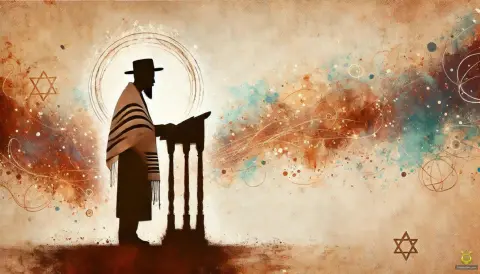
The Amidah prayer contains 18 blessings (and 1 that was added later). The bows during the central Jewish prayer "Amidah" (standing) have profound significance.
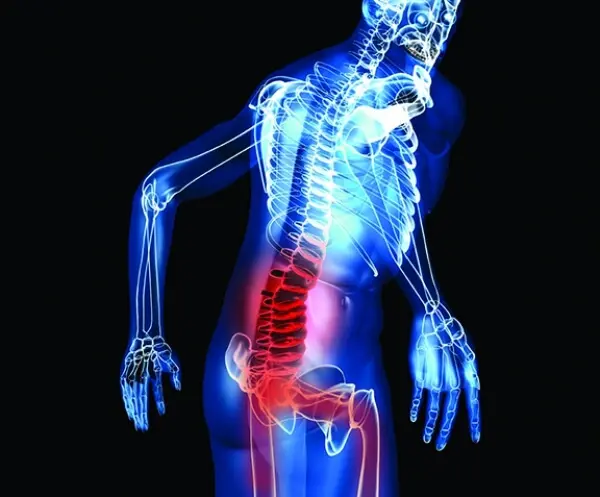
The Talmud states that the 18 original blessings of the Amidah correspond to the 18 vertebrae of the back and neck;
the 19th blessing, added later, corresponds to the coccyx, the small bone at the base of the spine.
The spine is the channel through which the energy received as a result of the Amidah prayer spreads.
During the Amidah, a person must bow, unlike in Eastern meditations involving the movement of energy along the spine (the so-called kundalini meditations), in which the spine remains completely straight.
This difference is highly significant: in Eastern "kundalini meditations," one seeks to raise energy from the base of the spine to the head, whereas in the Amidah prayer, a Jew does the opposite, spreading energy from the brain throughout the body.
The Talmud states that if someone does not bow during the blessing of thanksgiving, his spine will "turn into a snake."
Elsewhere, it is explained that the correspondence between the number of blessings and the number of vertebrae is meant to teach us that a person should bend so deeply when bowing that each vertebra is separated from its neighbor. The Talmud also teaches that one should bend straight "like a rod" and straighten up "like a snake"—raising the head first, followed by the torso.
18 and 1
A person has 7 cervical vertebrae, 12 thoracic vertebrae, 5 lumbar vertebrae, the sacrum (in which several vertebrae have fused into a single bone), and the coccyx.
Why, then, does the Talmud mention specifically “18 vertebrae”?
The cervical and thoracic vertebrae (together numbering 18 and 1—that is, 12 thoracic and 7 cervical vertebrae) are more mobile, and only they are associated with bowing. But we can also look at the matter more deeply. The structure of the spine contains a certain symmetry. From the thoracic vertebrae, both upward (12 thoracic and 7 cervical) and downward (12 thoracic, 5 lumbar, the sacrum, and the coccyx), there are exactly 18 and 1 vertebrae. In this structure of the spine, we can discern two intersecting systems—as though there were two spines, two aspects of the personality:
1) ascending toward the head,
2) descending downward (our Sages often call the reproductive organ rosh ha-gviyah—literally, the head of the body).
Such is the human personality—a intertwining of two forces: the spiritual (for example, the pursuit of justice, appreciation of beauty, conscience, and the desire to give charity) and the physical. The central lesson of Judaism is to devote both the spiritual and the physical to the service of the Almighty.
The holy book Zohar mentions that the resurrection of a person begins with the “luz” bone, which remains after a person’s death. It is usually identified with the uppermost vertebra. However, according to some Sages, it refers to the lowest vertebra—the coccyx.
We can explain this as follows: the soul can be returned to the body only through the connection it has retained with this world.
If no such connection remains, the soul ceases to exist as a separate entity and merges with the source of the souls of the entire Jewish people. A person leaves behind:
a) something physical—ideally, children; b) a spiritual legacy—students, ideas, and books.
This is the key to a person’s immortality, and it connects him to existence. The symbol of this connection is the “luz” bone, and it indeed has two possible manifestations: 1) in the part of the spine ascending toward the head; 2) facing the reproductive organs. (Rabbi U. Kalyuzhny)
Psalm 29 (the Name of Hashem appears 18 times, symbolizing Rachamim)
In Tehillim 29, the ineffable Name of Hashem is repeated 18 times.
This psalm is included in Kabbalat Shabbat as the psalm corresponding to the sixth day of the week.
It is recited standing, corresponding to the Amidah prayer.
Our Sages (of blessed memory) established the central prayer of our people, the "18 Blessings," following the structure of this psalm.
The Holy Zohar HaKadosh says that Psalm 29, "Sheva Kolot"—the seven voices—corresponds to the Kabbalistic prayer "Ana Bekoach," whose seven lines correspond to the seven sefirot.
"Ana Bekoach" is also included in Kabbalat Shabbat.
In Psalm 29, the Name of Hashem—Ad-nai—is repeated 18 times. This is a manifestation of Rachamim; 18 is "chai" (life). (Rabbi M. Glazerson)
Segulot for healing the spine:
- Pray the Amidah with kavanah while bowing;
- Read Psalm 29, focusing with kavanah on the Name of Hashem, which is repeated 18 times.