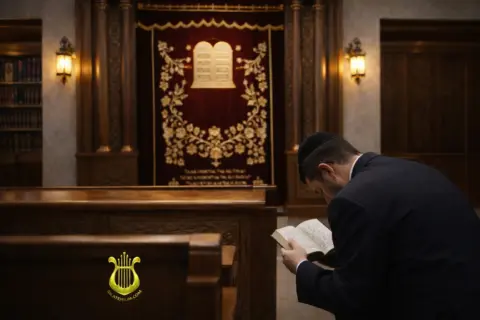
“Le-Shem Yichud Kudsha” — The Key to the Gates of Prayer
“Le-Shem Yichud Kudsha” — The Key to the Gates of Prayer
Before certain prayers and the performance of certain mitzvot, our Sages recommend reciting a kind of “declaration of intent” based on words from the holy Zohar. Each such “declaration” begins with the words:
“Le-Shem Yichud Kudsha Berich Hu u-Shechintei, bidchilu u-rechimu — u-rechimu u-dchilu, leyached Shem ‘Yud’ ve-‘Hei’ be-‘Vav’ ve-‘Hei’ be-yichuda shelim, be-Shem kol Yisrael, hine anachnu ba’im lesorer …” — which means:
“For the sake of uniting the Holy One, blessed be He, and His Shechinah, with awe and love, with love and awe; to reveal and hasten the manifestation in this world of the fulfillment of the Creator’s Will; for the sake of all the people of Israel, I am about to perform (the mitzvah, prayer, or other act being named).”
The Name of G-d consisting of four letters is mentioned — “Yud,” “Hei,” “Vav,” and “Hei.” It contains the “program” for the manifestation of His Will in all the worlds.
The first two letters — “Yud” and “Hei” — symbolize the setting of the goal and indicate the means of achieving it.
The third letter — “Vav” — represents the process of realization itself, while the fourth — “Hei” — represents the result: the fulfillment of the Creator’s Will.
Rabbi Elimelech of Lizhensk taught:
“Whenever you perform any act — whether you study Torah, recite a prayer, or fulfill a positive mitzvah — you should familiarize yourself with the following words, make them a habit, and recite them:
“Hareini oseh zot le-shem yichud Kudsha Berich Hu u-Shechintei, la’asot nachat ruach la-Borei, yitbarach Shemo” — (I am doing this in order to unite the Holy One, blessed be He, and His Shechinah, and to bring pleasure to the blessed Creator).
You should say this regularly and with great feeling, from the depths of your heart. After some time, you will experience a great spiritual awakening and inspiration when you recite it.”
Almost all siddurim include “Le-Shem Yichud Kudsha” before “Baruch She-amar,” the counting of the Omer, and the shaking of the lulav on Sukkot.
In Sephardic siddurim, it appears before the prayers “Shir HaShirim”, “Birkat HaMazon,” and others. It is especially appropriate to recite “Le-Shem Yichud Kudsha” before performing mitzvot that do not have a preliminary blessing.
Reciting “Le-Shem Yichud Kudsha” before performing a mitzvah is strongly encouraged by the Kabbalists. Kabbalah teaches that when a person performs a mitzvah after having recently committed even a minor transgression, it is as though he defiles the mitzvah with evil spirits. Reciting “Le-Shem Yichud Kudsha” removes this problem and ensures that the mitzvah will be performed with the proper intention and favorably accepted in Heaven.
(Or L’yisharim, cited in Minhag Yisrael Torah, OC 8:1; Rabbi Ari Enkin)
Was this helpful?
100% of readers found this article helpful (47 votes).
Please note: some articles on our site contain the holy Names of the Almighty. If you print these articles, they may not be thrown away or destroyed. Please handle printed copies with care and respect.
Tags: Prayer, L'Shem Yichud Kudsha, Rabbi Elimelech of Lizhensk, Gates of Prayer, “L'Shem Yichud Kudsha” – the Key to the Gate of Prayer, Key to the Gates of Prayer, How to Open the Gates of Prayer