10 Chapters of Tehillim Corresponding to the 10 Sefirot, According to Rabbi Naftali Ha-Kohen Katz
10 Chapters of Tehillim Corresponding to the 10 Sefirot, According to Rabbi Naftali Ha-Kohen Katz
Rabbi Naftali Ha-Kohen Katz was a descendant of the Maharal of Prague and a disciple of the great Polish Kabbalists Rabbi Neta Nathan Shapiro, the Shelah Ha-Kadosh, and Rabbi Shimshon of Ostropoli.
His knowledge of practical Kabbalah made him a renowned healer and miracle worker known throughout the Jewish world.
His amulets brought swift deliverance from troubles and aided the rapid healing of illnesses.
In addition to his major Kabbalistic works, he left behind many manuscripts containing unpublished prayers, tikkunim, and piyuttim.
Thus, thanks to Rabbi Yeshua Pinto, his famous “Tikkun Ha-Nefesh” was discovered and revived: 12 psalms arranged in a special order to rectify the level of the soul known as nefesh.
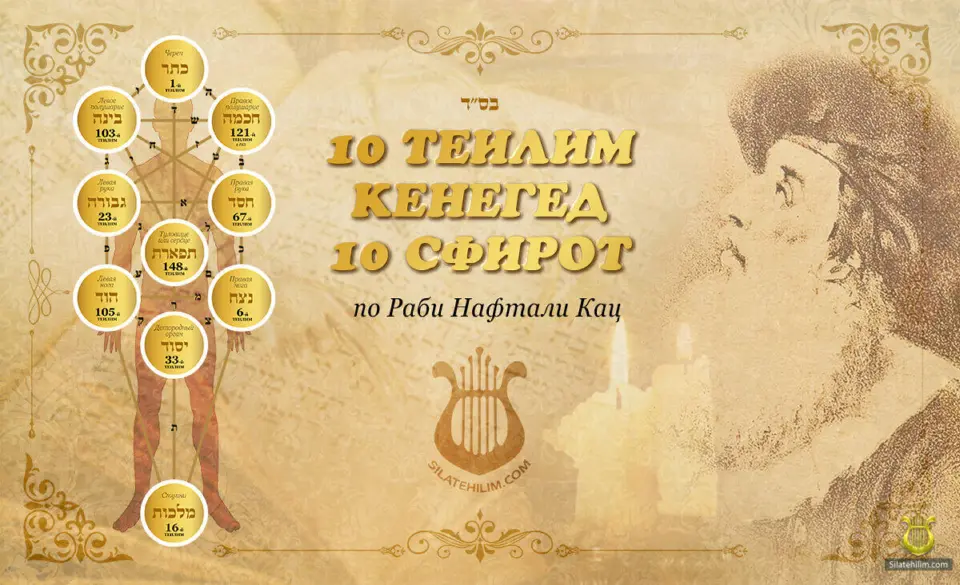
The same manuscripts contained a Kabbalistic recitation of selected chapters of Tehillim corresponding to the Tree of the Sefirot—10 chapters of Tehillim corresponding to the 10 Sefirot.
Rabbi Naftali instructed: “One who is meticulous regarding matters rooted in the hidden dimension of the Torah should recite these 10 mizmorim at least once a day with great kavanah. They are highly effective in all areas connected with holiness and possess special power during epidemics, disasters, and all forms of suffering, so that these should never affect us. One who recites these 10 psalms in this order will not be harmed by epidemics or troubles.”
It is stated in the Tikkunei Zohar (introduction): “You have revealed the ten attributes called the ‘ten Sefirot,’ and through them You govern the hidden and revealed worlds.”
By allowing the light of these 10 Sefirot, reflected in their corresponding psalms, to pass through him, a person builds a protective framework around himself.
It is also known from Eastern practices that when a person becomes ill, the cause should be sought in a blockage of one of the body’s chakras. This idea is derived from the teaching concerning the Sefirot. According to Kabbalah, the Divine Light descends into our world through the 10 Sefirot. Corresponding to the human body, the Divine Light descends successively through the crown of the head, which corresponds to the Sefirah of Keter, then passes through the Sefirah of Chochmah to the Sefirah of Binah, and so on through all the Sefirot down to the lowest—Malchut.
If a blockage occurs in any Sefirah, the light cannot proceed further, and the absence of light leads to problems in the body—illness.
Reciting Tehillim according to this pattern helps unblock the Sefirot and restore balance throughout the body.
It is also noteworthy that Rabbi Naftali Katz proposes this pattern for reciting Tehillim in connection with epidemics.
Today, when the entire world is gripped by an epidemic, the first thing doctors recommend is strengthening the immune system. The word “immunity” distinctly echoes the Hebrew word “emunah,” and it is quite possible that this is precisely what the great Rav Naftali Katz Ha-Kohen had in mind when composing this pattern of Tehillim recitation for protection from epidemics: to strengthen immunity, reinforce “emunah,” pass through all the Sefirot within one’s body, and thereby protect oneself, including from epidemics.
Tehillim Corresponding to the 10 Sefirot: 1, 121, 103, 67, 23, 148, 6, 105, 33, 17 (16).1. Psalm 1—corresponding to the Sefirah of Keter;
1. Ashrei ha-ish asher lo halach ba'atzat resha'im, u'vederech chata'im lo amad, u'vemoshav leitzim lo yashav.
2. Ki im b'Torat Ad-nai cheftzo, u'veTorato yehgeh yomam va-lailah.
3. V'hayah k'eitz shatul al palgei mayim, asher piryo yiten b'ito, v'alehu lo yibol, v'chol asher ya'aseh yatzliach.
4. Lo chen haresha'im, ki im kamotz asher tidfenu ruach.
5. Al ken lo yakumu resha'im ba-mishpat, v'chata'im ba'adat tzaddikim.
6. Ki yode'a Ad-nai derech tzaddikim, v'derech resha'im toved.
2. Psalm 121—corresponding to the Sefirah of Chochmah (6 times);
1. Shir la-ma'alot, esa einai el heharim, me'ayin yavo ezri.
2. Ezri me'im Ad-nai, oseh shamayim va'aretz.
3. Al yiten la-mot raglecha, al yanum shomrecha.
4. Hinei lo yanum v'lo yishan, shomer Yisrael.
5. Ad-nai shomrecha, Ad-nai tzilcha, al yad yeminecha.
6. Yomam ha-shemesh lo yakekah, v'yareach ba-lailah.
7. Ad-nai yishmarecha mi-kol ra, yishmor et nafshecha.
8. Ad-nai yishmor tzet'cha u'vo'echa, me'atah v'ad olam.
3. Psalm 103—corresponding to the Sefirah of Binah;
1. L'David, bar chi nafshi et Ad-nai, v'chol k'ravai et shem kodsho.
2. Barchi nafshi et Ad-nai, v'al tishkechi kol g'mulav.
3. Ha-sole'ach l'chol avonechi, ha-rofeh l'chol ta'alu'aychi.
4. Ha-go'el mi-shachat chayechi, ha-me'atrechi chesed v'rachamim.
5. Ha-masbia ba-tov edyech, tit-chadesh ka-nesher ne'uraychi.
6. Oseh tz'dakot Ad-nai, u-mishpatim l'chol ashuqim.
7. Yodia derachav l'Moshe, livnei Yisrael alilotav.
8. Rachum v'chanun Ad-nai, erech apayim v'rav chesed.
9. Lo la-netzach yariv, v'lo l'olam yitor.
10. Lo cha-chata'einu asah lanu, v'lo cha-avonoteinu gamal aleinu.
11. Ki chi-gvoah shamayim al ha-aretz, gavar chasdo al y're'av.
12. Ki-rchok mizrach mi-ma'arav, hirchik mi-menu et p'sha'einu.
13. K'racham av al banim, richam Ad-nai al y're'av.
14. Ki hu yada yitzrenu, zachur ki afar anachnu.
15. Enosh k'chatzir yamav, k'tzitz ha-sadeh ken yatzitz.
16. Ki ruach avrah bo v'einenu, v'lo yakirenu od m'komo.
17. V'chesed Ad-nai me'olam v'ad olam al y're'av, v'tzidkato livnei vanim.
18. L'shomrei vrito, u'l'zochrei pikudav la'asotam.
19. Ad-nai ba-shamayim hechin kis'o, u'malchuto ba-kol mashalah.
20. Barchu Ad-nai malachav, giborei cho'ach, osei d'varo, lishmo'a b'kol d'varo.
21. Barchu Ad-nai kol tz'va'av, m'shartav osei r'tzono.
22. Barchu Ad-nai kol ma'asav b'chol m'komot memshalto, barchi nafshi et Ad-nai.
4. Psalm 67—corresponding to the Sefirah of Chesed;
La-menatze'ach bin'ginot mizmor shir.
Elohim yechonneinu vivarcheinu, ya'er panav itanu selah.
Lada'at ba-aretz darkecha, b'chol goyim yeshu'atecha.
Yoducha amim Elohim, yoducha amim kulam.
Yismechu v'yiranenu l'umim, ki tishpot amim mishor, u'l'umim ba-aretz tanchem selah.
Yoducha amim Elohim, yoducha amim kulam.
Eretz natnah y'vulah, y'varecheinu Elohim Eloheinu.
Y'varecheinu Elohim, v'yiru oto kol afsei aretz.
5. Psalm 23—corresponding to the Sefirah of Gevurah;
1. Mizmor l'David, Ad-nai ro'i lo echsar.
2. Bin'ot deshe yarbitzeni, al mei m'nuchot y'nahaleni.
3. Nafshi y'shovev, yancheini v'ma'aglei tzedek l'ma'an sh'mo.
4. Gam ki elech b'gei tzalmavet, lo ira ra, ki atah imadi, shiv'techa u'mish'ant'cha hemah y'nachamuni.
5. Ta'aroch l'fanai shulchan neged tzorerai, dishanta va-shemen roshi, kosi r'vayah.
6. Ach tov va-chesed yird'funi kol y'mei chayai, v'shavti b'veit Ad-nai l'orech yamim.
6. Psalm 148—corresponding to the Sefirah of Tiferet;
1. Halleluyah, hallelu et Ad-nai min ha-shamayim, halleluhu ba-m'romim.
2. Halleluhu kol malachav, halleluhu kol tz'va'av.
3. Halleluhu shemesh v'yareach, halleluhu kol kochvei or.
4. Halleluhu sh'mei ha-shamayim, v'ha-mayim asher me'al ha-shamayim.
5. Y'halelu et shem Ad-nai, ki hu tzivah v'nivra'u.
6. Va-ya'amidem la-ad l'olam, chok natan v'lo ya'avor.
7. Halleluhu et Ad-nai min ha-aretz, taninim v'chol t'homot.
8. Esh u'varad, sheleg v'kitor, ruach s'arah osah d'varo.
9. Heharim v'chol g'va'ot, etz p'ri v'chol arazim.
10. Ha-chayah v'chol b'hemah, remes v'tzipor kanaf.
11. Malchei eretz v'chol l'umim, sarim v'chol shoftei aretz.
12. Bachurim v'gam b'tulot, z'keinim im n'arim.
13. Y'halelu et shem Ad-nai, ki nisgav sh'mo l'vado, hodo al eretz v'shamayim.
14. Va-yarem keren l'amo, t'hilah l'chol chasidav, livnei Yisrael am k'rovo, halleluyah.
7. Psalm 6—corresponding to the Sefirah of Netzach;
1. La-menatze'ach bin'ginot al ha-sh'minit, mizmor l'David.
2. Ad-nai, al b'apecha tochicheni, v'al ba-chamatcha t'yasreni.
3. Chonneini Ad-nai, ki umlal ani; r'faeini Ad-nai, ki nivhalu atzamai.
4. V'nafshi nivhalah m'od, v'atah Ad-nai, ad matai.
5. Shuvah Ad-nai, chal'tzah nafshi, hoshi'eini l'ma'an chasdecha.
6. Ki ein ba-mavet zichrecha, bi-sh'ol mi yodeh lach.
7. Yagati b'an'chati, ascheh v'chol lailah mitati b'dim'ati, arsi amseh.
8. Ash'shah mi-ka'as eini, atkah b'chol tzorerai.
9. Suru mimeni kol po'alei aven, ki shama Ad-nai kol bich'i.
10. Shama Ad-nai t'chinati, Ad-nai t'filati yikach.
11. Yevoshu v'yibahalu m'od kol oyvai, yashuvu yevoshu raga.
8. Psalm 105—corresponding to the Sefirah of Hod;
1. Hodu la-Ad-nai, kir'u vi-shmo, hodi'u va-amim alilotav.
2. Shiru lo, zamru lo, sichu b'chol nifl'otav.
3. Hit'hall'lu b'shem kodsho, yismach lev m'vakshei Ad-nai.
4. Dirshu Ad-nai v'uzo, bakshu fanav tamid.
5. Zichru nifl'otav asher asah, moftav u'mishp'tei fiv.
6. Zera Avraham avdo, b'nei Yaakov b'chirav.
7. Hu Ad-nai Eloheinu, b'chol ha-aretz mishpatav.
8. Zachar l'olam b'rito, davar tzivah l'elef dor.
9. Asher karat et Avraham, u'shvu'ato l'Yitzchak.
10. Va-ya'amideha l'Yaakov l'chok, l'Yisrael b'rit olam.
11. Lemor, l'cha eten et eretz K'na'an, chevel nachalatchem.
12. Bi'h'yotam m'tei mispar, kim'at v'garim bah.
13. Va-yit'hall'chu mi-goy el goy, mi-mamlachah el am acher.
14. Lo hiniach adam l'ashkam, va-yochach aleihem m'lachim.
15. Al tig'u vi-m'shichai, v'linviai al tare'u.
16. Va-yikra ra'av al ha-aretz, kol mateh lechem shavar.
17. Shalach lifneihem ish, l'eved nimkar Yosef.
18. Innu va-kevel raglo, barzel ba nafsho.
19. Ad et bo d'varo, imrat Ad-nai tz'rafat'hu.
20. Shalach melech va-yatirehu, moshel amim va-yefat'chehu.
21. Samo adon l'veito, u'moshel b'chol kinyano.
22. Le'sor sarav b'nafsho, u'z'keinav y'chakem.
23. Va-yavo Yisrael Mitzrayimah, v'Yaakov gar b'eretz Cham.
24. Va-yefar et amo m'od, va-ya'atzimehu mi-tzarav.
25. Hafach libam lisno amo, l'hit'nakel ba-avadav.
26. Shalach Moshe avdo, Aharon asher bachar bo.
27. Samu vam divrei ototav, u'moftim b'eretz Cham.
28. Shalach choshech va-yachshich, v'lo maru et d'varo.
29. Hafach et meimeihem l'dam, va-yamet et d'gatham.
30. Sharatz artzam tz'far'de'im, b'chadrei malcheihem.
31. Amar va-yavo arov, kinim b'chol g'vulam.
32. Natan gishmeihem barad, esh l'havot b'artzam.
33. Va-yach gafnam u-t'einatam, va-yishaber etz g'vulam.
34. Amar va-yavo arbeh, v'yelek, v'ein mispar.
35. Va-yochal kol esev b'artzam, va-yochal p'ri admทatam.
36. Va-yach kol b'chor b'artzam, reishit l'chol onam.
37. Va-yotzi'em b'chesef u-v'zahav, v'ein bi-shvatav koshel.
38. Samach Mitzrayim b'tzeitam, ki nafal pachdam aleihem.
39. Paras anan l'masach, v'esh l'ha'ir lailah.
40. Sha'al va-yave slav, v'lechem shamayim yasbi'em.
41. Patַח צור, va-yazuvu mayim, halchu ba-tziot nahar.
42. Ki zachar et d'var kodsho, et Avraham avdo.
43. Va-yotzi amo v'sason, b'rinah et b'chirav.
44. Va-yiten lahem artzot goyim, va-amal l'umim yirasu.
45. Ba'avur yishm'ru chukav, v'torotav yintzoru, halleluyah.
9. Psalm 33—corresponding to the Sefirah of Yesod;
1. Ran'nu tzaddikim ba-Ad-nai, la-yesharim navah t'hilah.
2. Hodu la-Ad-nai b'chinor, b'nevel asor zamru lo.
3. Shiru lo shir chadash, heitivu nagen bitruah.
4. Ki yashar d'var Ad-nai, v'chol ma'asehu be'emunah.
5. Ohev tzedakah u'mishpat, chesed Ad-nai male'ah ha-aretz.
6. Bi-dvar Ad-nai shamayim na'asu, u'v'ruach piv kol tz'va'am.
7. Kones ka-ned mei ha-yam, noten b'otzarot t'homot.
8. Yir'u me-Ad-nai kol ha-aretz, mi-menu yaguru kol yoshvei tevel.
9. Ki hu amar va-yehi, hu tzivah va-ya'amod.
10. Ad-nai hefir atzat goyim, heni machsh'vot amim.
11. Atzat Ad-nai l'olam ta'amod, machsh'vot libo l'dor va-dor.
12. Ashrei ha-goy asher Ad-nai Elohav, ha-am bachar l'nachalah lo.
13. Mi-shamayim hibit Ad-nai, ra'ah et kol b'nei ha-adam.
14. Mi-m'chon shivto hishgiach el kol yoshvei ha-aretz.
15. Ha-yotzer yachad libam, ha-meivin el kol ma'aseihem.
16. Ein ha-melech nosha b'rov chayil, gibor lo yinatzel b'rov ko'ach.
17. Sheker ha-sus li-shu'ah, u-v'rov cheilo lo y'malet.
18. Hinei ein Ad-nai el y're'av, la-meyachalim l'chasdo.
19. L'hatzil mi-mavet nafsham, u'l'chayotam ba-ra'av.
20. Nafsheinu chik'tah la-Ad-nai, ezreinu u'magineinu hu.
21. Ki vo yismach libeinu, ki v'shem kodsho batachnu.
22. Y'hi chasdecha Ad-nai aleinu, ka'asher yichalnu lach.
10. Psalm 16—corresponding to the Sefirah of Malchut (according to another nusach, Psalm 17—corresponding to the Sefirah of Malchut)
1. Michtam l'David, shomreini El, ki chasiti vach.
2. Amarti la-Ad-nai, Adonai atah, tovati bal alecha.
3. Likdoshim asher ba-aretz hemah, v'adirei kol cheftzi vam.
4. Yirbu atzvotam, achar maharu, bal asich nis'cheihem mi-dam, u'val esa et sh'motam al sfatai.
5. Ad-nai m'nat chelki v'chosi, atah tomeich g'orali.
6. Chavalim naflu li ba-ne'imim, af nachalat shafrah alai.
7. Avarech et Ad-nai asher ye'atzani, af leilot yisruni chil'yotai.
8. Shiviti Ad-nai l'negdi tamid, ki mi'mini bal emot.
9. Lachen same'ach libi va-yagel k'vodi, af b'sari yishkon la-vetach.
10. Ki lo ta'azov nafshi li-sh'ol, lo titen chasidecha lirot shachat.
11. Todi'eni orach chayim, sova s'machot et panecha, n'imot bi-minecha netzach.
(Sila Tehillim translation based on the book “Segulot &Tefilot memekorot kdoshot”)
Was this helpful?
94% of readers found this article helpful (105 votes).
Please note: some articles on our site contain the holy Names of the Almighty. If you print these articles, they may not be thrown away or destroyed. Please handle printed copies with care and respect.
Material from our site may be copied for the purpose of spreading Torah, provided a link to Silatehilim.com is included. Any use of the site's material in print publications or for commercial purposes is prohibited without the rights holder's consent.