The word “charoset” first appears in the Mishnah (Pesachim 10:3) and means “clay.”
There, the Sages explain that “charoset” is part of the Seder but is not obligatory, although Rabbi Elazar ben Tzadok disagrees and maintains that “charoset” is in fact part of the mitzvah of Pesach.
The Mekubalim teach that the word “charoset” consists of two words: חס “chas” (he pities, shows mercy) and רות Ruth.
Interestingly, among Mountain Jews, “charoset” is pronounced “chaserut”, clearly reflecting this division of the word.
On the seder plate, “charoset” corresponds to “Netzach” (eternity), while Ruth, in the merit of her modesty and righteousness, symbolizes the eternal Davidic dynasty until the coming of Mashiach, her descendant.
Rabbi Saadia Gaon, in his commentary on the Haggadah, notes that the head of the Seder “should prepare a sauce from dates, walnuts, and sesame, mix it together with wine, and this is called ‘chalik.’” The word “chalik” is still used by Iraqi Jewish communities today.
In the Talmud, the rabbis offer a number of explanations for “charoset”:
its texture—“in remembrance of the clay”, namely, the mud and straw from which the Israelite slaves made bricks;
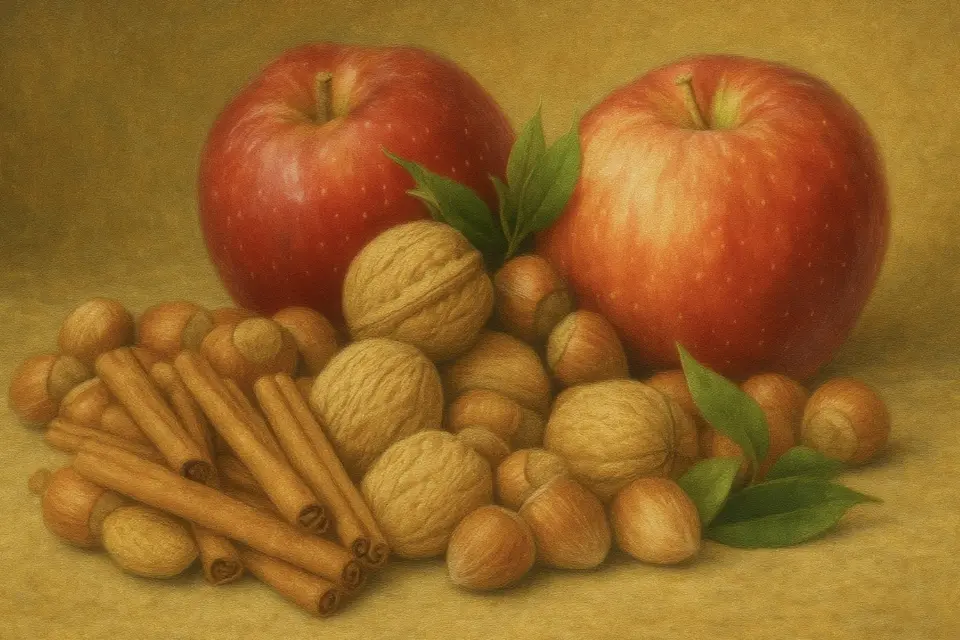
its taste—“in remembrance of the apple trees”, namely, the trees beneath which, according to the Midrash, the Jewish women enticed their husbands;
its color—“in remembrance of blood”—the blood of the Paschal sacrifice on the doorposts of the Israelites’ homes on the night before the Exodus, as well as the blood of the goat on Joseph’s garment after his brothers sold him, which ultimately led to the descent into Egypt.
However, there is another aspect.
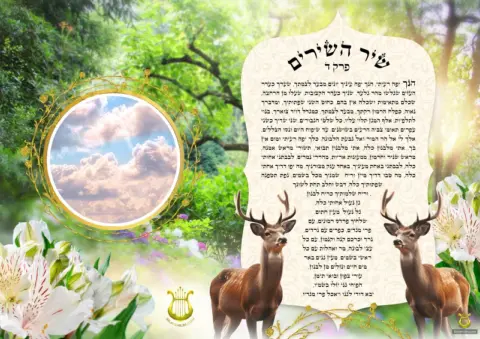
An ancient tradition states that on Shabbat during Pesach, Jews sing the Song of Songs. Most likely, this is what led to the development of two traditions: Sephardim read “Shir HaShirim” every erev Shabbat, while Ashkenazim read it only on Pesach.
Rabbeinu Chida teaches that there is an explanation for this: “The enslavement of the Jews began after the death of Levi; 117 years passed from Levi’s death until the Exodus of the Jews from Egypt. “Shir HaShirim” contains exactly 117 verses—it foretells the future redemption of our people.”
Rabbi Eliyahu HaKohen of Smyrna, in his “Midrash Talpiot”, based on the Zohar HaKadosh (Parashat “Noach”), calculated that the souls of sinners suffer in Gehinnom for 117 hours. The sefer “Shir HaShirim” was composed by Shlomo HaMelech with exactly 117 verses, corresponding to the 117 hours of suffering experienced by sinners in Gehinnom. Shlomo HaMelech wrote this book to atone for three sins he had committed by violating the Torah’s restrictions concerning the number of wives, wealth, and horses that a king may have. Each transgression is punished with 39 lashes, and 39 multiplied by 3 equals 117; therefore, he composed 117 pesukim of “Shir HaShirim”. This is why Sephardim read “Shir HaShirim” every Erev Shabbat.
Thus, at some point, another tradition also emerged among Sephardim: all the fruits mentioned in “Shir HaShirim” are included in the “charoset”, including apples (2:3), figs (2:13), nuts (6:11), dates (7:7), wine (1:2), and cinnamon (4:14).
“Shir HaShirim” is regarded by our Chazal as an allegorical “love story” between G-d and Israel, with the fruits used metaphorically in the text to describe this passionate love.
“Charoset” is a mixture of sour and sweet, crunchy and soft, simple and spicy—it symbolizes slavery and freedom, the bitterness of slavery and the terror of the long, dark night, yet still with hope for the Exodus.
(based on material from the websites: maimachoronim.com&dailyalacha.com)
Was this helpful?
100% of readers found this article helpful (43 votes).
Please note: some articles on our site contain the holy Names of the Almighty. If you print these articles, they may not be thrown away or destroyed. Please handle printed copies with care and respect.
Material from our site may be copied for the purpose of spreading Torah, provided a link to Silatehilim.com is included. Any use of the site's material in print publications or for commercial purposes is prohibited without the rights holder's consent.