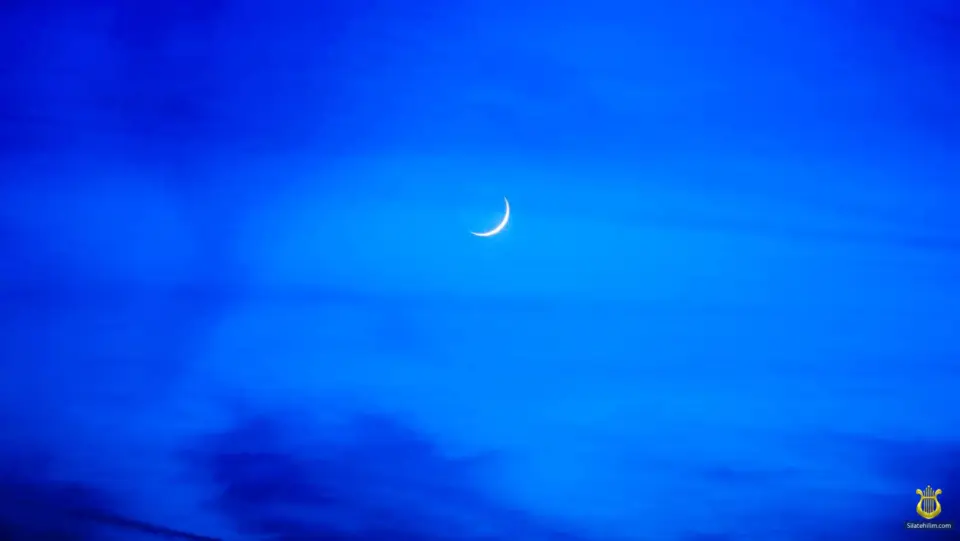
The Sages call this psalm a hymn praising the Almighty for the Creation of the world.It describes the creation of the world in sequence, from the first day through the seventh, while also explaining the significance of everything created for human beings.On Rosh Chodesh, it is customary to recite a passage from Tehillim 104 — “Bless the L-rd, O my soul,” in which we find the verse: “He made the moon to mark the times.”From this we learn that the phases of the moon were created not to influence people, as astrologers believe, but to mark the times ordained by the Almighty.This psalm speaks of G-d’s creation of the world, of His sovereignty, and of the fact that He is Master over all. Everything that exists in the material and spiritual worlds fulfills only His will and His word, as He established when He created them; and He has the power to change the nature of things as He wishes.King David begins and ends the psalm with the words:“Bless the L-rd, O my soul,” as if to say: The rational soul, to which the secret of creation has been revealed, should not thank and praise G-d’s servants, for nothing depends on their will. Even their own actions are carried out not by their own choice, but according to the nature implanted within them so that they may fulfill the will of the Creator. Therefore, the rational soul blesses the One by whose word the world was created.This psalm ends with the word:“Hallelujah!” — (Praise G-d), because it speaks of the downfall of the wicked, the enemies of the Almighty and of truth: “May sinners vanish from the earth, and may the wicked be no more. Bless the L-rd, O my soul! Praise the L-rd!”The Talmud (Berakhot 96) states: “David recited 130 chapters in the Book of Psalms and did not say Hallelujah until he saw the downfall of the wicked, for they destroy the world, as it is written (Mishlei 11:10): “When the wicked perish, there are joyful songs.”The blessing we recite over the new moon gives us an understanding that everything comes from the Almighty and that everything was created by His word, so that no one should think that any created being can do anything — good or bad — without the Creator’s command.That is why the Talmud says that one who blesses the new month is considered as though he has received the Divine Presence. At the conclusion of the blessing, we say: “Blessed are You Who renews the months,” to show that the blessing is directed to the One Who renews the moon.Until the full moon, while the moon is waxing, it is considered new, and the blessing over the new moon may be recited.(Rabbi Isaac Aboab, “Menorat HaMaor”)Tehillim 104 begins with the words: “Barechi nafshi ET Ado-nai.”The address “Barechi nafshi et Ado-nai” — (bless the Almighty) — refers to the angels who occupy the highest level of the Upper Chamber.But why do we, who are below, say: “Barechi… et Ado-nai”?The reason is that we are obligated to draw this level, “ET” (Malchut), toward ourselves, so that together with it we may come before the King (Zeir Anpin) and behold His Face.That is why David said: “I will behold Your Face through righteousness” — “righteousness” is a name for the sefirah of Malchut; therefore, through the power of this level, I will behold Your Face.Consequently, it is necessary to begin the prayer with the words: “Barechi et Ado-nai” — Bless the Almighty — in order to draw this level, “ET” (Malchut), upon our heads. Only afterward may we recite the prayer and praises.(The Zohar on Balak, translated by Tzvi Nisanzen)
Was this helpful?
100% of readers found this article helpful (74 votes).
Please note: some articles on our site contain the holy Names of the Almighty. If you print these articles, they may not be thrown away or destroyed. Please handle printed copies with care and respect.
Material from our site may be copied for the purpose of spreading Torah, provided a link to Silatehilim.com is included. Any use of the site's material in print publications or for commercial purposes is prohibited without the rights holder's consent.