Sefer Devarim on the Night of Hoshana Rabbah
Hoshana Rabbah is the 51st day from
Rosh Chodesh Elul—the beginning of Selichot according to the Sephardic minhag. It is important to remember that this was how the Arizal and most of the Mekubalim prayed.
These
51 days were given to Am Yisrael as an act of chesed—the gates of teshuvah, hinted at by the word
«נא» (“please”). The gematria of
«נא» is
51, and this is precisely why this day is called
«הושע נא»—(Hosha Na). On this day, the final seal is placed.
There are exactly
516 hours between the beginning of Rosh Hashanah and the end of Hoshana Rabbah. Moshe Rabbeinu prayed 515 prayers until Hashem stopped him—had Moshe recited the 516th prayer, Hashem would have forgiven him and would have been compelled to bring him into the Land of Israel.
Hoshana Rabbah is the
21st day from Rosh Hashanah—the Day of Judgment.
The light of Avraham Avinu shone after
20 generations of sinners. Hashem promised Avraham that his sons would be redeemed, if not immediately on Rosh Hashanah, then at least on the 21st day from the beginning of the Judgment—on Hoshana Rabbah. (“Mateh Moshe”)
Sefer Devarim on Hoshana Rabbah
Thirty-six
days before his death, Moshe Rabbeinu began writing
Sefer Devarim, which
King Yoshiyahu found
40 years before the destruction of the Temple.
What did Moshe Rabbeinu do?
He translated Sefer Devarim into 70 languages.
The Sages say:
“In the fortieth year, on the first day of the eleventh month, Moshe spoke to the Jews everything that the L-rd had commanded him to say.”
Before his death, Moshe Rabbeinu wrote
955 pesukim of Sefer Devarim in
70 languages.
He taught us that there are
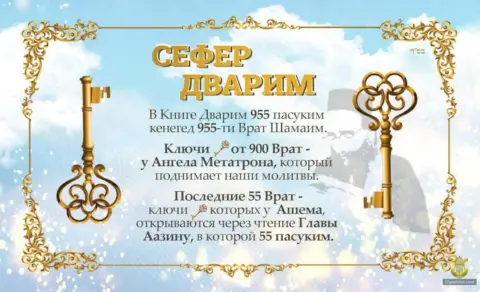
955 gates leading to the Heavenly Throne.
But there are also
955 keys to these gates, with which to open them.
900 of the
955 keys belong to the Archangel
Metatron.
This angel can raise our prayers only to the
900th gate.
The remaining
55 are under Hashem’s control.
When a person prays to the Creator, there are many barriers that prevent his prayers from reaching the Creator and passing through the
900th gate.
Each time a person sins, he adds another klipah to his soul, making it more difficult to connect with the Creator.
Sefer Devarim consists of
955 verses—corresponding to the
955 Gates of Prayer. Each verse opens one gate.
By the time a Jew has read all of Sefer Devarim, especially the final
55 verses, he is already standing before the King of all kings, and at that moment the Almighty blesses him with everything he needs, spiritually and physically.
Our Sages say that when a Jew reads Sefer Devarim, Moshe Rabbeinu stands beside him.
Moshe Rabbeinu knew that every Jew has a
“nitzotz”—a spark—in Sefer Devarim.
Sefer Devarim is a holy book, and when a Jew serves the Almighty in holiness, the spark of his soul draws closer to Sefer Devarim and to the Creator.
Sefer Devarim is the
fifth book, corresponding to the completion of the rectification of the world, which will take place before the Redemption.
When King Yoshiyahu found Sefer Devarim, he understood that the Redemption was drawing near, since Sefer Devarim symbolizes the end.
King Yoshiyahu then became frightened and hid the Ark of the Covenant of the Almighty. He understood that the world was approaching its end and that the Temple, too, would soon disappear.
Moshe Rabbeinu knew that if he departed this world without entering the Land of Israel, the complete rectification would not take place. The Temple—the Eternal Temple—would not be built.
The one that would be built would be destroyed and rebuilt, destroyed again and rebuilt again...
Moshe Rabbeinu knew that a Book was needed that would contain all the souls of the Jewish people.
And just as the Almighty took the Ten Utterances and,
“like a hammer shattering a rock,” divided them into 70 languages, so that the 70 languages would be subject to the Ten Utterances, Moshe Rabbeinu did the same—36 days before his death,
“like a hammer shattering a rock,” he explained the 955 pesukim in 70 languages for all the nations of the world.
So that in every place in the world there would be 955 levels in every language, and the message could be spread:
“Return, Israel, to the L-rd your G-d.”
We must know that there are two ways to draw closer to the Almighty and rectify the sparks of this world.
What are these sparks?
When Adam HaRishon sinned—when he ate from the Tree of Knowledge—he fragmented the good and scattered it throughout the world. And every person who leaves Israel for another country and recites the blessing,
“G-d, by whose word everything was created,” rectifies something.
Putting on tefillin rectifies something; performing a mitzvah rectifies something.
But if a person violates any mitzvah, he brings destruction into this world.
If the people of Israel follow the path of the Almighty, then G-d Himself will gather the sparks of holiness, and we will not have to wander throughout the world to collect them.
But when the Jewish people are not on a sufficiently high spiritual level, they are compelled to wander and gather the sparks of holiness.
One must travel to America, France, Morocco, and throughout the world, perform mitzvot there, establish yeshivot, strengthen Torah, and gather the sparks of holiness.
And when we gather all the sparks of holiness, we will rectify the world and establish the Kingdom of the Almighty.
This is why it is so important on the
Night of Hoshana Rabbah—the decisive night of judgment, when it is still possible to influence the final verdict—to read
Sefer Devarim, which contains the soul of every Jew, and thereby influence the rectification of the world.
It is very important to read all of Sefer Devarim before
Et Ratzon—the time of Heavenly Favor, when prayers are accepted without impediment and without intermediaries.
Sefer Devarim is read until Chatzot, during the Lel. After Chatzot, when the Layla begins, Sefer Tehillim is read together with Selichot.
To learn about the difference between Lel and Layla, read here:
A Night for Tikkunim — “Leil” or “Layla” According to “Zera Shimshon”
On this day, Jews wish one another:
“Pitka Tova”—a favorable verdict!
(Based on the lectures of Rabbi Yehoshua Pinto, “Sefer Devarim”; edited by the silatehilim.com website)
Please note: some articles on our site contain the holy Names of the Almighty. If you print these articles, they may not be thrown away or destroyed. Please handle printed copies with care and respect.