
The Secrets of Tehillim in Its First Line
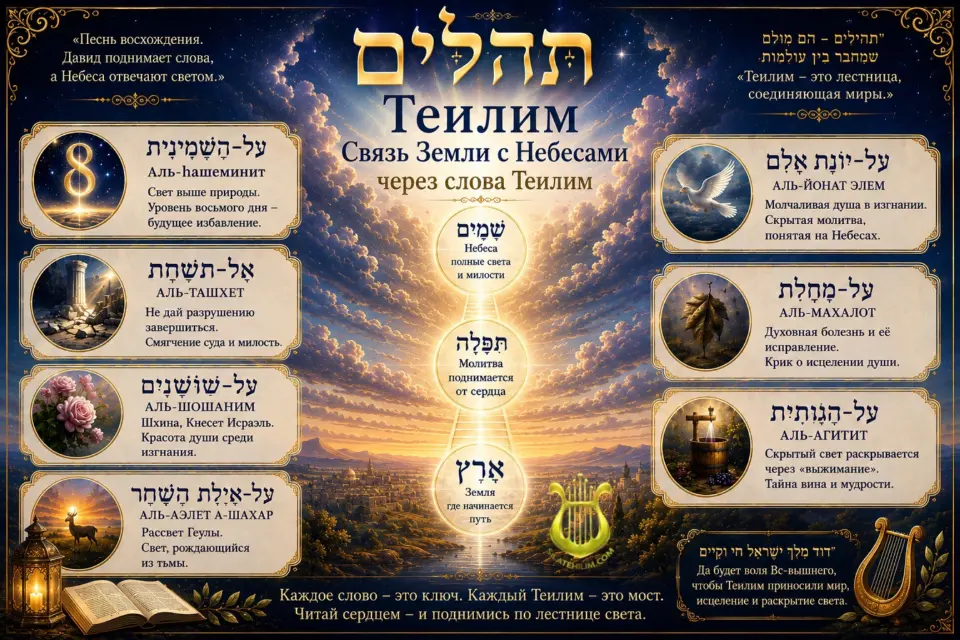
In Sefer Tehillim, we find chapters whose headings contain words beginning with the prefix “al”:- עַל־הַשְּׁמִינִית (al ha-sheminit)
- עַל־שׁוֹשַׁנִּים (al shoshanim)
- עַל־אַיֶּלֶת הַשַּׁחַר (al ayelet ha-shachar)
- עַל־יוֹנַת אֵלֶם (al yonat elem)
- עַל־מָחֲלַת (al machalat)
- עַל־הַגִּתִּית (al ha-gittit)
The Kabbalists explain that the heading indicates the spiritual level upon which the psalm is built.
For example:
- “Al ha-sheminit” — above the level of the eighth light,
- “Al shoshanim” — above the mystery of the Shechinah,
- “Al ayelet ha-shachar” — above the state of dawn preceding the Geulah.
In other words, this is the psalm’s spiritual platform.
The word following “al” then defines the entire meaning of the psalm. Sometimes these are the names of musical instruments, but overall, they are profound spiritual codes through which the power of the particular psalm is revealed. According to the Mekubalim, these code words allude to the spiritual sefirot, the state of the Shechinah, various manifestations of judgment and mercy, and specific channels of prayer. Let us examine these words.- Tehillim 45, 60, 69, 80 – “al shoshanim,” “shir yedidut” (a song of love);
Therefore, psalms with “al shoshanim” often speak:
- of the people of Israel among the nations,
- of the beauty of the soul,
- of salvation after suffering,
- of the revelation of mercy.
- between the Almighty and Israel,
- with the Temple,
- with the union of Zeir Anpin and Malchut.
The Kabbalists explain that this is connected with arousing the quality of mercy during judgment. In other words, the heading itself already says: “There is דין (judgment), but David HaMelech asks that this judgment not lead to destruction.” The entire psalm therefore unfolds the theme of salvation amid danger.
3. Tehillim 96, 98, 149 – “shir chadash” (a new song);The Kabbalists explain that the expression שִׁיר חָדָשׁ — “shir chadash” (“a new song”) alludes to:
- a new revelation of the Divine light,
- the rectification of the world,
- the song of the future Redemption. They reveal that all previous salvations were temporary, whereas the future Geulah will be eternal. Therefore, in the future there will be not merely a “song,” but a “new song,” because a new light will be revealed—the likes of which have never before existed in the world.
In Aramaic and in the language of the Zohar HaKadosh, the root דת is associated with the concept of strict judgment, דין, and the issuing of a verdict—a person appears to be standing before the Heavenly Court. David HaMelech therefore composed three psalms capable of effecting “hamtakat dinim” (sweetening the judgments).
5. Tehillim 81, 84, 8 – “al ha-gittit” According to the peshat, “gittit” is a musical instrument, but in Kabbalah it is understood much more deeply. The word גת “gat” refers to a place where grapes are pressed to produce wine. Wine symbolizes hidden inner wisdom, as it is said: נכנס יין — יצא סוד (wine enters—mystery emerges). Just as wine is produced by pressing grapes, so the soul reveals its light through trials. 6. Tehillim 71 – “al evosha” (from shame) The simple meaning of “al evosha” is connected with בושה (busha)—shame, disgrace, and spiritual decline. According to Kabbalah, “busha” (shame) arises only when one has become distanced from the light of the Almighty.The Kabbalists explain that the opposite of shame is “bitachon” (trust). Thus, “al evosha” is a plea that even through judgments and trials, the soul should not lose its connection to holiness.
7. Tehillim 70 – “lehazkir” (to remember)—at the end, “al te’achar” (do not delay) In Kabbalah, “zikaron” is not memory in the human sense. It is the awakening of attention Above. Despite the exile, we remember G-d. “Lehazkir” means to arouse mercy through spiritual remembrance. For the withholding of light is itself a judgment. A person feels distance and loneliness. Then the soul cries out: “Do not let me remain within this concealment.” A person awakens “zikaron” Above so that the light will not be held back in the worlds of judgment.The Arizal explains that brief psalms of outcry possess tremendous power, because they emerge from the depths of constriction, directly from the point of the soul’s pain.
8. Tehillim 61 – “al neginat” According to the peshat, “neginat” is connected with melody, a distinctive tune.But in Kabbalah, the word נְגִינָה / נְגִינוֹת has a profound meaning.
The Kabbalists explain: music is a form of the movement of light between the worlds. Just as there is prayer through words, there is also “negינה”—the inner sound of the soul, which cannot be fully expressed in words. David HaMelech transformed his suffering into nigunim—his pain did not disappear, but ascended through song Above.
Therefore, psalms with “al neginat” help the soul attain harmony, soothe pain, and become a channel for the soul’s ascent.
9. Tehillim 56 – “al Yonat” – (the silent dove)This is one of the deepest headings in Tehillim, and the Kabbalists devote tremendous attention to it. “Yonah” (dove) in Kabbalah and the Midrash almost always symbolizes Knesset Yisrael, the Shechinah.
Sometimes the highest form of prayer is precisely silence. When a person is silent, yet the heart remains connected to the Almighty, there arises “yonat elem” (the soul’s silent cry)—when a person can no longer express the pain in words, but the heart remains connected to the Almighty.The Kabbalists see the connection between the dove and Israel as follows: the dove does not defend itself with claws or teeth like other birds—its strength lies in faithfulness and return. Israel, too, endures not through force, but through its connection to the Almighty.
10. Tehillim 53 – “al machalat” (from illnesses) According to the peshat, “machalat” is the name of a melody or musical instrument. In Kabbalah, however, it refers to an illness of the soul, a spiritual breakdown. An intriguing connection lies in the shared root: מַחֲלָה “machalah” (illness) and מְחִילָה “mechilah” (forgiveness). The Mekubalim explain that through forgiveness and purification, illness can be transformed into rectification. 11. Tehillim 46 – “al alamot”According to the peshat, “alamot” is understood as a high musical register, or singing in “female voices,” from the word עַלְמָה “almah” (young woman).
In Kabbalah, however, the root of this word, ע־ל־ם , is connected with concealment. From it comes the word עולם — world, because in the world, Divinity is concealed, נעלם—hidden.
Therefore, the Kabbalists associate “alamot” with hidden worlds, hidden levels of the Shechinah, and the concealed governance of the Almighty. These are also the “hidden forces” through which the world is governed.
12. Tehillim 37 – “al titchar” (do not envy, do not compete) “Al titchar” means not merely “do not envy,” but “do not allow the inner fire to take hold of your soul.” The Kabbalists explain that when a person observes and focuses on how successful the wicked are, he begins to nourish them with his attention, connects with the forces of judgment, and loses his inner peace. Envy of the wicked is a spiritual danger. “Al titchar” means not allowing evil to enter the heart, not turning someone else’s success into one’s own destruction, and not being consumed by comparison. Even amid the apparent injustice of the world, one must preserve the inner connection with the Almighty. 13. Tehillim 22 – “al ayelet ha-shachar” – (for the pre-dawn prayer) Ayelet HaShachar is associated with the Jewish people, who are compared to a hind at dawn, whose beauty resembles the dawn. “Ayelet” (hind) is a symbol of the delicacy of the soul and the Shechinah. “Shachar” (dawn) is not yet the full light—it is the end of night, but not yet day. Darkness still exists, but the light has already been born. This is a very high spiritual level.The Mekubalim say that the Geulah comes like the dawn—not all at once, but gradually. The darkest moment is not the middle of the night, but the instant before dawn, and at that time all judgments can be removed.
14. Tehillim 12, 6 – “al ha-sheminit” – (an eight-stringed instrument—8 transcends the natural order of things, for healing and redemption) “Sheminit” refers to an eight-stringed instrument. In Kabbalah, however, the number 8 שמונה has tremendous significance. Eight represents that which is above nature, above time, and above the ordinary order of the world. Therefore, the Mekubalim say that “sheminit” alludes to a light that comes from beyond natural reality. Salvation arrives not through the laws of nature, but through a light above nature—a miracle. An important Kabbalistic allusion is that a brit milah (circumcision) is performed on the eighth day because the covenant with the Almighty is above nature. 15. Tehillim 9 – “al mut laben” – (for the death of a son—David associates this song with the death of Goliath and prophesies the same concerning Amalek)This is one of the most enigmatic headings in Tehillim.
According to the peshat, this is the name of a melody. In Kabbalah, however, a deeper meaning is revealed. “Mut” (death) does not always mean physical death. Very often it means the cessation of the power of impurity, the destruction of the ego, and the disappearance of the forces of judgment. “Mut laben” means the death or destruction of judgment through the revelation of the white light, “laben,” the death of the power of the sitra achra.
16. Tehillim 5 – “el ha-nechilot” – (a swarm of bees, an instrument resembling the buzzing of bees).
According to the peshat, it is a musical instrument. In Kabbalah, however, a deeper meaning is revealed. The root of the word “ha-nechilot” comes from “nachal” (stream).The Kabbalists explain that prayer is a stream rising from below to Above, and simultaneously, a stream of light flowing from Above downward. “El ha-nechilot” is a reference to the spiritual channels of prayer.
On the other hand, “nechilah” is a swarm of bees. Bees produce honey, and in Kabbalah, honey is a symbol of transforming judgment into sweetness. Prayer likewise rises from pain but is transformed into mercy. The Mekubalim also interpret the swarm of bees as the multitude of spiritual forces joining together in a single voice of prayer.
(Compiled by the website from holy Jewish sources)