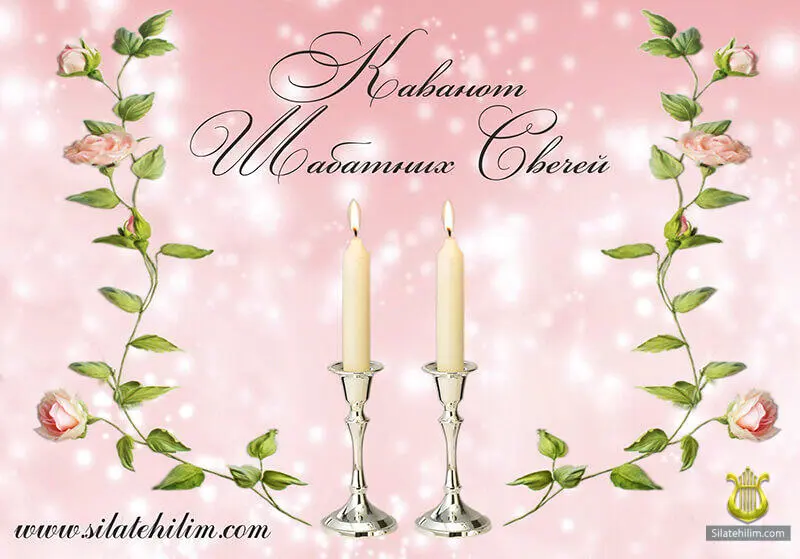
Shabbat Candle Lighting with Kavanot
Prayer before putting on Shabbat clothing:
כָּל כְּלִי יוּצַר עָלַיִךְ לֹא יִצְלָח וְכָל לָשׁוֹן תָּקוּם אִתָּךְ לַמִּשְׁפָּט תַּרְשִׁיעִי זֹאת נַחֲלַת עַבְדֵי יְה וְצִדְקָתָם מֵאִתִּי נְאֻם יְה:
“Kol kli yutzar alayich lo yitzlach vechol lashon takum itach lamishpat tarshii zot nachalat avdei Ha-Shem vetzidkatam me’iti neum Ha-Shem” —
(Any weapon fashioned against you will not succeed, and every tongue that rises against you in judgment you shall condemn. This is the heritage of the servants of G-d, and their righteousness is from Me, says G-d.)
Midrash Peliah (the wondrous Midrash) explains that the custom of reciting this pasuk specifically before putting on Shabbat clothing arose because Bilaam was unable to curse the Jewish people because they were wearing Shabbat clothing: “Any weapon fashioned against you will not succeed, and every tongue that rises against you in judgment you shall condemn.”
Candle lighting
[Shabbat candles are lit 18 minutes before sunset]
Sephardim recite the berachah first and only then light the candles; Ashkenazim light the candles and then recite the berachah.
בָּרוּךְ אַתָּה יְיָ אֱלֹהֵינוּ מֶלֶךְ הָעוֹלָם אֲשֶׁר קִדְּשָׁנוּ בְּמִצְוֹתָיו וְצִוָּנוּ לְהַדְלִיק נֵר שֶׁל שַׁבָּת
“Baruch atah, Ha-Shem, Eloheinu, Melech ha-olam, asher kidshanu bemitzvotav vetzivanu lehadlik ner shel Shabbat!”
(Blessed are You, G-d, our Lord, King of the universe, who has sanctified us with His commandments and commanded us to kindle the Shabbat lights.)
יהי רצון מלפניך ה' אלהינו ואלוהי אבותינו, שייבנה בית המקדש במהרה בימינו, ותן חלקינו בתורתך. ושם נעבדך ביראה כימי עולם וכשנים קדמוניות. וערבה לה' מנחת יהודה וירושלים כימי עולם וכשנים קדמוניות
“Yehi ratzon milfanecha, Ha-Shem Eloheinu v’Elohei avoteinu, sheyibaneh Beit Ha-Mikdash bimherah beyameinu, veten chelkeinu beToratecha. Vesham na’avdecha beyirah kimei olam uche-shanim kadmoniyot. Ve’arvah la-Ha-Shem minchat Yehudah viYerushalayim kimei olam uche-shanim kadmoniyot.”
(May it be Your will, G-d, our Lord and the G-d of our fathers, that the Temple be rebuilt speedily in our days. Grant us a portion in Your Torah, and there may we serve You with awe, as in days of old and former years. May the offering of Judah and Jerusalem be pleasing to G-d, as in days of old and former years.)
יְהִי רָצוֹן מִלְּפָנֶיךָ, יְיָ אֱלֹהַי אֱלֹהֵי יִשְׂרָאֵל, שֶׁתְּחוֹנֵן אוֹתִי וְאֶת אִישִׁי וְאֶת כֹּל קְרוֹבַי, וְתִתֶּן לָנוּ וּלְכָל יִשְׂרָאֵל חַיִּים טוֹבִים וַאֲרֻכִּים, וְתִזְכְּרֵנוּ בְּזִכְרוֹן טוֹבָה וּבְרָכָה, וְתִפְקְדֵנוּ בִּפְקֻדַּת יְשׁוּעָה וְרַחֲמִים, וְתַשְׁכֵּן שְׁכִינָתְךָ בֵּינֵינוּ, וְזַכֵּנוּ לְגַדֵּל בָּנִים וּבְנֵי בָנִים חֲכָמִים וּנְבוֹנִים אוֹהֲבֵי יְיָ, יִרְאֵי אֱלֹהִים, אַנְשֵׁי אֱמֶת זֶרַע קֹדֶשׁ, בַּיְיָ דְּבֵקִים וּמְאִירִים אֶת הָעוֹלָם בְּתּוֹרָה וּבְמַעֲשִׂים טוֹבִים וּבְכָל מְלֶאכֶת עֲבוֹדַת הַבּוֹרֵא. אָנָּא, שְׁמַע אֶת תְּחִנָּתִי בִּזְכוּת שָׂרָה וְרִבְקָה רָחֵל וְלֵאָה אִמּוֹתֵינוּ, וְהָאֵר נֵרֵנוּ שֶׁלֹּא יִכְבֶּה לְעוֹלָם וָעֶד, וְהָאֵר פָּנֶיךָ וְנִוָּשֵׁעָה אָמֵן
“Yehi ratzon milfanecha, Ha-Shem Elohai, Elohei Yisrael, shetechonen oti ve’et koli krovai, vetiten lanu ulechol Yisrael chayim tovim va’arukim, vetizkerenu bezichron tovah uverachah, vetifkedenu bifkudat yeshuah verachamim, vetashken Shechinatecha beineinu, vezakenu legadel banim uvene vanim chachamim unevonim ohavei Ha-Shem, yirei Elokim, anshei emet, zera kodesh, ba-Ha-Shem deveikim, ume’ir’im et ha-olam baTorah uvema’asim tovim uvechol melechet avodat ha-Borei. Ana, shema et techinati bizchut Sarah veRivkah, Rachel veLeah imoteinu, veha’er neireinu shelo yichbeh le’olam va’ed, veha’er panecha venivash’ah, amen.”
(May it be Your will, G-d, my Lord and the G-d of my fathers, that You show compassion to me, my husband, my sons, and all my relatives, and grant us and all Israel good and long life. Remember us favorably and with blessing, visit us with salvation and mercy, and cause Your Shechinah to dwell among us. Grant us the merit to raise wise and understanding children and grandchildren who love G-d and fear Him, people of truth, a holy seed, cleaving to G-d and illuminating the world through Torah, good deeds, and every form of service of the Creator. Please hear my supplication in the merit of Sarah, Rivkah, Rachel, and Leah, our mothers. Let the light of our candle shine so that it never goes out; shine upon us with the light of Your countenance, and we shall be saved. Amen.)
Prayers by the light of the candles
תפילת האשה על בעלה
יְהִי רָצוֹן מִלְּפָנֶיךָ ה' אֱלֹהֵינוּ וֵאלֹהֵי אֲבוֹתֵינוּ אֱלֹהֵי אַבְרָהָם, אֱלֹהֵי יִצְחָק וֵאלֹהֵי יַעֲקֹב, שֶׁתִּשְׁמוֹר וְתִנְצוֹר וְתִטֹּר אֶת בַּעֲלִי מִכָּל נֶזֶק וּמִכָּל רַע וּמִכָּל חֹלִי. וְתִתֵּן לוֹ חַיִּים טוֹבִים, חַיִּים אֲרוּכִים, חַיִּים שֶׁל עוֹשֶׁר וְכָבוֹד. וְתִתֵּן לָנוּ זֶרַע שֶׁל קַיָּמָא וּבָנִים הֲגוּנִים וְצַדִּיקִים, וְתִטַּע בֵּינֵינוּ תָּמִיד אַהֲבָה וְאַחְוָה, שָׁלוֹם וְרֵעוּת.
וְתִטַּע בְּלִבֵּנוּ אַהֲבָתְךָ וְיִרְאָתְךָ, לַעֲשׂוֹת רְצוֹנְךָ וּלְעָבְדְךָ בְּלֵבָב שָׁלֵם כִּיהוּדִים כְּשֵׁרִים. וְלַעֲשׂוֹת צְדָקָה וָחֶסֶד עִם עַמְּךָ יִשְׂרָאֵל. וּתְבָרֵך אֶת בַּעֲלִי בְּרָכָה שְׁלֵמָה בְּרֹב עוֹז וְשָׁלוֹם, כַּדָבָר שֶׁנֶּאֱמַר: " יְבָרֶכְךָ ה' וְיִשְׁמְרֶךָ. יָאֵר ה' פָּנָיו אֵלֶיךָ וִיחֻנֶּךָּ. יִשָּׂא ה' פָּנָיו אֵלֶיךָ וְיָשֵׂם לְךָ שָׁלוֹם". ונאמר: "ה' יִשְׁמְרֵהוּ וִיחַיֵּהוּ וְאֻשַּׁר בָּאָרֶץ", אָמֵן כֵּן יְהִי רָצוֹן.
(Sefer Techinot u-Vakashot)
Prayer for a husband's wellbeing by the Shabbat candles
“Yehi ratzon milfanecha, Ha-Shem Eloheinu, ve-Elohei avoteinu, Elohei Avraham, Elohei Yitzchak ve-Elohei Yaakov, shetishmor vetin’tzor vetitor tamid et ba’ali mikol nezek, umikol ra, umikol choli. Vetiten lo chayim tovim, chayim arukim, chayim shel osher vechavod.
Vetiten lanu zera shel kayama uvanim hagunim vetzadikim, vetita beineinu tamid ahavah ve’achvah, shalom vere’ut, vetita belibeinu ahavatecha veyir’atecha, la’asot retzonecha ul’ovdecha belevav shalem kiYehudim kesherim. Vela’asot tzedakah vachesed im amcha Yisrael, utevarech et ba’ali berachah shelemah berov oz v’shalom, kadavar shene’emar: ‘Yevarechecha Ha-Shem veyishmerecha. Ya’er Ha-Shem panav elecha vichuneka. Yisa Ha-Shem panav elecha veyasem lecha shalom.’ Vene’emar: ‘Ha-Shem yishmerehu vichayehu ve’ushar ba’aretz.’ Amen, ken yehi ratzon.”
Translation
(May it be Your will, G-d, our Lord and the G-d of our fathers, the G-d of Avraham, the G-d of Yitzchak, and the G-d of Yaakov, that You always protect, guard, and preserve my husband from every harm, evil, and illness. Grant him a good and long life, with prosperity and honor. Give us lasting offspring and worthy, righteous children. Plant constant love, brotherhood, peace, and friendship among us. Plant in our hearts love and fear of You, so that we may fulfill Your will and serve You wholeheartedly as upright Jews, doing justice and kindness with Your people Israel. Bless my husband with a complete blessing of strength and peace, as it is said: ‘May G-d make you like Ephraim and Menashe. May G-d bless you and protect you. May G-d shine His face upon you and grant you grace. May G-d turn His face toward you and grant you peace.’ And it is said: ‘May G-d protect him and preserve him alive; may he be happy in the land.’ Amen; so may it be Your will.)
תפילה לגידול בנים
ריבון כל העולמים, רם על רמים, שמע תפלת באי עדיך, לבקש רחמיך וחסדיך. תזכני ברוב .חמלתך לגדל בני לעבודתך, בנחת ולא בצער ולא יבושו, כי-ידברו את-אויבים בשער. ויהיו ממלאים ומזרזים בתורה. ויתפרנסו מתחת ידך בנקיות ובשפי. ולא ימצא בהם שמץ דופי. ועינינו רואות בשמחתם, בתורתם ובהצלחתם. יהיו לרצון אמרי-פי, בעד עוללי וטפי. ויחשב לפניך כהקרבת פר, בזכות ישני אדמת עפר. והגיון לבי לפניך, ה' צורי וגאלי. אמן
Prayer for children before the Shabbat candles
“Ribono shel Olamim, ram al ramim, shema tefilat ba’ei adecha, levakesh rachamecha vachasadeycha. Tezakeni berov chemlatecha, legadel banai la’avodatecha, benachat velo vetza’ar. Velo yevoshu, ki yedabru et oyevim bashaar. Veyihyu memulachim umezorazim baTorah. Veyitparnesu mitachat yadecha binekiyut uveshofi, velo yimatzei vahem shemetz dofi. Ve’eineinu ro’ot besimchatam, beToratam uvehatzlachatam. Yihyu leratzon imrei fi, be’ad olalai vetapai. Veyechashev lefanecha keha’akravah par, bizchut yeshenei admat afar. Vehegyon libi lefanecha, Ha-Shem tzuri vego’ali. Amen.”
(Lord of all worlds, exalted above the exalted! Hear the prayer of those who turn to You, seeking Your mercy and kindness. In Your abundant compassion, grant me the merit of raising my children for Your service, peacefully and without suffering. May they not be put to shame when they encounter their enemies, and may they be diligent and accomplished in Torah. May they earn their livelihood from Your hand with honesty and ease, without the slightest blemish. May our eyes see their joy, their Torah, and their success. May the words of my mouth concerning my children be acceptable before You, as though they were the offering of a bull, in the merit of the righteous who sleep in the dust of the earth; and may the meditation of my heart be acceptable before You, G-d, my Rock and Redeemer. Amen.)
Channah’s Prayer
In Uman, at the kever of Rabbi Nachman of Breslov, one can find a booklet in which the tzadik recommended that Jewish women pray at length by the lit Shabbat candles: “Cry, my daughter, and ask the Blessed One for everything, for this is the best time for you to speak with the Creator. Recite Channah’s prayer, for it contains all the foundations of Jewish prayer.”
Channah’s prayer is a very powerful segula for children—not only for women struggling with infertility—by the Shabbat candles. At the end, we ask Ha-Shem to hear our prayer for children just as Ha-Kadosh Baruch Hu heard Channah’s prayer. (Based on the booklet “The Teachings of Rabbi Nachman of Breslov.”)
תפילת חנה
וַתִּתְפַּלֵּל חַנָּה וַתֹּאמַר עָלַץ לִבִּי בַּיְהֹוָה, רָמָה קַרְנִי בַּיְהֹוָה רָחַב פִּי עַל אוֹיְבַי – כִּי שָׂמַחְתִּי בִּישׁוּעָתֶךָ. אֵין קָדוֹשׁ כַּיְהֹוָה כִּי אֵין בִּלְתֶּךָ, וְאֵין צוּר כֵּאלֹהֵינוּ. אַל תַּרְבּוּ תְדַבְּרוּ גְּבֹהָה גְבֹהָה יֵצֵא עָתָק מִפִּיכֶם, כִּי אֵל דֵּעוֹת יְהֹוָה וְלוֹ נִתְכְּנוּ עֲלִלוֹת. קֶשֶׁת גִּבֹּרִים חַתִּים, וְנִכְשָׁלִים אָזְרוּ חָיִל. שְׂבֵעִים בַּלֶּחֶם נִשְׂכָּרוּ וּרְעֵבִים חָדֵלּוּ, עַד עֲקָרָה יָלְדָה שִׁבְעָה וְרַבַּת בָּנִים אֻמְלָלָה. יְהֹוָה מֵמִית וּמְחַיֶּה מוֹרִיד שְׁאוֹל וַיָּעַל. יְהֹוָה מוֹרִישׁ וּמַעֲשִׁיר מַשְׁפִּיל אַף מְרוֹמֵם. מֵקִים מֵעָפָר דָּל מֵאַשְׁפֹּת יָרִים אֶבְיוֹן, לְהוֹשִׁיב עִם נְדִיבִים וְכִסֵּא כָבוֹד יַנְחִלֵם, כִּי לַיְהֹוָה מְצֻקֵי אֶרֶץ וַיָּשֶׁת עֲלֵיהֶם תֵּבֵל. רַגְלֵי חֲסִידָיו יִשְׁמֹר, וּרְשָׁעִים בַּחֹשֶׁךְ יִדָּמּוּ, כִּי לֹא בְכֹחַ יִגְבַּר אִישׁ. יְהֹוָה יֵחַתּוּ מְרִיבָיו עָלָיו בַּשָּׁמַיִם יַרְעֵם, יְהֹוָה יָדִין אַפְסֵי אָרֶץ, וְיִתֶּן עֹז לְמַלְכּוֹ וְיָרֵם קֶרֶן מְשִׁיחוֹ.
לאחר תפילת חנה נוהגים להוסיף:
ריבונו של עולם, כשם ששמעתה לחנה בתפילתה, כן תשמע ותענה לתפילתי.
(ובשחרית מוסיפים:)
אָתוֹהִי כְּמָה רַבְרְבִין, וְתִמְהוֹהִי כְּמָה תַקִּיפִין, מַלְכוּתֵהּ מַלְכוּת עָלַם, וְשָׁלְטָנֵהּ עִם דָּר וְדָר.
וַאֲנַחְנוּ עַמְּךָ וְצֹאן מַרְעִיתֶךָ, נוֹדֶה לְּךָ לְעוֹלָם לְדֹר וָדֹר נְסַפֵּר תְּהִלָּתֶךָ.
עֶרֶב וָבֹקֶר וְצָהֳרַיִם אָשִׂיחָה וְאֶהֱמֶה וַיִּשְׁמַע קוֹלִי.
בְּרָן יַחַד כּוֹכְבֵי בֹקֶר וַיָּרִיעוּ כָּל בְּנֵי אֱלֹהִים.
לֹא אִירָא מֵרִבְבוֹת עָם אֲשֶׁר סָבִיב שָׁתוּ עָלָי.
וַאֲנִי בַּה' אֲצַפֶּה אוֹחִילָה לֵאלֹהֵי יִשְׁעִי יִשְׁמָעֵנִי אֱלֹהָי.
אַל תִּשְׂמְחִי אֹיַבְתִּי לִי, כִּי נָפַלְתִּי קָמְתִּי, כִּי אֵשֵׁב בַּחֹשֶׁךְ ה' אוֹר לִי.
(אין אומרים פסוק זה בשבת)
כִּי לְךָ יְהֹוָה הוֹחָלְתִּי אַתָּה תַעֲנֶה אֲדֹנָי אֱלֹהָי.
רַגְלִי עָמְדָה בְמִישׁוֹר בְּמַקְהֵלִים אֲבָרֵךְ יְהֹוָה.
“Vatitpalel Channah vatomar, alatz libi ba-Ha-Shem, ramah karni ba-Ha-Shem, rachav pi al oyevai, ki samachti bishu’atecha. Ein kadosh ka-Ha-Shem ki ein biltecha, ve’ein tzur k’Eloheinu. Al tarbu tedaberu gevohah gevohah, yetzei atak mipichem, ki E-l de’ot Ha-Shem, velo nitkenu alilot.
Keshet giborim chatim, venichshalim azru chayil. Seve’im balachem nischaru, ure’evim chadelu, ad akarah yaldah shiv’ah, verabat banim umlalah.
Ha-Shem memit umechayeh, morid Sheol vaya’al.
Ha-Shem morish uma’ashir, mashpil af meromem.
Mekim me’afar dal, me’ashpot yarim evyon, lehoshiv im nedivim, vechisei chavod yanchilem, ki la-Ha-Shem metzukei aretz, vayashet aleihem tevel; raglei chasidav yishmor, uresha’im bachoshech yidamu, ki lo vecho’ach yigbar ish.
Ha-Shem yechatu merivav; alav bashamayim yarem, Ha-Shem yadin afsei aretz, veyiten oz lemalco, veyarem keren meshicho.
Atahi kema ravrevin vetimhohi kema takifin, malchuteh malchut alam vesholtaneh im dar vedar. Va’anachnu amcha vetzon mar’itecha, nodeh lecha le’olam, ledor vador nesaper tehilatecha. Erev vavoker vetzohorayim asichah ve’ehemah, vayishma koli. Beran yachad kochvei voker, veyariu kol benei Elokim. Lo ira merivvot am asher saviv shatu alai. Va’ani ba-Ha-Shem atzapeh, ochilah l’Elohei yishi, yishma’eni Elohai. Ki lecha Ha-Shem hochalti, atah ta’aneh, Adonai Elohai. Ragli amdah bemishor, bimhekelim avarech Ha-Shem.”
Translation
(Channah prayed and said: My heart rejoices in G-d; my glory is exalted through G-d. My mouth is opened wide against my enemies, for I rejoice in Your salvation. There is none as holy as G-d, for there is none besides You, and there is no Rock like our G-d. Do not speak arrogantly and haughtily; let no insolence come from your mouths, for G-d is all-knowing, and deeds are weighed by Him. The bows of the mighty are broken, while those who stumbled gird themselves with strength. Those who were satisfied hire themselves out for bread, while the hungry cease to hunger. Even the barren woman bears seven, while she who had many children languishes. G-d puts to death and gives life; He brings down to the grave and raises up. G-d makes poor and makes rich; He humbles and also elevates. He raises the poor from the dust and lifts the needy from the refuse, to seat them with nobles and grant them a throne of honor, for the pillars of the earth belong to G-d, and He set the world upon them.
He guards the feet of His pious ones, while the wicked perish in darkness, for man does not prevail through strength. G-d’s adversaries are shattered; He thunders against them from heaven. G-d judges the ends of the earth, gives strength to His king, and raises the glory of His anointed one. How great are His signs and how mighty His wonders! His kingdom is an everlasting kingdom, and His dominion endures from generation to generation!
We are Your people and the flock of Your pasture; we will thank You forever and recount Your praise from generation to generation. Evening, morning, and noon I will speak and sigh, and He will hear my voice. Amid the joyful song of the morning stars, all the sons of G-d will raise a triumphant cry. I will not fear tens of thousands of people who have encamped around me. I place my hope in G-d; I wait for the G-d of my salvation: “My G-d will hear me!”
Do not rejoice over me, my enemy: though I have fallen, I will rise; though I sit in darkness, G-d is my light. For I place my hope in You, G-d; You will answer, G-d, my Lord! My foot stands on level ground; in the assemblies I will bless G-d.
Kavanot for Shabbat candles
The time of Shabbat candle lighting is Et Ratzon—the time of Heavenly favor, when Heaven is especially receptive to us.
“Jewish women are commanded to light Shabbat candles. The Sages indicated the reason: Chavah extinguished the light of the world and brought death into the world through the sin of eating from the Tree of Knowledge of Good and Evil. She gave Adam to eat from it and thereby brought darkness into the world.”
The mitzvah of candle lighting rectifies Chavah’s transgression.
Adam Ha-Rishon was the candle of the universe: “The candle of G-d is the soul of man” (Mishlei 20:27). Chavah contributed to his death by extinguishing that candle.
The secret of rectification is that on Shabbat, Sukkot Shabbat—the sefirah of Binah, the source of all souls and the mother of the world—shines. A special light emanates from it on Shabbat. From there we also receive an additional soul on Shabbat—the neshamah yeterah. By lighting the candles, a woman performs an act of “itaruta deletata,” an awakening from below, in order to bring about an awakening above. In other words, by lighting the candles, a Jewish woman—the mother—awakens the Supernal Mother above, Binah, to provide additional souls, holy souls, to her sons—to kindle the higher spiritual candles.
Therefore, a woman should light the candles with special kavanah, with joy in her heart, recognizing that this is an honor and a great merit.
For this, the Almighty will send her sons who will become lights for the world, and her husband’s life will be extended.”
(Zohar on Toledot, Sulam, translated by Tzvi Nissanzon)
Rabbeinu Bachya says that the moments illuminated by the first light of the Shabbat candles are especially suitable for a mother’s prayer for her children.
The Talmud gives two reasons for lighting Shabbat candles: “Shalom Bayit”—peace and harmony in the home, since household members suffer when they are in darkness; and “Kavod Shabbat”—honoring Shabbat.
The gematria of the word
נר, candle, is 250. Two candles—
“zachor” (remember the Shabbat day, corresponding to the husband) and
“shamor” (observe it, corresponding to the wife)—equal 500.
The gematria of the expression
פרו ורבו “pru urvu” is also 500.
Chazal teach that a man’s body has 248 limbs and a woman’s body has 252, together equaling 500. This hints that when a Jewish woman lights two Shabbat candles, she builds her home, strengthens her relationship with her husband, and gives birth to children.
(“The Hidden Light of Shabbat,” M. Glazerson)
Our Sages said: “The Shabbat lights are the honor of Shabbat. If you observe the mitzvah of Shabbat lights, I will show you the lights of Zion… You will not need to see the light of the sun, for I Myself will give you light… The nations of the world will walk by your light… Why? Because of the candles they light on Shabbat.”
(Midrash Yalkut Shimoni, section Beha’alotcha)
“Ner”—a candle—is an acronym formed from two words:
“nefesh” and
“ruach.”
The gematria of
“ner” נר is 250, while two Shabbat candles equal 500. The gematria of the two candles equals that of the expression “Chanun hamarbeh lisloach” (the Merciful One, abundant in forgiveness), for the lit Shabbat candles rectify Chavah’s sin and bring forgiveness for the transgressions of the person who lights them.
(Bavli, Shabbat 119; Rabbi A. Davidov, “The Letters of Our Life”)
Segulot involving Shabbat candles:
- Women experiencing difficulties raising their children should read the Haftarah from the Book of Shmuel (chapters 1–2) by the Shabbat candles;
- Undertaking to light Shabbat candles 10 minutes earlier is a segula against all troubles and problems;
- Place the candles near the table where the meal will take place; the table should stand to the north and the candles to the south, corresponding to the positions of the table and the Menorah in the Temple.
(Zohar Ha-Kadosh)
Shabbat segulot
1. The segula of separating challah for Shabbat on Friday
Mishnah Berurah, Ben Ish Chai, in the name of the
Arizal and other Chazal, explain in detail the idea of separating challah specifically on Friday:
“Adam Ha-Rishon, who was created on Friday, was called the ‘challah of the world.’ Because of the sin of the Etz Ha-Da’at, Chavah spoiled this ‘challah dough’ on Friday.
Women rectify this act through the mitzvah of ‘hafrashat challah’ specifically on Friday—Erev Shabbat.”
30 Rare Segulot of Hafrashat Challah
2. Read Shir HaShirim every Erev Shabbat
The Sephardic minhag of
Shlomo HaMelech is to read Shir HaShirim on Erev Shabbat for mechilah and the annulment of sins. Details here:
Shir HaShirim on Erev Shabbat – Tikkun of Shlomo HaMelech According to the Sephardic Minhag
2. Bathing in hot water before Shabbat
the Arizal Ha-Kadosh taught that a person effects a great and wondrous rectification on the eve of Shabbat, both for the body and for the worlds, by bathing in hot water in the following order: face—hands—body, from top to bottom.
3. Shabbat clothing
After washing, a person should put on Shabbat clothing—special, beautiful garments for prayer.
The “Midrash Reuveni” explains that the clothing a person wears on Shabbat is the clothing he will wear in Olam Ha-Ba, the World to Come.
The Midrash reveals that when Balak asked Bilaam to curse the Jews, Heaven forbid, Bilaam replied: “How can I curse them when they are wearing Shabbat clothing?” From this we learn that Shabbat clothing protects against curses.
Shabbat clothing should not be worn on weekdays.
Moreover, it is said that white clothing on Shabbat atones for the sin of “gilui arayot”—forbidden sexual relations.
Women who put on their Shabbat clothing before lighting the candles are promised by the Sages that they will be happy.
4. Shabbat candles.
Rabbi Mordechai Eliyahu taught that one should light the most beautiful candles for Shabbat, as it says: “Ki ner mitzvah veTorah or”—“For a mitzvah is a lamp, and Torah is light” (Mishlei 6:23).
This is a segula for parnasah tovah and for children to become talmidei chachamim.
1) It is preferable to light with olive oil, since olive oil symbolizes anointing and wealth (the blessing of Yaakov to Asher);
2) The husband should prepare the candles—this is a segula for deriving nachat from one’s children;
Segulot of Rav Mordechai Eliyahu
5. Light Shabbat candles 10 minutes early
The gedolei Yisrael accustomed Jewish women to accept Shabbat 10 minutes early, demonstrating to the Almighty that we await and value the gift He has given us—Shabbat.
Shabbat candles represent Kavod Shabbat, honoring Shabbat. Measure for measure: when we treat Shabbat as the most precious guest and eagerly invite it into our home, Ha-Shem, who sent this guest to us, rewards us in turn.
The mekubal Rabbi Meir ben Gabai says: “One who adds from the mundane to the holy, enlarging the boundary of holiness… and is careful with this mitzvah—the Almighty will grant him salvation in his time of distress.”
It is transmitted in the name of the Arizal that lighting Shabbat candles earlier than the prescribed time is a segula for having children.
The Segula of Accepting Shabbat 10 Minutes Early
6. The segula of looking at the Shabbat candles during Kiddush
There is a beautiful custom to observe on Shabbat night: look at the Shabbat candles before beginning Kiddush.
Many different segulot are associated with this. The Gemara notes that it is very beneficial for the eyes and brings them healing.
The mekubalim reveal another secret: they connect the two Shabbat candles with raising children, and those who observe this custom will not experience difficulties in raising their children. The Gemara says: “One who is accustomed to lighting Shabbat candles will have children who become Torah scholars.”
The two candles symbolize husband and wife. A man has 248 limbs, while a woman has 252, four more because of the female reproductive system. Together, husband and wife have 500 limbs. The gematria of “ner” (candle) is 250; the two candles, totaling 500, represent the union between husband and wife that brings forth children. Interestingly, the phrase “Pru Urvu” (“be fruitful and multiply”) also has the numerical value 500.
This is one reason women should light Shabbat candles near the place where the Shabbat meal will take place.
7. Kavanah on Ha-Shem’s Name for success throughout the week
During Shabbat Kiddush we say:
יום הַשִּׁשִּׁי. וַיְכֻלּוּ הַשָּׁמַיִם וְהָאָרֶץ וְכָל צְבָאָם
“Yom hashishi, vayechulu hashamayim veha’aretz vechol tzeva’am.” If we look at the rashei tevot, the initial letters of the three words
“vayechulu hashamayim veha’aretz”, we see that they form the acronym of the Name
וה׳׳ו—and one should have the kavanah that Ha-Shem send help from Heaven, good fortune, and blessing.
8. A segula for memory during Kiddush
During Kiddush, after the blessing over the wine, while reciting the blessing for the Shabbat day and the words
“zikaron lema’aseh vereshit” (“a remembrance of the work of Creation”), Rabbi Ovadiah Yosef would draw out the word
“zikaron” with the kavanah of remembering the creation of the world. This is a segula for a good memory.
9. The Shabbat table
1)
The table should stand to the north (a segula for wealth), and the candles to the south, corresponding to the positions of the table and the Menorah in the Temple. (Zohar Ha-Kadosh)
2)
The secret of the white tablecloth on the Shabbat table
It is stated in Parashat Beshalach (16:13):
- “Uva-boker hayetah shichvat hatal saviv lamachaneh. Vata’al shichvat hatal saviv lamachaneh” —
(and in the morning there was a layer of dew around the camp. When the layer of dew evaporated, behold, upon the surface of the wilderness there was a fine, flaky substance, as fine as frost on the ground).
The Midrash says that the manna fell upon the dew,
שִׁכְבַת הַטָּל “shichvat hatal”, which had been spread over the ground like a white cloth. Moreover, the manna was covered from above by another layer of dew, so that it lay between two white coverings. These two layers of frost preserved the manna and protected it from spoiling.
Since the Shabbat challot on the table represent the manna, the bread from Heaven that the Jews ate in the wilderness, we follow this model: we cover the Shabbat table with a pure white tablecloth, place the challot on it, and cover them with a white challah cloth.
3)
The following should remain on the table throughout Shabbat: a knife, salt, challot, and a bottle of wine;
4)
It is good to place a packet of za’atar on the Shabbat table;
5)
Apples on the Shabbat table—a segula for shefa (abundance), longevity, and Shalom Bayit.
Chiddushei Ha-Rim quotes the Maggid of Kozhnitz as saying that one should eat an apple during the first Shabbat meal, and that eating an apple on Saturday night guarantees abundance and prosperity throughout the week;
10. Segulot of the four Shabbat meals
The four Shabbat meals correspond to the four supports of the Merkavah.
It is said in Tehillim (39:5):
- “Hodi’eni Ha-Shem kיצי umidat yamai mah hi, eda meh chadel ani” — (I said with my tongue: Make known to me, G-d, my end and the measure of my days—what it is, so that I may know when I will cease to live).
King David asked the Almighty to reveal the precise date of his death, but the Almighty told him only the day of the week—the eve of Shabbat—and only because David Ha-Melech was blessed. In memory of this, every Motza’ei Shabbat David Ha-Melech held a meal at which he praised Ha-Shem for remaining alive.
Observing the four Seudot, the Shabbat meals, serves to invoke Heavenly compassion through the four supports of the Merkavah—the Heavenly Chariot: Avraham, Yitzchak, Yaakov, and David Ha-Melech.
– In the merit of the first Shabbat meal, Avraham Avinu will save us, Klal Yisrael, from the suffering of Gehinnom;
– In the merit of the second meal, Yitzchak Avinu will save us from the pangs of Chevlei Mashiach;
– In the merit of the third meal, Yaakov Avinu will save us from the dangers of the war of Gog and Magog;
– In the merit of the fourth meal, Melaveh Malkah, David Ha-Melech will save us from punishment in the grave (Chibbut Ha-Kever).
4 Shabbat Meals – 4 Supports of the Merkavah
8. The segula of tasting Shabbat dishes
The Arizal Ha-Kadosh advised tasting the Shabbat dishes before Shabbat, as it is said: “Those who taste them will merit life.”
The future Redemption—Geulah—is also called Shabbat: “a day that is entirely Shabbat and rest for everlasting life.”
Since one day of the Creator is a thousand years, as King David said: “For a thousand years in Your eyes are like a single day” (Tehillim 90:4), the seventh millennium—the time of the Final Redemption—is, as it were, Ha-Shem’s “Shabbat.” Accordingly, today, when we are in the sixth millennium, we are on Friday, the eve of Shabbat: beginning in the year 5501, the morning of Friday begins, and from 5751 it is already Friday afternoon. Therefore, it is already time to “taste” the Shabbat dishes—the dishes of the Redemption. On a deeper level, Shabbat dishes represent the attainment, in the final generations, of the secrets of the Torah—the study of Kabbalah.
Tehillim 90 – the AriZal and Shabbat Dishes
8. Three drops of water in the Kiddush cup
There is a minhag to add three drops of water to the Kiddush cup. Wine, which is red, represents Gevurah, judgment; water, which is white, represents Chesed. Thus the judgments are sweetened.
9. A segula for Refuah Sheleimah
Rabbi Mordechai Eliyahu taught that the cup of water from which these three drops were taken is a segula for Refuah Sheleimah; it is good to drink this water afterward.
The Secrets of Jewish Wine
10. The segula of eating fish on Shabbat
Tehillim 23:2
- “Bin’ot deshe yarbitzeni, al mei menuchot yinahaleni” — (He settles me in pleasant meadows). Rabbi Tzvi Elimelech of Dinov, author of “Bnei Yissachar,” taught that there is a custom to eat fish on Shabbat because of the three blessings G-d pronounced during Creation:
The first blessing was given to the fish, when G-d said: “Be fruitful and multiply, and fill the waters of the seas” (Bereishit 1:22).
The second blessing was given to man: “Be fruitful and multiply, and fill the earth” (Bereishit 1:28).
The third blessing was given to Shabbat: “G-d blessed the seventh day and sanctified it” (Bereishit 2:3).
When we eat fish on Shabbat, we merit uniting these three blessings, given to man, Shabbat, and fish, and fulfilling them through us, as it says: “A threefold cord is not quickly broken” (Kohelet 4:12).
We find an interesting hint to this in the verse: “Bin’ot deshe yarbitzeni, al mei menuchot yinahaleni”—“He settles me in pleasant meadows” (Tehillim 23:2).
The Almighty is described as a shepherd who cares for His people and provides for their needs. The word “deshe” (green pastures) is an acronym for “dagim” (fish), “Shabbat,” and “adam” (man). Through the simple act of eating fish on Shabbat, Ha-Shem’s constant care is revealed to us in this world, uniting the three things blessed at Creation.
18 тевета йорцайт раби цви элимелех из
9. The segula of repeating at the Shabbat table the phrase:
“One who eats dag on dag will be saved from dag.”
By this expression, the Arizal meant the following: “Dag” (דג) means “fish” in Hebrew.
The gematria of “dag” is 7, corresponding to the seventh day of the week.
The initial letters of the word “dag” stand for “Dino shel Gehinnom”—the Heavenly judgment by which the soul of a sinner is sent to Gehinnom.
Thus, the meaning of the phrase “One who eats dag on dag will be saved from dag,” as explained by the Arizal, is: “One who eats ‘dag’ (fish) on ‘dag’ (the seventh day, Shabbat) will be saved from ‘dag’ (the suffering of Gehinnom).”
Fish for Shabbat—Deliverance from Judgment
10. A segula for parnasah: recite Tehillim 23 three times during the third meal
(Based on the siddur “Siddur for Shabbat,” Shorashim Publishing; Rabbi Daniel Cohen’s book “Shabbat Kodesh”; and the teachings of Rabbi Yisrael Yaakovov and Rabbi Alexander Tzvi Sypkov)
Please note: some articles on our site contain the holy Names of the Almighty. If you print these articles, they may not be thrown away or destroyed. Please handle printed copies with care and respect.