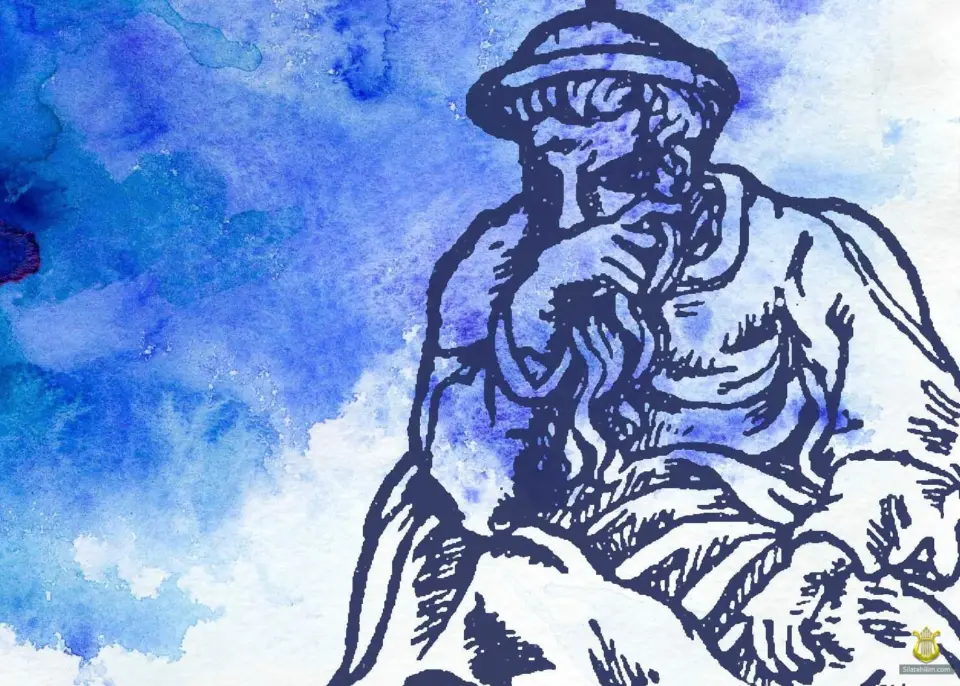
The great Shelah HaKadosh (Rabbi Yeshayahu Horowitz), zechuto yagen aleinu, writes in his book “Shnei Luchot HaBrit”:
“If a person’s soul desires to cleave to the Al-mighty and praise Him, let him cleave to the Book of Tehillim.”
Our Sages, of blessed memory, said that David HaMelech prayed that his psalms would be recited in synagogues and houses of study, for we have nothing more significant than the Book of Tehillim, which contains psalms of various kinds: some are expressions of praise to the Al-mighty, while others are filled with pleas for forgiveness. They were all composed by King David through the spirit of prophecy.
Praiseworthy is the person who recites Tehillim melodiously and with concentration, rather than hurriedly and mechanically, as is commonly done nowadays. If a person wishes to receive reward and to ensure that the recitation of his psalms brings pleasure to the Al-mighty, he should read them attentively.
Whenever the word עדותיך appears in the Psalms, it is pronounced “eidotecha.”
The exception is Psalm 119, where in the verses beginning with the letters Dalet, Mem, Hei, Bet, Nun, Pei, Reish, and Tzadi (forming the mnemonic sequence DaMa(h) BeN PeReTZ), this word is pronounced “eidvotecha,” except in verse 138, where the pronunciation remains “eidotecha.” This is the tradition we received from our fathers.
In the first chapter of the book “Levush” by Rabbi Mordechai Jaffe, it is stated:
“Since the primary purpose of reciting psalms is to destroy all the prosecuting angels, thereby allowing our prayer to ascend peacefully, it is highly commendable to recite Tehillim whenever possible before prayer, in order to restrain the harsh forces and cut away the thorns and briars surrounding the heavenly rose before prayer. As a result, the prayer will ascend to the Al-mighty and be welcomed before Him. However, if a person arrives late at the synagogue, when the congregation is already praying, he should not make the secondary primary and the primary secondary. In that case, it is more important for him to pray with a minyan, with concentration and without haste. For our Sages included psalms in the morning prayer (from “Baruch SheAmar” through “Yishtabach”) in order to eradicate all the kelipot (negative forces) and prosecuting angels, allowing the prayer to ascend Above in peace.” (Shnei Luchot HaBrit, p. 257, the book “Tehillim Ohel Yosef Yitzchak”)
Was this helpful?
100% of readers found this article helpful (12 votes).
Please note: some articles on our site contain the holy Names of the Almighty. If you print these articles, they may not be thrown away or destroyed. Please handle printed copies with care and respect.
Material from our site may be copied for the purpose of spreading Torah, provided a link to Silatehilim.com is included. Any use of the site's material in print publications or for commercial purposes is prohibited without the rights holder's consent.