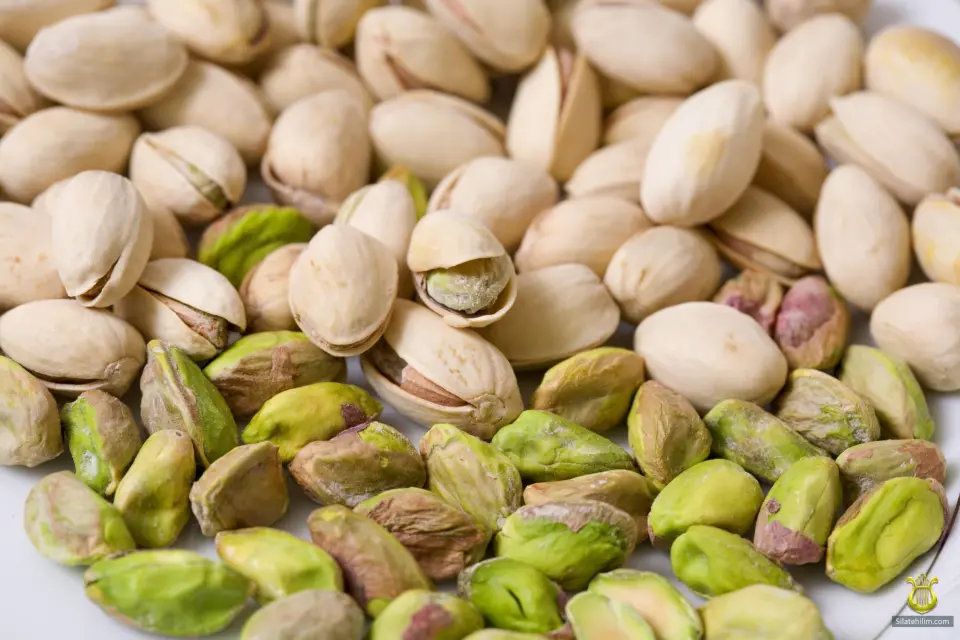
1. A fruit for which the Land of Israel is renownedIn the Torah, pistachios are mentioned in Parashat Miketz, when Yaakov sends his sons to Yosef in Egypt with gifts (Bereishit 43:11):
“Then their father Yisrael said to them: ‘If it must be so, then do this: Take some of the land’s choice products in your bags and bring them down as a gift to the man—a little balm, a little honey, spices and laudanum, pistachios and almonds.’”
From this we learn that pistachios are one of the fruits for which the Land of Israel is renowned.
Chazal teach that the gifts listed here are the most powerful segula for Parnassah.
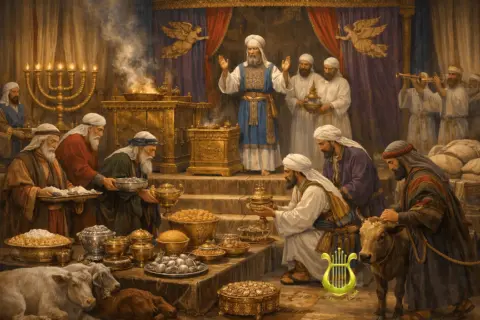
2. A fruit compared to incenseIn the Aggadah for Tu BiShvat, based on the book “Pri Etz Hadar,” included in the book “Hemdat Ha-Yamim,” pistachios, which belong to the world of Asiyah, are discussed as follows:
“Where wine is brought to them during the meal, each person recites the blessing for himself; after the meal, one recites the blessing on behalf of everyone, and he also recites the blessing over the incense, even though the incense is brought only after the meal has ended.” (Mishnah, Berakhot 6:6)
Segula for a child to begin speaking
Interestingly, the shape of pistachios resembles an open mouth.
It is stated in Ezekiel (47:12):
“And by the stream, on its banks on either side, every kind of tree bearing edible fruit shall grow; their leaves shall not wither nor their fruit fail, but they shall yield fresh fruit every month, because the water for them flows from the Temple; their fruit shall serve for food and their leaves for healing.”
The Mekubalim teach that for a child who simply will not begin speaking (and is not too young), it is beneficial to give him pistachios and, while he is eating them, recite the words of the prophet Ezekiel:
והיה פריו למאכל ועלהו לתרופה— “Ve-hayah peri'o le-ma'akhal ve-alehu li-trufah” —
(and their fruit shall serve for food and their leaves for healing).
[Other segulot for opening the mouth]Tehillim 51:17Rabbi Mordechai Eliyahu (may his merit protect us) taught that if a child does not begin speaking for a long time, or has lost the ability to speak, the father should touch the child’s mouth daily with his right hand and, at the same time, recite the verse from Tehillim (51:17):
אדנ׳ שְׂפָתַ֣י תִּפְתָּ֑ח וּ֝פִ֗י יַגִּ֥יד תְּהִלָּתֶֽךָ — “Ado-nai sefatai tiftach u-fi yagid tehilatecha” —
(G-d, open my lips, and my mouth shall declare Your praise).
Tehillim 58:2 Segula for those who are mute (those who stopped speaking due to fright or illness).
In Tehillim 58, verse 2 states:
הַֽאֻמְנָ֗ם אֵ֣לֶם צֶ֭דֶק תְּדַבֵּר֑וּן
— “Ha-umnam elem tzedek tedabberun” — (Do you indeed speak righteously, O assembly [of the wicked]?).
One should make seven whispers of the word אֵ֣לֶם (elem) into the mute person’s ear, then write this word on a “klaf” (parchment) and have him wear it as an amulet.
(Compiled from the lessons of Rabbi Yisrael Yakobov and other holy sources)
Was this helpful?
100% of readers found this article helpful (28 votes).
Please note: some articles on our site contain the holy Names of the Almighty. If you print these articles, they may not be thrown away or destroyed. Please handle printed copies with care and respect.
Material from our site may be copied for the purpose of spreading Torah, provided a link to Silatehilim.com is included. Any use of the site's material in print publications or for commercial purposes is prohibited without the rights holder's consent.