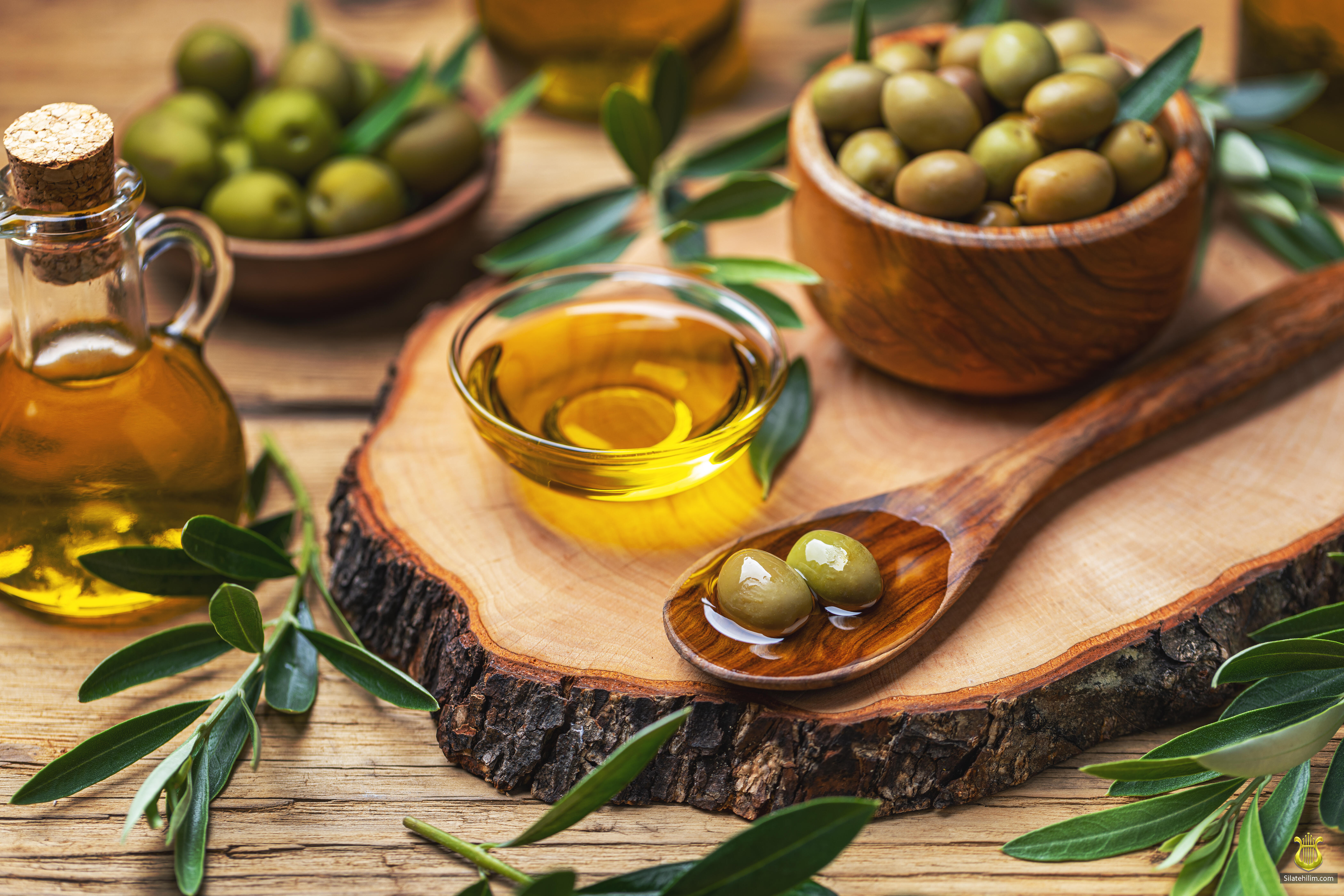
Rabbi Yohanan said: “Olives can cause a person to forget everything he learned over the course of 70 years, while olive oil helps a person remember everything he learned over the course of 70 years.” (Horayot 13b)
That is why the Land of Israel is customarily praised not for the olives that grow there, but for the oil that restores to a person the years of Torah learning he has forgotten.
Rabbeinu Bahya explains that olives cause forgetfulness because, unlike other trees, the olive tree has no heartwood (indeed, when cut, an olive tree does not display the familiar ring pattern).
Thus, olives symbolically “lock” the heart and cause a person to forget what he previously learned. (R. Bahya on Genesis 34:1)
Olive oil, which provides light, is associated, by contrast, with wisdom and intellect. The olives themselves, which conceal the oil within them—and thus the light as well—also symbolically conceal the wisdom associated with it. Therefore, eating olives without adding olive oil can negatively affect a person’s memory, whereas olive oil has the opposite effect: it illuminates a person’s heart with wisdom. (Maharal, Chiddushei Aggadot 4)
Some sages maintain that only raw olives cause forgetfulness, and that this does not apply to pickled olives. Others hold that memory loss results from olives eaten in any form. This is why the custom arose of eating olives with a drop of olive oil, in order to neutralize their negative effect on memory. (Sefer HaZikaron)
How can this be rectified?
The great Ari HaKadosh writes in his works that if a person eats olives while concentrating intently on the Names of the Almighty, the negative effect of olives on memory can be overcome.
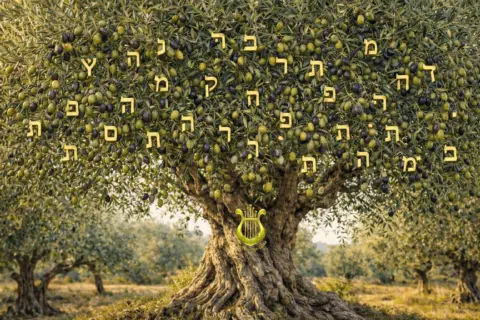
As the Arizal teaches, one should focus one’s mind on the three letters that comprise the Name of the Almighty: “yud,” “vav” and “heh”.
Each of these letters corresponds to one of the three Divine Names: Elohim, El and Matzpatz.
The gematria of these three Names is 417, which is equal to the gematria of the word זית “zayit” (olive).
According to Atbash gematria, the Name Matzpatz corresponds to the unpronounceable four-letter Name of the Almighty, represented as “yud-heh-vav-heh”. In the name Matzpatz, the letter “mem” takes the place of “yud”, the letter “tzadi” takes the place of “heh”, and the letter “peh” takes the place of “vav”.
The word “oil” is pronounced in the Holy Tongue as שמן “shemen”.
If we apply Atbash gematria to the word “shemen”, we obtain the letters “bet-yud-tet”, whose gematria is 21; moreover, 21 is the numerical value of the letters comprising the Name of the Almighty: “yud, heh, vav”.
(Arizal, Sefer HaLikutim, Ekev 8, based on the book “The 7 Fruits of Israel” by H. B. Sigelbaum)
Was this helpful?
100% of readers found this article helpful (19 votes).
Please note: some articles on our site contain the holy Names of the Almighty. If you print these articles, they may not be thrown away or destroyed. Please handle printed copies with care and respect.
Material from our site may be copied for the purpose of spreading Torah, provided a link to Silatehilim.com is included. Any use of the site's material in print publications or for commercial purposes is prohibited without the rights holder's consent.