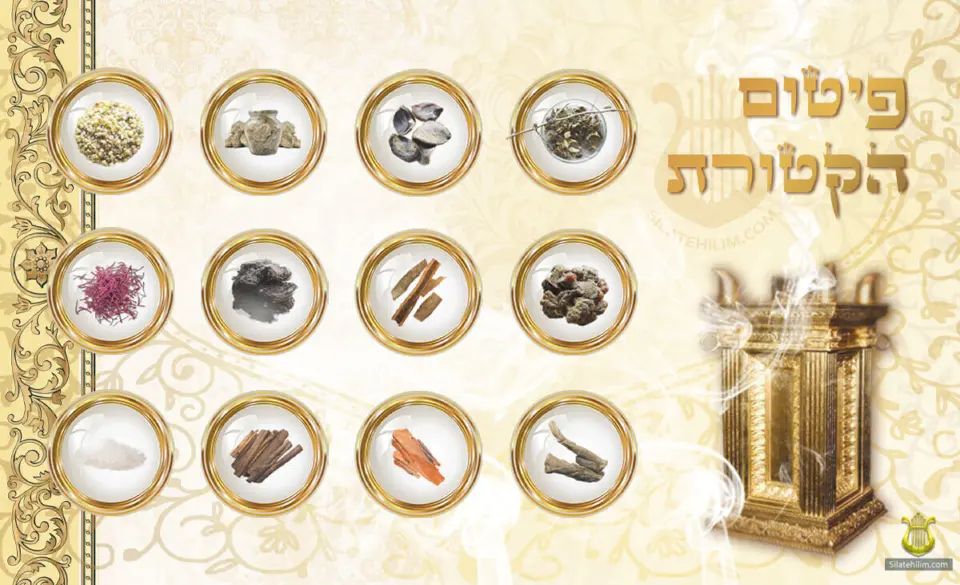
The Sefer “Mi-Zahav Umi-Paz” by Rabbi Pinchas Zabihi reveals the hidden meaning of one of the most important prayers, “Pitum HaKetoret”
It teaches that when texts concerning the laws of the sacrifices are recited, powerful mystical forces are activated. As stated in the Zohar (Vayera 100a), all the angels who accuse a person in Heaven become his defenders and mention only his merits. As a result, severe decrees are annulled and everything is turned to his benefit.
Rabbeinu Chida taught: “Fortunate are those who study the laws of the Temple service day after day ... and Torah scholars who study the Talmudic tractate Kodashim, which is devoted to the Temple service, merit great rewards.” (Commentary on “Avot DeRabbi Natan” 4:3)
Gaon Rabbi Chaim Palagi writes in his book
“Nefesh Kol Chai” (100:6) that studying the laws of the sacrifices (the end of Parashat Pinchas), the laws of the daily offerings, additional offerings, and others, is extremely important. It is also a miraculous, tried-and-tested remedy for a person involved in a lawsuit or conflict with other nations and their authorities: by reading these laws of the sacrifices, he can be saved from persecution.
The same miraculous and redemptive mystical forces are activated through the daily recitation of the text of
“Pitum HaKetoret”—with full awareness and understanding.
According to the
Arizal (may his merit protect us), the Ketoret should be recited three times a day (“Sha'ar HaKavanot”—Drushei Tefillat HaShachar):
1) the first time—before the morning prayer, together with the
“Order of the Sacrifices”;
2) the second time—immediately after the Amidah, before
“Aleinu Leshabe’ach”;
3) the third time—before Mincha.
According to the Arizal, the prayer of the Ketoret concludes before the words: “Ve’arvah la-HaShem minchat Yehudah vi-Yerushalayim kimei olam u-kheshanim kadmoniyot.”
The importance of reciting the text of the Ketoret every day, with proper intention and understanding, is explained in the holy Zohar. (Vayakhel 218b)
The Zohar on the Importance of Reading “Pitum HaKetoret”
1.
Rabbi Shimon bar Yochai said: “If people knew how significant the text of ‘Pitum HaKetoret’ is to the Holy One, blessed be He, they would crown every word of this text with a golden crown. Whoever studies these laws and recites this text every day, with concentration and awareness, acquires a worthy portion in this world and in the World to Come; he distances death from himself and from the entire world; he is delivered from all severe decrees issued against him, from all misfortunes, from the punishment of Gehinnom, and from the yoke of foreign rulers.”
2. No harm will befall a person who recites the text of “Pitum HaKetoret” throughout that entire day, and the “sitra achra” (the Other Side) will have no power over him. (Zohar, Vayakhel 218b)
3. The Holy One, blessed be He, decreed that everyone who recites the Ketoret daily will be saved from all forms of sorcery, from every kind of accident, from all severe decrees issued against him, and from obsessive negative thoughts; he will be saved from death.
4. Reciting the text of the Ketoret saves one from death. The burning of the Ketoret connects the inhabitants of this world with the higher worlds and with the source of life; therefore, it diverts death and Heavenly anger so that they do not rule over the world. (Zohar, Vayechi 230a; Zohar Chadash, Shir HaShirim 68a)
5. The Zohar HaKadosh (Va’era 101a) relates how
Rav Acha saved an entire city from a deadly epidemic: by instructing the people to read the Ketoret, he brought the Jews back from death to life. When we recite the Ketoret day after day, pronouncing every word precisely, unhurriedly and with concentration, we weaken the power of Samael (the Angel of Death) and sever him from the source of his power. Therefore, reciting the text of the Ketoret annuls a death sentence even if, Heaven forbid, it has already been issued against a person or one of his relatives. (Sefer Segulot Yisrael, Kuf 26)
6. We know from the Oral Tradition that in a place where the Ketoret is recited with full awareness and sincere devotion, death has no dominion, no misfortune occurs, and idolaters have no power over that place. (Zohar, Vayakhel 119a)
7. At the conclusion of the morning prayer, before reading the text of the Ketoret, we recite a verse from Tehillim (102:14): “You will arise and have mercy on Zion, for it is time to favor her; the appointed time has come!” See what the book
“Yesod VeShoresh HaAvodah” (5:9) says about this verse:
“Let the people of Israel rejoice and be glad when reciting this verse—for when the appointed time arrives, the Holy One, blessed be He, will certainly have mercy on Zion and rebuild the cities of Judah. We should beseech Him with all our soul that this take place speedily, in our days.” (Perhaps this is precisely why the verse “You will arise...” is combined with the text of the Ketoret: as stated above, the nations of the world cannot rule over a place where this text is recited. Therefore, the Holy One, blessed be He, in His great mercy, will “have mercy on Zion and rebuild the cities of Judah,” through the mystical forces activated by reciting the Ketoret.)
8. Daily recitation of the Ketoret contributes to an increase in prosperity. The Talmudic tractate Yoma (26a) notes that a kohen who burned the Ketoret became wealthy. The responsa collection of
Rabbi Yechezkel Landau, “Noda BiYehudah” (Orach Chaim 10), states that even today, when there is no Temple, daily recitation of the text of the Ketoret brings wealth, just as the burning of the Ketoret did in the Temple.
The same is stated in the book
“Kol Bo” (41): “Reciting the text of the Ketoret brings abundance.”
This is also stated by
Rabbeinu Yehudah ben Yakar, the teacher of the Ramban, in his book
“Perush HaTefillot VeHaBrachot” (“Motzaei Shabbat”).
The book
“Ma'avar Yabok” (4:6) likewise states that one who makes an effort to recite the text of the Ketoret in its entirety and with awareness will never experience want, and will merit prosperity.
9. A person who sees and feels that troubles and misfortunes are pursuing him and that everything he undertakes fails should recite the text of the Ketoret every day without fail, in the morning and before evening, with great concentration. He should also repent of his sins wholeheartedly; through this, all harsh decrees will surely pass him by. (Zohar, Vayakhel 219a)
10. One who, Heaven forbid, is beset by misfortune should make an effort to recite the Ketoret every day, reading the text slowly and precisely, with heartfelt intention. This will help bring about a positive change in his destiny. (Sefer Segulot Yisrael, Kuf 26)
11. One who recites the Ketoret during the morning prayer, before
“Aleinu Leshabe’ach”, keeps death away from his home. (Zohar, Pinchas 224a)
12. It brings longevity.
Rav Alexander Ziskind writes about this in
“Yesod VeShoresh HaAvodah” (5:9): “A person who desires life and loves longevity” (Tehillim 34:13) should accustom his mouth to reciting the text of the Ketoret with heartfelt intention.
13. See also what is written in
“Seder HaYom” (Seder Avodah) about the great significance of reading the Ketoret daily: it saves one from every trouble and illness, as stated in the Zohar (Vayikra). Through the burning of the Ketoret, all the kelipot (spiritual shells) of evil and ignorance that bind our souls are destroyed, and a person overcomes his evil inclinations.”
Therefore, a person should make every effort to recite the text of the Ketoret slowly and with concentration, especially at the end of the morning prayer, before
“Aleinu Leshabe’ach”, since this is precisely when people often hurry to leave the synagogue. How many great blessings can a person merit by remaining for a few more minutes and reading the text of the Ketoret attentively!
The book
“Ma'avar Yabok” (4:5) states that it is a “stratagem of the evil inclination” to make people hurry out of the synagogue, preventing them from reciting the Ketoret properly and causing them, Heaven forbid, to lose the great blessings associated with reciting this text. Indeed, this text helps a person overcome the sitra achra.
It is also stated that “the chazzan leading the communal prayer should take special care to pronounce the Ketoret precisely and without haste. His example will then influence all the worshippers, and they will act as he does.”
The book
“Ma'avar Yabok” (4:3) states that from the sayings cited in the holy Zohar, we see the beneficial results brought about by reciting the Ketoret:
- epidemics cease and illnesses are healed;
- deliverance from exile;
- blessing accompanies all a person’s endeavors, and he merits success;
- deliverance from the punishment of Gehinnom;
- the forces of impurity withdraw from a person, and the kelipot (shells of evil) that bind his soul are destroyed;
- a person becomes protected from occult and magical influences;
- obsessive negative thoughts leave him;
- a person merits a good portion in this world and in the World to Come;
- harsh decrees of the Heavenly Court are annulled.
14. Daily recitation of the text of the Ketoret helps a person gain respect in the eyes of others and win their affection; he is delivered from oppression by those in power and by non-Jews. (Sefer Segulot Yisrael, Kuf 26)
15. Studying the laws of the sacrifices and the burning of the Ketoret brings the Geulah—the Final Redemption—closer. (From a letter of the Chafetz Chaim, 1927; see the edition “Kovetz Igrot,” Bnei Brak, 1986)
16. Burning the incense purified a person’s heart and moved him to repent of the sins he had committed. (Zohar, Vayakhel 218b)
17. In our time as well, reciting the text of the Ketoret with awareness awakens a person to repentance. (Kav HaYashar 59)
18. Similarly, the book
“Yesod VeShoresh HaAvodah” states in the name of the Arizal that reciting the text of the Ketoret leads to repentance.
The text of the Ketoret should also be recited on certain special occasions.
1) Since the burning of the Ketoret brings healing into the world, it is important for a sick person to try to recite the text of the Ketoret with special concentration and awareness; with G-d’s help, this will assist him. If he is unable to recite the text himself, others should read the Ketoret near the sick person. It is especially meritorious for ten men constituting a minyan to recite the Ketoret near him, with concentration and awareness. (Ma'avar Yabok, 4:5)
2) Reciting the text of the Ketoret with awareness and wholeheartedly is equivalent to fulfilling the 613 mitzvot (and one should carefully understand Rashi’s commentary on the verse “one spoonful, full of Ketoret” (Numbers 7:20)). The gematria of the word “Ketoret,” according to the kabbalistic atbash code, is 613. Rashi derived this gematria from Midrash Bamidbar Rabbah (13:16).
3) See also what
Rama mi-Fano—Rabbi Menachem Azariah of Fano writes in his book
“Kanfei Yonah” (2:15): “The burning of the Ketoret is equivalent to all the mitzvot.”
4) Reciting the Ketoret by mourners helps elevate the soul of the deceased to higher spiritual levels and also protects the mourners, since during this period they need particularly strong protection from misfortune. Therefore, the Ketoret should be recited in the home of the deceased with special concentration and attention. (Ma'avar Yabok 4:2)
5) In a time of communal distress, when, Heaven forbid, terrifying Heavenly decrees are being enacted, the text of the Ketoret should be recited in Houses of Prayer and Houses of Study several times a day, in addition to the recitation prescribed as part of the prayer—with great concentration and awareness. In such a case, according to the laws of the Heavenly Court, the decree will be changed for the benefit of the community. (Zohar, Vayera 100a)
6) It is especially meritorious during such a time of distress for ten G-d-fearing men (a minyan) to gather and recite the text of the Ketoret after midnight, with great concentration. (Arizal, Sha'ar HaKavanot, Tefillat HaShachar 3)
7) The burning of the Ketoret strikes enemies and subdues them; therefore, reciting the Ketoret contributes to the destruction of enemies and retribution. (“Mi-Zahav Umi-Paz,” pp. 197, 428)
8) Reciting the Ketoret helps ensure that prayers will be accepted. (“Mi-Zahav Umi-Paz,” p. 606)
9) Reciting the Ketoret with awareness and without haste, at least twice a day, helps a husband and wife who have remained childless for many years merit a child. It is especially beneficial for them to read the Ketoret from a “klaf” scroll (written on parchment). (Collected responsa “Teshuvot VeHanhagot” 1:790)
10) The Ramban also writes in his commentary on the Torah (Numbers 3:39) that the Ketoret contributes to increasing the birthrate.
11) We have received a tradition from the sages of previous generations: in a time of distress, when a person needs salvation and deliverance, while reciting the Ketoret after the words “This is the daily incense before the L-rd throughout your generations,” he should ask the Almighty, blessed be He, for deliverance with a broken heart, addressing Him in the Holy Tongue. He should then continue: “The Sages taught: How was the mixture for the incense prepared?” and read the entire text to the end with great concentration, pronouncing every word precisely. This is an auspicious time for the Almighty, blessed be He, to fulfill the person’s request for his benefit. (“Mi-Zahav Umi-Paz,” p. 604, note 22)
12) In a case of mortal danger or serious illness, every effort should be made to write the complete text of “The Preparation of the Ketoret” on kosher parchment in Ashurit script, the script used for a Torah scroll, and to read from this parchment once in the morning and once before evening, with great concentration—and I guarantee this remedy. (Rabbi Moshe ben Yehudah Makir, a contemporary of the Arizal and Rabbi Yosef Karo, “Seder HaYom,” chapter Avodah, p. 15 in the Jerusalem edition, 1978)
Note that this Sage, may his memory be a blessing, was so confident in this that he even said: “I guarantee it.”
His words are also cited in the book “Ma'avar Yabok” (4:2).
13) See what
Gaon Rabbi Chaim Palagi writes about this in his book
“Kaf HaChaim” (17:18): “One who writes the text of the Ketoret on parchment in Ashurit script, like a Torah scroll, and reads from it is guaranteed lasting prosperity. He will always live in abundance and never experience want, because the Ketoret contributes to success.”
14) He writes similarly in his commentary on the Shulchan Aruch (“Ruach Chaim,” Orach Chaim 132:4): “Reciting the text of the Ketoret written in Ashurit script, like a Torah scroll, contributes to acquiring wealth and success in all one’s endeavors.”
From these statements of the Sages, it is clear how great and wondrous are the merits of one who recites the text of “The Preparation of the Ketoret” every day with concentration and awareness. He will be blessed from Heaven with every kind of goodness: children, longevity, and abundance.
15) As stated above, by virtue of reciting the Ketoret, death sentences are annulled both for individuals and for the community; a person merits children, since the Ketoret contributes to increasing the number of Jews in the world; and he will also be blessed with prosperity, since the Ketoret brings wealth. He will merit good health, since the Ketoret contributes to healing. With G-d’s help, such a person will succeed in his spiritual achievements and material affairs, and goodness will accompany him and his children throughout all his days.
Since the merits of reciting the Ketoret are so great, a person should endeavor to recite this text every day—in the morning and in the evening—and should not consider it difficult to remain at prayer for a few additional minutes in order to read the text and bring Nachat Ruach (pleasure) to the Creator.
Indeed, in one respect the burning of the Ketoret is more important than prayer, since the prayers were instituted in correspondence with the sacrifices offered in the Temple, while the Ketoret is more important than any sacrifice. Consequently, it is more beloved to the Creator than all prayers.
16) In addition, the Ketoret helps purify a person from sins committed against the Creator. (“Me'am Lo'ez,” Ki Tisa, p. 1084)
Rabbeinu Chida further writes in his book
“Tzipporen Shamir” (2:14):
“The Ketoret should be recited with particular concentration, for the holy Zohar speaks extensively about it. The importance that the Zohar HaKadosh attributes to reciting the Ketoret with awareness should kindle the hearts of the children of Israel, so that they recite this text with complete devotion and with the joy that comes from bringing Nachat Ruach, pleasure, to their Creator. They must not have their own benefit in mind, Heaven forbid.”
Such great gifts are granted to a person from Heaven so that he can recite the Ketoret properly. Nevertheless, his primary intention when reciting this text should be to bring Nachat Ruach, pleasure, to the Holy One, blessed be He—not to seek reward. The reward will come of itself.
Segulot Associated with “Pitum HaKetoret”
1. Turning prosecuting angels to one’s side and transforming them into defenders, thereby annulling severe decrees; (Zohar, Vayera 100a)
2. Salvation from lawsuits and persecution; (Rabbi Chaim Palagi)
3. No harm will befall a person throughout the day on which “Pitum HaKetoret” is recited, and the “sitra achra” (the Other Side) will have no power over him. (Zohar, Vayakhel 218b)
4. Protection from kishuf (sorcery) and all kinds of magic, and salvation from accidents and obsessive thoughts;
5. Salvation from epidemics; (Zohar, Va’era 101a)
6. Salvation from death—the burning of the Ketoret connects the inhabitants of this world with the higher worlds, the source of life; (Zohar, Vayechi 230a)
7. Annulment of a death sentence, even one that has already been issued; (Sefer Segulot Yisrael, Kuf 26)
8. Where the Ketoret is recited, death has no dominion, misfortunes do not occur, and idolaters have no power over that place. (Zohar, Vayakhel 119a)
9. Increased prosperity; (Noda BiYehudah, Orach Chaim 10; Kol Bo 41; Ma'avar Yabok)
10. Reading “Pitum HaKetoret” before “Aleinu Leshabe’ach” in the morning keeps death away from the home; (Zohar, Pinchas 224a)
11. Healing from illness; (Zohar, Vayikra)
12. Deliverance from exile; (Ma'avar Yabok 4:3)
13. Bringing success and blessings; (Ma'avar Yabok 4:3)
14. Deliverance from the punishment of Gehinnom; (Ma'avar Yabok 4:3)
15. Contributes to the withdrawal and destruction of the kelipot (shells of evil); (Ma'avar Yabok 4:3)
16. Contributes to gaining the respect and affection of others; (Sefer Segulot Yisrael, Kuf 26)
17. A person merits a portion in this world and in the World to Come; (Ma'avar Yabok 4:3)
18. Inspires teshuvah; (Zohar, Vayakhel 218b)
19. For healing, it is beneficial for ten men to read Pitum HaKetoret over the sick person; (Ma'avar Yabok 4:5)
20. Reciting it in a house of mourning elevates the soul of the deceased and protects the mourners; (Ma'avar Yabok 4:2)
21. Contributes to defeating enemies and bringing retribution; (“Mi-Zahav Umi-Paz,” p. 197)
22. Contributes to prayers being accepted in Heaven; (“Mi-Zahav Umi-Paz,” p. 606)
23. Contributes to having children, especially when reading from a “klaf” scroll; (“Teshuvot VeHanhagot” 1:790)
24. In a case of mortal danger or serious illness, write the text of the Ketoret on parchment in “Ashurit” script and read it once in the morning and once in the evening; (Rabbi M. Makir, Rabbi Yosef Karo)
25. Protection from the illness whose name is customarily not spoken; (Rav Kaduri according to the Zohar, Vayakhel)
The Order of “Pitum HaKetoret” According to the Arizal—Prayer Text with Transliteration
The Order of "Pitum HaKetoret" According to the Arizal - Prayer Text with Transliteration
Pitum HaKetoret—Segulot
Pitum HaKetoret – Segulot
(Based on the book “Incense on the Altar (Ketoret),” published by Beit Malkiel)
Please note: some articles on our site contain the holy Names of the Almighty. If you print these articles, they may not be thrown away or destroyed. Please handle printed copies with care and respect.