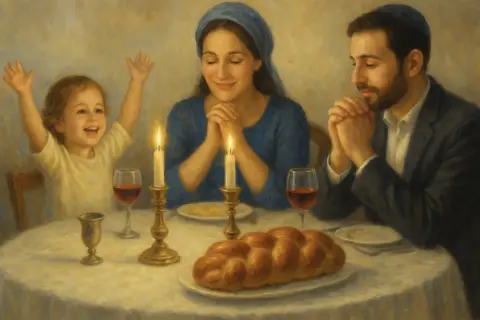
Seudah Shlishit is one of the three meals established by the Jewish sages on Shabbat: the first is held on Friday evening, the second during the day on Shabbat, and the third after Mincha on Shabbat.
The source of the three meals is connected to the falling of the manna in the wilderness: “And Moshe said: Eat it today, for today is Shabbat for the L-rd. Today you will not find it in the field.” (Shemot 16:25)
The word “ha-yom” (today) alludes to the three meals, which correspond to the three patriarchs: the first to Avraham, the second to Yitzchak, and the third to Yaakov.
The Mekubalim teach that the third meal—“Seudah Shlishit”—contains great mysteries, although many people treat it lightly.
Chazal say: “Three complain to the Almighty: Seudah Shlishit (because many Jews neglect it), the prayer “Aleinu Leshabeach” (because Jews recite it hurriedly at the end, without proper kavanah), and a person who is Jewish on his father’s side (because among the gentiles he suffers due to his Jewish appearance, while halachah does not recognize him as Jewish).”
The sages reveal the secret of “Seudah Shlishit”.
Rabbi Asher Zelig Grinzweig conveys a tradition from the Mekubalim about the importance of the third meal, saying that it is the most mystical of the three Shabbat meals, and that whoever connects with its spirit will survive the war of Gog and Magog:
“Remember the words of our sages: ‘Whoever observes the three Shabbat meals will be spared the suffering before the coming of Mashiach: the first meal saves one from the birth pangs of Mashiach, the second meal from the judgments of Gehenom, and the third from the war of Gog and Magog.’” (Shabbat 118a)
Mishnah Berurah points out that a woman is also obligated to participate in the third meal, since she too witnessed the miracle of the manna.
Why do not everyone eat bread at the third meal?
The Gemara (Shabbat 117b) connects the source of the three meals with a pasuk in the Torah concerning the falling of the manna in the wilderness:
“And Moshe said: Eat it today, for today is Shabbat for the L-rd. Today you will not find it in the field.” (Shemot 16:25)
The thrice-repeated word “ha-yom” (today) hints that one should eat three meals on Shabbat.
Nevertheless, halachah is lenient regarding the obligation to eat bread at the third meal. (Orach Chaim 291)
The reason is that the manna was described as “lechem” (bread) after the first two occurrences of the word “ha-yom”, while after the third “ha-yom” it says: “you will not find it in the field”. Therefore, the sages explain, eating bread is not obligatory.
Moreover, the Bach (Tur, Orach Chaim 291) writes that the first Shabbat meal corresponds to the first Shabbat of Creation, the second to the Shabbat when the Torah was given, and the third to the Shabbat of the World to Come. Since the Gemara (Berachot 17a) states that in the World to Come there is neither eating nor drinking, many omit an ordinary bread-based meal.
At the same time, most people associate the “Oneg” (delight) of Shabbat with a meal including bread—and eat bread at the third meal.
Shabbat Shalom u-Mevorach!
100% of readers found this article helpful (20 votes).
Please note: some articles on our site contain the holy Names of the Almighty. If you print these articles, they may not be thrown away or destroyed. Please handle printed copies with care and respect.
Material from our site may be copied for the purpose of spreading Torah, provided a link to Silatehilim.com is included. Any use of the site's material in print publications or for commercial purposes is prohibited without the rights holder's consent.