The Secrets of the White Tablecloth on the Shabbat Table
It is written in Parashat Beshalach (16:13):
- “Uva-boker hayetah shikhvat ha-tal saviv la-machaneh. Va-ta'al shikhvat ha-tal saviv la-machaneh” -
(And in the morning there was a layer of dew around the camp. The layer of dew evaporated, and behold—on the surface of the wilderness there was something fine and flaky, as fine as frost on the ground.)
The Midrash says that the manna fell onto the dew,
שִׁכְבַת הַטָּל (shikhvat ha-tal), which had spread across the ground like a white cloth. Moreover, the manna was also covered with a layer of dew from above, so that it lay between two white coverings. These two layers of frost, as it were, preserved the manna in a fresh state and protected it from spoiling.
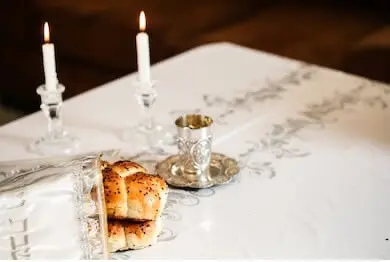
Since the Shabbat challot on our table represent the manna—the Bread from Heaven that the Jews ate in the wilderness—we follow the same pattern: we cover the Shabbat table with a pure white tablecloth, place the challot on it, and cover them with a white challah cloth.
We demonstrate this symbol of our complete emunah on our Shabbat table every week, continuing a practice that has endured for thousands of years.
The Gemara (Yoma 75a) explains why the manna was white.
The manna was white as a symbol of
שֶׁמַּלְבִּין עֲווֹנֹתֵיהֶן שֶׁל יִשְׂרָאֵל—that the manna whitened the sins of Am Yisrael.
In Hebrew,
“white tablecloth” is
מפה לבנה, whose gematria is
212.
In the book
“Baiti Le-Armoni” (I Have Come into My Palace), it is written in the name of
Rabbi Shimshon of Ostropoli that the name of the Kelipah of Forgetfulness is
Riv (ריב). The gematria of this name is 212, the same as the gematria of
מפה לבנה “white tablecloth”.
The equality of these gematriot indicates that a white tablecloth can counteract memory loss.
The Arizal (zekhuto yagen aleinu) instructed that the Shabbat table be covered with two white tablecloths, whose combined gematria is
424. Using two coverings on the table on Shabbat is undoubtedly a segulah against this kelipah.
The Kabbalistic sages further explain that the wrinkles on the Mashiach’s forehead will form what appears to be the written Name of the Almighty (
כדת).
The gematria of this Name is 424, that is, twice 212.
This tells us that in the days of Mashiach, the Kelipah of Forgetfulness will be nullified and removed from the world.
Rabbi Shimshon of Ostropoli found hidden allusions indicating that the kelipah with a gematria of 212 opposes the Holy Name with a gematria of 424. The following story is related in tractate Shabbat (147b):
Rabbi Chelbo said:
“The wine of Purgaita and the water of Diyomsit severed ten tribes from Israel.”
Rabbi Eliezer ben Arach visited those places—Purgaita and Diyomsit. He enjoyed himself there, and his Torah learning was severed from him. When he returned, he came to the synagogue to stand and read from the Torah. The scroll required him to read:
“This month shall be for you (ha-chodesh ha-zeh lachem),” but he said instead:
“Their hearts were deaf (ha-cheresh hayah libam).”
The sages pleaded with the Almighty to have mercy on him, and his Torah learning returned to him. (Shabbat 147b)
To clarify the matter, it is necessary to explain what Purgaita and Diyomsit were:
Purgaita was a place in the Galilee where delicious wine was made. It was also quiet and peaceful, and Torah was not studied there (as written in נתן פריו).
Diyomsit was a city near Tiberias, where there were hot springs and comfortable bathhouses.
After relaxing in these places,
Rabbi Eliezer ben Arach forgot how to read.
Rabbi Shimshon of Ostropoli discovered in the confusion that befell
Rabbi Eliezer ben Arach the influence of the Kelipah Riv: “He erred in reading three letters. He should have read these words:
החדש הזה לכם -
“This month is for you,” but instead he read:
החרש היה לבם -
“Their hearts were deaf.”
In other words, he erred by changing the reading of three letters into
Riv (ריב), the name of the kelipah that causes forgetfulness. The question arises: Why did
Rabbi Eliezer ben Arach “stumble” precisely on this verse? It turns out that the gematria of the words
(החדש הזה לכם) is 424. This shows that the kelipah first attacks what is most dangerous to it—the allusions to the Holy Name that destroys it.
Segulot of the White Tablecloth on Shabbat
The white tablecloth is placed on the Shabbat table and left unchanged until Havdalah; many people leave it in place for Melaveh Malkah as well.
The white tablecloth is covered with a thin, special transparent tablecloth, which may be changed as needed.
A Segulah with a White Tablecloth on Shabbat That Coincides with Rosh Chodesh
On Meron, on the Shabbat after Lag BaOmer in 2020, when entry was prohibited to anyone who was not a resident of Meron due to the pandemic, a small group of Sephardic Mekubalim gathered for a meal. As they joked, they were the ones whom Rabbi Shimon bar Yochai had allowed in.
At Seudat Shlishit, the Mekubal Rabbi Eliezer (his surname is not disclosed) explained how to perform a simplified yet guaranteed
“She'elat Chalom”—a segulah involving the white tablecloth from the Shabbat meal that coincides with Rosh Chodesh.
If a Jew wishes to receive an answer to a question that concerns him, he should take the tablecloth after the meal, without shaking off the food remnants, fold it, place it under his pillow before going to sleep, and ask his question, as is done with
“She'elat Chalom”, but without the preliminary ta'anit or other procedures—and an answer from Heaven is guaranteed.
(https://torasavigdor.org/parshas-beshalach-3-bread-from-the-heavens/, based on a lesson by Alexander Tzvi Sypkov, a segulah involving the Shabbat meal in Meron)
Please note: some articles on our site contain the holy Names of the Almighty. If you print these articles, they may not be thrown away or destroyed. Please handle printed copies with care and respect.