Segulot of the Weekly Torah Portions
Segulot of Vayakhel
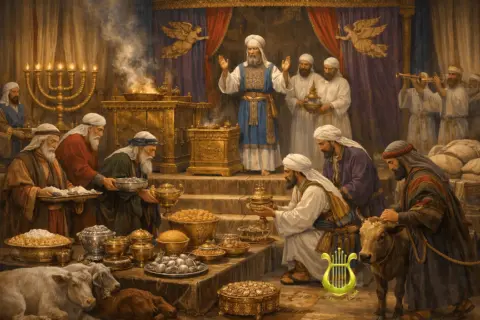
This portion speaks of the construction of the Mishkan and of the leather coverings that were attached to the pillars of the Mishkan with hooks.
The letter
ו “vav” is itself a hook; it is also synonymous with a picklock or key.
When the letter
ו “vav” appears in a person’s name, it is a good sign.
If a person takes an additional or new name, it is good for it to contain the letter
ו “vav”.
The letter
ו “vav” was on Cain’s forehead—the Almighty promised to protect him through this letter.
Weekly portions that begin with the letter “
vav” are a special and auspicious time for prayer and supplication.
The best time is Friday—the sixth day; it is good to pray during the sixth hour, at halachic midday.
There are 12 such portions in the Torah:
Bereishit
- Vayeira
- Vayeitzei
- Vayishlach
- Vayeishev
- Vayigash
- Vayechi
Shemot
7. Va'eira
8. Vayakhel
Vayikra
9. Vayikra
Devarim
10. Va'etchanan
11. Vayeilech
12. Vezot HaBrachah.
Vayakhel is special among these 12 portions because it is specifically here that the hooks are discussed, and the letter “
vav” is mentioned as a hook.
The Arizal taught, in his commentary on the Zohar HaKadosh in the portion of “Pekudei,” that there are seven heavenly palaces, one of which is called “
Heichal Ratzon” (the Palace of Desire), and that before creating the world, the Almighty knew what desires people would have and placed them all in this palace. When desires descend into this world, they descend specifically from this palace.
He discussed this in his commentary on the morning blessing after the Shema, where the 15 words beginning with “
vav” are recited after the Shema in Shacharit:
- “Vayatziv, VeNachon, VeKayam, VeYashar, VeNe'eman, VeAhuv, VeHaviv, VeNechmad, VeNa'im, VeNora, VeAdir, UMetukan, UMequbal, VeTov, VeYafeh.”
Since, according to the Arizal, the morning prayer—Shacharit—is structured according to the soul’s ascent through the spiritual worlds during prayer and passes through these palaces, and since the concluding section of the Shema passes precisely through the Palace of Desire, the 15 words beginning with “
vav” serve as picklocks and keys to this palace.
If a person’s desires correspond to these 15 criteria, he can open them.
Likewise, the 12 weekly portions beginning with
ו “vav” are a highly auspicious time for finding a picklock for the Palace of Desire.
Segulot of Pekudei
1. A segula for memorization—repeat four times
In this portion, the word “Mishkan” is repeated twice in one sentence: “Eileh fekudei ha-Mishkan Mishkan.” It is explained that since Mishkan is the name of the temporary, traveling Temple—a temporary dwelling—this hints at the two temporary Temples, while the Third Temple will not be called a Mishkan but will be eternal.
Moshe Rabbeinu studied each portion of the Torah four times:
The first time with the Almighty
The second time with Aaron
The third time with Aaron’s sons
The fourth time with all the Jewish people
This repetition is a sign that if a person repeats something four times, he will remember it.
Another segula for memorization is to repeat something 100 times.
2. A segula: looking into metal mirrors (not on Shabbat)—for mental illness;
Segulot of Vayikra
1. A segula for a housewarming
The words
Mishkan and “
shokhen” (neighbor) share the same root. In other words, the Almighty wanted to become the neighbor of the Jewish people and asked them to build Him a Mishkan (a guest house).
The
Zohar says in the portion of
Vayikra (a description of a housewarming) that this is the custom of the world: after a house is built, a housewarming is held—the house is illuminated and a meal is served. Therefore, the portion of Vayikra describes the sacrifices, essentially the menu, that will be served at the housewarming.
The Kabbalists of Jerusalem had the custom, on the eve of Rosh Chodesh Nisan, of reading the portions of “
Vayikra” and “
Tzav” until midday. (“Chemdat Yamim”)
According to the Zohar HaKadosh
1) There should not be
sour foods or honey at a Chanukat HaBayit meal;
2)
Beef at a Chanukat HaBayit meal is a sign of prosperity (a hint to the
shelamim offering, since only wealthy people brought this offering).
3) There should not be
poultry on the table, because it is written: “and if a person cannot afford two turtledoves…”—the words referring to lack of means appear next to poultry.
2. A segula against witchcraft during a sea voyage
One should learn the following verse and recite it in both forward and reverse order:
וַיִּקְרָא אֶל מֹשֶׁה וַיְדַבֵּר יְהוָֹה אֵלָיו מֵאֹהֶל מוֹעֵד לֵאמֹר לֵאמֹר מוֹעֵד מֵאֹהֶל אֵלָיו יְהוָֹה וַיְדַבֵּר מֹשֶׁה אֶל וַיִּקְרָא
- “Vayikra el Moshe, va-yedaber Ado-nai elav me-ohel mo'ed lemor”
- “Lemor mo'ed me-ohel elav Ado-nai va-yedaber Moshe el vayikra”
(and He called to Moshe, and G-d spoke to him from the Tent of Meeting, saying…).
3. A segula involving honey—for healing the eyes.
The Book of Samuel (I Samuel 14:27) tells how Jonathan extended the end of his staff into a honeycomb and ate the honey, after which “his eyes brightened.”
4. A segula for healing the eyes.
Rav Kanievsky taught that eating honey daily heals the eyes (the Talmud writes that a person suffering from bulmus was fed honey, and his eyes brightened);
5. A segula for the eyes—eat honey in the morning on an empty stomach.
One should dip the index finger into honey
three times.
The five fingers are associated with the
five senses:
The thumb is associated with
taste—according to psychosomatic theory, an infant puts precisely the thumb into its mouth and sucks it;
The index finger is associated with
smell—people pick their noses with the index finger;
The middle finger—“amah”—is associated with
touch—it is the longest and is the first to touch objects;
The ring finger is associated with
the eyes—when a person cleans his eyes, he unconsciously extends the ring finger;
The little finger is associated with
hearing—a person scratches inside the ear with this finger.
6. Beef for eyesight.
Rav Kanievsky advised eating at least a kezayit of beef daily to improve eyesight;
Segulot against theft
1) A segula against theft—to find stolen property—one should hang an axe outside the house; (Segulot Yisrael)
2) For protection against theft and against the klipot (spiritual thieves)—keep the afikoman remnants in a concealed place;
3) One should recite Psalm 67 at night in the form of a menorah. Then recite the prayer:
“Rachmana de-min Shmaya, rachem alai ve-hoshieni mi-kol oyev ve-orev, ve-lo yuchal shum ganav leikanes be-vayit zeh ve-lo litol shum davar ve-shum mamon mi-beiti be-Shem:
[this Name is not pronounced aloud—only contemplated mentally]
Tzadi-Vet-Alef
Reish-Mem
Reish-Mem
Al ramim yihyeh davar zeh elai [name] ben/bat [father’s name]. Amen, sela!
Translation
Merciful One in Heaven, have compassion on me and save me from every enemy and ambusher, and may no thief be able to enter this house or take anything or any wealth from my home, in the Name:
Tzadi-Vet-Alef
Reish-Mem
Reish-Mem
May this matter be established on high for me, (name), son/daughter of (father’s name). Amen. Sela! (Refuah ve-Chaim mi-Yerushalayim”)
(stay tuned for updates)
(Based on the lessons of Rav Alexander Tzvi Sypkov, “Segulot of the Weekly Torah Portions”)
Please note: some articles on our site contain the holy Names of the Almighty. If you print these articles, they may not be thrown away or destroyed. Please handle printed copies with care and respect.