5. Rabbi Chaim Palagi taught that it is good to read the entire “Pirkei Avot” (Ethics of the Fathers) on Rosh Chodesh Nisan, and this will be considered as if one had read all six Orders of the Mishnah.
6. During the Rosh Chodesh meal, it is good to recite Tehillim 38 five times—this is for “lemittuk hadinim veha-issurim” (sweetening judgments and suffering). 7. Gaon Rav Ben-Tzion Mutzafi teaches that it is good to say the following pasuk 24 times: “Hayom hazeh—hu Yom Rosh Chodesh Nisan—mevorach aleinu” (This day—the day of Rosh Chodesh Nisan—is blessed upon us), and this blesses all the months of the year, because Nisan is the King of months, “Chodesh HaMelech,” as the Torah says: “This month shall be for you the head of the months; it shall be for you the first month of the year.” The word לכם (for you) consists of the same letters as מלכ (King)—hence, Chodesh HaMelech. 8. 1 Nisan is the birthday of Rabbi Nachman of Breslov—it is good to recite the entire “Tikun HaKlali,” whose 10 mizmorim correspond to the 10 Sefirot, and HaShem performed 10 miracles for Am Yisrael in the month of Nisan.
Segulot for Rosh Chodesh Nisan
Rosh Chodesh Nisan
This month is called the head of all months—Chodesh HaChodashim—or the royal month—Chodesh HaMelech.
The word “Nisan” is connected in Aramaic with spring and has the same root as “nitzan”—a bud or blossom, as it says in Shir HaShirim (2:12): “hanitzanim nir'u va'aretz”—the blossoms have appeared in the land.
Rabbi Tzvi Elimelech of Dinov, in “Bnei Yissachar”, taught that each day of the month of Nisan is equal in its spiritual power to Rosh Chodesh, like the days of Et Ratzon—days of special closeness to G-d.
The Zohar HaKadosh states that Rosh Chodesh Nisan is the most auspicious day, and Nisan is the most favorable month of the year for Am Yisrael. The Torah says: “This month shall be for you the head of the months; it shall be for you the first month of the year.” The word לכם (for you) consists of the same letters as מלכ (King)—hence, Chodesh HaMelech.
G-d hints to us that we are kings, and just as all the commands of a king are carried out, our prayers will be heard and our requests fulfilled.
In the Torah, Nisan is called אביב Aviv, meaning אב יב —Father of the Twelve.
The 12 months correspond to the 12 permutations of the letters of the Four-Letter Name, which represents Mercy—“Rachamim Gemurim.” Therefore, the month of Nisan became the first month, so that the year would begin with mercy.
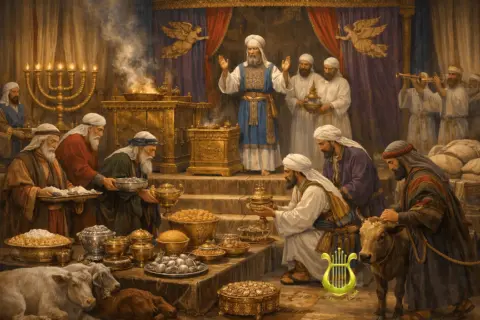
The first 13 days of Nisan are the days of the consecration of the Mishkan in the second year after the Exodus from Egypt. During the first 12 days of Nisan, the leader of each tribe brought an offering in turn; on the 13th day, it was the tribe of Levi.
Rabbi Tzvi Elimelech of Dinov taught that each day G-d designated the month of Nisan as the first month of the year—Chodesh HaChodashim.
The Baal Shem Tov revealed that everything is renewed on Rosh Chodesh Nisan. Regardless of what a person has gone through, beginning on Rosh Chodesh Nisan, the world and every Jew are “renewed.”
The holy mekubal of Apt confirms that Rosh Chodesh Nisan is a time of renewal for the world and for every Jew, when all harsh decrees are annulled.
The first Birkat Kohanim (Priestly Blessing) in history took place on Rosh Chodesh Nisan.
For the first time, Aharon HaKohen blessed Am Yisrael. From that day onward, Rosh Chodesh Nisan has been a day of blessing.
The gematria of the word Nisan is 170. The word טוב (good) has a value of 17, and since we always want everything to be perfect, and 10 is the number of perfection, 170 is very good.
Segulot for Rosh Chodesh Nisan
1. Fasting before Rosh Chodesh Nisan
The Shelah HaKadosh writes in “Masechet Tamid” (at the end of the section “Ner Mitzvah”), that one should fast before Rosh Chodesh Nisan, so that we do not consume our merits before G-d in this world. This fast should take place before Rosh Chodesh Nisan, because in the month of Nisan the Dew of Blessings is revealed. Here is the text of a prayer that may be recited even without fasting, by redeeming the fast with a monetary donation—tzedakah—the full prayer is here:
Erev Rosh Chodesh Nissan - Tefillah for Parnassa from the Shlah HaKadosh
2. Having a haircut before Rosh Chodesh Nisan—a segula for relief from headaches.
It is transmitted in the name of Rav Yosef Chaim Sonnenfeld (alav hashalom) that the holy books of the elders of Jerusalem state that there is one day in the year—Erev Rosh Chodesh Nisan—and if a person makes an effort to have a haircut before Rosh Chodesh Nisan, he will be freed from headaches.
3. The Bnei Yissachar prayer during the first 12 days of Nisan—a segula to begin on Erev Rosh Chodesh.
Rosh Chodesh Nisan - The Bnei Yissaschar's Prayer for the First 12 Days of Nisan
4. The prayer “Tefillah LeParnassah of the Shelah HaKadosh” on Erev Rosh Chodesh
Erev Rosh Chodesh Nissan - Tefillah for Parnassa from the Shlah HaKadosh
Was this helpful?
97% of readers found this article helpful (102 votes).
Please note: some articles on our site contain the holy Names of the Almighty. If you print these articles, they may not be thrown away or destroyed. Please handle printed copies with care and respect.
Tags: Segulot, Rosh Chodesh, Rosh Chodesh Nissan, The Month of Nisan, The Month of Aviv, Chodesh Nisan, Hodesh HaMelech, Segulot for Rosh Chodesh Nisan