Why Are There 36 Cards in a Deck, and What Do Hanukkah Vacations Have to Do with It?
Why Are There 36 Cards in a Deck, and What Do Hanukkah Vacations Have to Do with It?
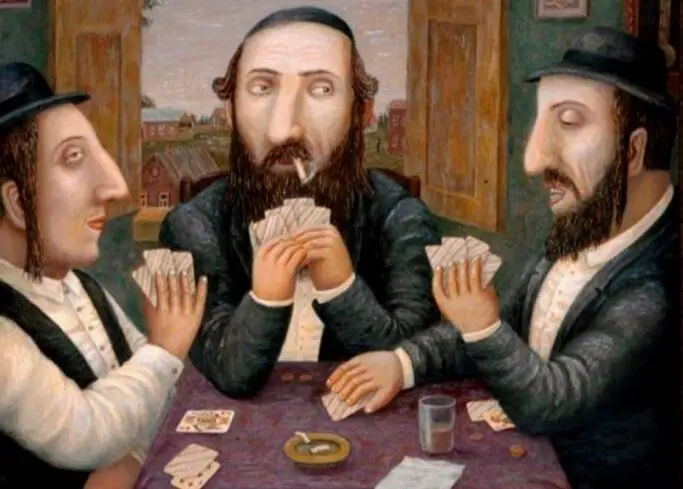
Once, while reading my favorite book by Isaac Bashevis Singer, “The Family Moskat”, I was extremely surprised to learn that on Hanukkah, alongside the traditional game of dreidel played by children, men had a favorite game—cards—while women played lotto.
I remember from my childhood how the adults would become indignant when, after a meal, the young people gathered to play cards, remarking on what an impure and sinful occupation it was. And this was not even during the holy holidays.
Rabbi Levi Yitzchak of Berditchev writes the same in his drashot on Hanukkah.
He writes that the days of the Hanukkah holiday fall during the long winter evenings, when there is plenty of free time, and it is a shame to waste it. Hanukkah evenings are specifically intended to strengthen faith within the family circle.
Hanukkah gives us a unique opportunity to sense the Hand of the Almighty guiding us through life. Therefore, he warned against playing cards on these evenings, because this game is associated with an exceptionally powerful klipah, incompatible with the concept of fear of G-d—“yirat Hashem.”
It is no coincidence, writes Rabbi Levi Yitzchak, that there are 36 cards in a deck—the number of tractates in the Talmud.
This is the antithesis of the holiness and wisdom of the Torah, defiling a Jew’s soul.
The 36 cards are countered by the 36 Hanukkah lights, since it is known that over the eight days of Hanukkah we kindle 36 lights (44 lights, including the shamash). Chanokh reveals that 36 represents the 36 hidden tzadikim in every generation.
Rabbi Yisrael of Ruzhin taught that angels stand above the Hanukkah lights: “The angels stand above them” (mima'al lo). The numerical value of “lo” (above them) is 36. Angels stand above the 36 Hanukkah lights, directly elevating every prayer recited beside the lights to Heaven. The number 36 also alludes to the 36 hours during which the hidden light (Ohr HaGanuz) shone during the Creation of the world—and it is specifically on Hanukkah that one can draw it down.
Regarding gambling, the Mishnah states in two places that people who engage in it are disqualified from testifying in a Jewish court.
In addition to the halachic problems, gambling is also associated with numerous moral and ethical concerns.
Rav Moshe Feinstein(Igrot Moshe, Yoreh De'ah 3:35) likewise speaks of the prohibition against activities that cause addiction and lead to a loss of self-control.
Rabbi Eliyahu de Vidas, in “Reshit Chochmah” (Sha'ar Kedushah 12), states that gambling is prohibited even when no money is involved, because the group of players constitutes a “gathering of scoffers.”Mishnah Berurah (Bi'ur Halachah 671), discussing the custom of holding festive meals on Hanukkah, speaks sharply against those who spend this time playing cards and says that worthy people should avoid such activities.
(Based on the book “At the Holiday Table” by R. Yaakov Doktor and an article by R. Yaakov Shuba)
Was this helpful?
100% of readers found this article helpful (50 votes).
Please note: some articles on our site contain the holy Names of the Almighty. If you print these articles, they may not be thrown away or destroyed. Please handle printed copies with care and respect.
Material from our site may be copied for the purpose of spreading Torah, provided a link to Silatehilim.com is included. Any use of the site's material in print publications or for commercial purposes is prohibited without the rights holder's consent.