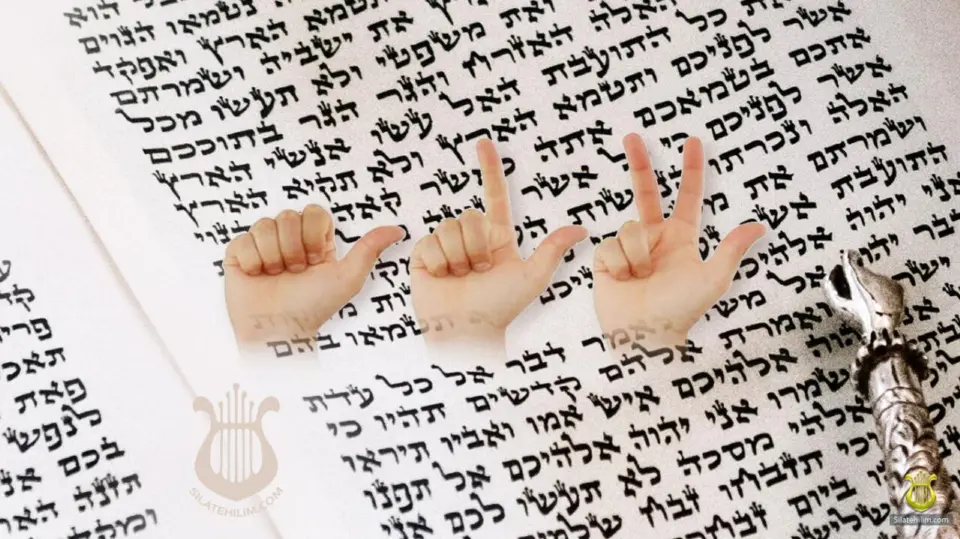
In Judaism, there is a tradition of counting on the fingers during certain prayers—for example, when enumerating the attributes of the Almighty, certain principles (Rabbi Ishmael’s Baraita), or the ingredients of the Ketoret; when reciting Tehillim a specific number of times; and so on.
Ben Ish Chai reveals the origins of this tradition, writing that an ancient manuscript called “Keter Malchut” states:
“When a person recites the three passages containing the Thirteen Attributes of Mercy, beginning with ‘Ven’emar: Mi El Kamocha…’, he should count them using the fingers of his right hand, just as he does when enumerating the ingredients of the Ketoret:
‘Ven’emar: 1. Mi El Kamocha, 2. Nosei Avon, 3. VeOver al Pesha, 4. Lish’erit Nachalato, 5. Lo hechezik La’ad Apo, 6. Ki Chafetz Chesed Hu, 7. Yashuv Yerachamenu, 8. Yichbosh Avonoteinu, 9. Vetashlich Bimtzulot Yam kol Chatotam, 10. Titen Emet le-Yaakov, 11. Chesed le-Avraham, 12. Asher Nishbata la-Avoteinu, 13. Mimei Kedem.’
It is taught that counting indicates the importance and distinction of what is being counted. Since the subject being mentioned is worthy of enumeration, it is preferable to count it on one’s fingers, so that this can be seen and so that it will awaken the thoughts of the heart.
The passages of Tamid (concerning the daily offering) and Ketoret (concerning the incense offering) should be recited with great concentration, because their merit is immense and their recitation takes the place of an offering.
All 11 ingredients of the Ketoret should be counted on the fingers: ‘ha-tzori, ve-ha-tziporen…’.
As stated in the book “Mechavtze’el”, counting testifies to the importance and distinction of what is being counted. It is said in the Talmud (Beitzah 3): “Anything that is counted will not become nullified even in a thousand. In addition, counting awakens the thoughts of the heart.”
There is another explanation for counting on the fingers. Although it is specifically the recitation that takes the place of the Ketoret itself, in order to enhance the beauty and preciousness of the mitzvah, we should add a practical action to our words—and that action is performed with our fingers.
In this way, the words are joined with an action, and it is as though we have actually offered the Ketoret.
It is preferable to count specifically on the fingers of the right hand, rather than using both hands, so that both hands will be given the merit of the mitzvah.
First, the actions of the right hand are always more precise and nimble.
Moreover, the Kohen who offered the Ketoret in the Temple did so with his right hand.
Here is another explanation of why the fingers should be used when counting.
The 11 ingredients of the Ketoret correspond to the selection of the Seven Kings, which correspond to the seven sefirot: Chesed, Gevurah, Tiferet, Netzach, Hod, Yesod, and Malchut.
It is known that the five fingers of the hand correspond to the sefirot Chesed, Gevurah, Tiferet, Netzach, and Hod, as stated in the “Sha’ar HaKavanot”, in the section discussing tzitzit.
Thus, an allusion to most of these seven sefirot is contained in the fingers of the hand.
Therefore, they should be used for counting.
The handwritten book “Keter Malchut” further states that the 11 ingredients indicated by the verse:
“Kach lecha samim”—“Take for yourself spices” (Exodus 30:34)—should also be counted on the fingers: “Vayomer Ha-Shem el Moshe,
- Kach lecha samim—2,
- nataf, ushchelet, ve-chelbena—another 3,
- samim—another 5,
- ulvonah zakah—1; altogether, this makes 11.
When reciting the Baraita “Rabbi Ishmael says”, counting on the fingers is also important, since it contains profound mysteries, as explained in the Rashash Siddur. It should therefore be recited calmly and without haste.
The Sefer “Keter Malchut” likewise states regarding this baraita that it is desirable to count its 13 attributes on the fingers, and provides the reasons and explanations for this practice.
It is known that the Jewish people count by extending their fingers, beginning with the thumb, while other nations count on their fingers differently—by bending the fingers and in a different order.
In Jewish tradition, counting on the fingers was practiced as far back as the time of David HaMelech.
David HaMelech said in Tehillim (144:1):
“Melamed yaday la-milchamah, etzbe’otai la-milchamah”—“Who trains my hands for battle, my fingers for war.”
The Sages ask: Why does he mention both hands and fingers in a single sentence? Surely it is understood that one fights with one’s hands.
The Mekubalim explain that David HaMelech composed this psalm in such a way that in three verses of Tehillim 19 (verses 8 through 10), the four-letter Name of Ha-Shem appears six times in the second position.
If each of these verses is divided into five words, corresponding to the five fingers of the hand, and the fingers are extended beginning with the thumb, then each time the Name of Ha-Shem falls on the second finger—the index finger, “etzba”:
8. Torat A-donai temimah, meshivat nafesh,
Edut A-donai ne’emanah, machkimat peti;
9. Pikkudei A-donai yesharim, mesamchei lev,
Mitzvat A-donai barah, me’irat einayim;
10. Yirat A-donai tehorah, omedet la’ad,
Mishpetei A-donai emet tज़adku yachdav.
Six times, the index finger is extended after the thumb and sanctified by the Name of Ha-Shem. It is precisely because of the special significance of the index finger that, during Kiddushin (the betrothal of a bride), the ring is placed on it: this represents the unification of the Name of the Holy One. The ring corresponds to the letter י; the groom’s hand holding the ring with its five fingers corresponds to the first letter ה; the bride’s finger corresponds to the letter ו; and the hand that she opens to accept the betrothal corresponds to the final letter ה.
David HaMelech would recite this psalm before battles while extending his fingers in precisely this manner. He would then point at his enemies with his index finger—and immediately overcome them.
A person can also make use of this segula for a refuah sheleimah (by pointing at the ailing organ with the finger), for success in Torah study (by pointing to difficult pesukim), for success in life, and so on.
Source:(По Книге «Бен Ши Хай, Кодекс законов, Берешит/Дварим», по уроку Рава Исраэля Якобова «Тайный смысл Теилим 19»)
Was this helpful?
98% of readers found this article helpful (64 votes).
Please note: some articles on our site contain the holy Names of the Almighty. If you print these articles, they may not be thrown away or destroyed. Please handle printed copies with care and respect.
Material from our site may be copied for the purpose of spreading Torah, provided a link to Silatehilim.com is included. Any use of the site's material in print publications or for commercial purposes is prohibited without the rights holder's consent.