Do Not Curse—Our Grandmothers’ Jewish Prohibitions
Do Not Curse—Our Grandmothers’ Jewish Prohibitions
The most vivid memories of childhood are endless games in the courtyard with our friends, accompanied by equally endless quarrels and hurt feelings—and how, after every offense, we would run to our grandmothers for support, only to hear the same familiar words: “Never complain and never quarrel with anyone.” Their admonition, “Never curse anyone,” echoing through the large Jewish courtyard, began to sink in much later, after we had already said farewell to childhood.
According to tradition, when Baba Sali was a child, he once witnessed a fight between some boys. “The one who started it made me so angry that I nearly cursed him!” Israel shared his feelings with his father and received from him a life-defining lesson: “My son! You are destined for a great future: whatever comes from your lips will come to pass. So throughout your life, strive only to bless and to speak kindly to people—but never curse!”
Parashat Balak tells how the king of Moab hired the wicked Balaam to curse the Jews.
Balaam intended to curse a nation that could not hear him.
The Torah itself contains a prohibition against “cursing the deaf,” meaning one who cannot hear you.
It says (Leviticus 19:14): “You shall not curse the deaf.” Even the deaf.
It follows that it is certainly forbidden to curse someone who can hear you. Here are several provisions of this law.
It is forbidden to threaten a person in the form of a curse, especially by invoking the name of the Almighty (in any language).
One must not say, for example:
“G-d will punish you!”One must not utter similar curses even without invoking the name of the Almighty, for example:
“May you end up with neither a home nor a grave!”; “May you be left with nothing!”;
And not even to oneself—for example:
“I’m telling the truth—may I burn if I’m lying!”; “May I never leave this place!”;
The gravest sin is cursing Jewish sages and teachers.
It is forbidden to curse the dead, even if we think that during his lifetime he was far from righteous.
Important!
A curse, like a blessing, has power.
The degree of that power varies from person to person.
But not a single word spoken by a person remains entirely without consequences.
The Torah strongly urges us to guard our speech. We must not say anything that could have negative consequences. As we noted regarding Balaam, it is better to bless than to curse. Instead of cursing someone whom you consider a bad person, bless those who suffer because of him!
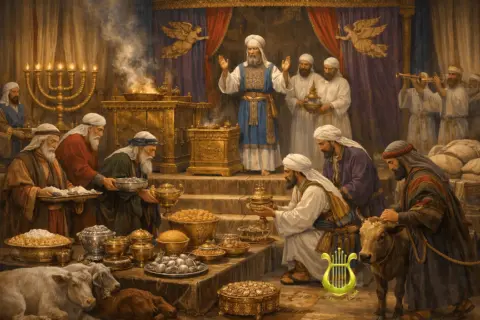
Balak’s 42 sacrifices
The Gemara says (Nazir 23:2): Rabbi Judah said in the name of Rav: “A person should always engage in Torah and mitzvot, even if not for their own sake, for eventually he will come to do them for their own sake. For as a reward for the 42 sacrifices that Balak offered, Ruth descended from him.”
And Rabbi Yosei bar Ḥanina said: “Ruth was the daughter of Eglon, the son of the king of Moab.”
Does this mean that Balak offered sacrifices in order to completely annihilate the Jewish people, and the Creator rewarded him by bringing forth Ruth from his descendants—the one through whom the Jewish kingdom would ultimately be established?!
The 42 boys cursed by the prophet Elisha
We find in another place (Sotah 47a):
“And he went up from there to Bet-El. As he was going up along the road, young boys came out of the city and mocked him, saying to him: ‘Go up, baldhead! Go up, baldhead!’He turned around, saw them, and cursed them in the name of the L-rd. Then two she-bears emerged from the forest and mauled 42 of the boys.”(II Kings 2:23–25)
The Sages explain Elisha’s conduct as follows: “na'arim ketanim” (young boys) does not refer here to their age, but indicates that they were ne'urim—those who had cast off the yoke of the mitzvot (from the root lena'er, to cast off)—and ketanim—lacking in faith.
Either they were simply mocking Elisha’s baldness, or they were angry that he had made the water in their area fit to drink (previously, the water was undrinkable, and those who could not afford to buy water from elsewhere became ill and died). By doing so, he deprived the young men of their livelihood—this was the “baldness” they referred to: they brought drinking water from far away and sold it.
The Sages say that a double miracle occurred: there was no forest there and no wild animals, yet two she-bears came and mauled 42 boys.
The Mekubalim explain that the number 42 corresponds to Balak’s 42 sacrifices—Balak being the king of Moab. The Sages also say that these were 42 souls conceived on Yom Kippur.
Rabbi Hanina said:
—Because of the 42 sacrifices offered by Balak, the king of Moab, 42 children of the Jewish people were destroyed.—Really? But Rav said: “As a reward for the 42 sacrifices that Balak offered, Ruth descended from him.”—His intention, however, was to curse.
This is precisely the only place in the Written Torah where we find that a curse nevertheless struck our people.
But how could this have happened, if Abraham had already been promised (Genesis 12:3): “I will bless those who bless you, and the one who curses you I will curse”?
In other words, there is no possibility that a curse could befall our people! (The verse shows that Abraham is associated with blessing, not with cursing.)
And if a curse nevertheless did strike some Jews, it was the consequence of the actions of Balaam and Balak (the 42 sacrifices they offered in order to curse the Jewish people).
As a result, a new reality arose and settled upon the nation, allowing the curse to come to pass.
Thus, the offering of the 42 sacrifices led to two opposite consequences: on the one hand, Balak received a reward for it (Ruth descended from him);
On the other hand, because of his intention to curse the Jews, our people suffered (although the curse was not fully realized).
(Compiled by the editorial staff based on articles by Gaon Rabbi Moshe Shapiro and Rabbi Reuven Piatigorsky)
Was this helpful?
100% of readers found this article helpful (11 votes).
Please note: some articles on our site contain the holy Names of the Almighty. If you print these articles, they may not be thrown away or destroyed. Please handle printed copies with care and respect.
Material from our site may be copied for the purpose of spreading Torah, provided a link to Silatehilim.com is included. Any use of the site's material in print publications or for commercial purposes is prohibited without the rights holder's consent.