Mishnayot Kinnim — Rabbanit Kanievsky’s Segula for Salvation
Rabbanit Batsheva Kanievsky would often distribute copies of “Ken Mefureshet”—Rabbi Tzvi Gutmacher’s commentary on Mishnah tractate Kinnim (“Birds’ Nests”). Rabbi Tzvi Gutmacher, author of Ken Mefureshet and Nachlat Tzvi, was the son of the renowned Rabbi Eliyahu Gutmacher, a student of the great Rabbi Akiva Eiger. A Kabbalist and miracle worker, Rabbi Eliyahu of Grodzisk (Grayditsa) received thousands of Jews who came to him seeking blessings and healing from illness. After outliving his son, Rav Eliyahu published his work “Ken Mefureshet”, writing the following in its introduction. These words became the source of Rabbanit Kanievsky’s segula: “When someone is in particular need of salvation and assistance from the Almighty, he should study Mishnah Kinnim with the commentaries of Rabbi Ovadiah of Bartenura, Tosafot Yom Tov, and my son. He should then recite a special prayer (the text appears after the Mishnayot). He should then present his request to the Almighty, with the hope that his prayer will be answered. If he does not receive an immediate answer, he should repeat this for three consecutive days—once a day.” The book Sukkat Shalem (p. 107) states: “We heard from distinguished families that they performed this segula and had no need for doctors.” It is widely known that Rav Chaim Kanievsky repeatedly recommended it to those who approached him in need of salvation. This segula brought salvation to many people. Rabbanit Kanievsky also instructed unmarried girls to ask members of their families to study these Mishnayot and pray for them. When she herself was feeling unwell, she would ask members of her family to study tractate Kinnim on her behalf.TRACTATE KINNIM (NESTS)
CHAPTER 1
Mishnah 1 The bird sin-offering is performed below, whereas the animal sin-offering is performed above. The bird burnt-offering is performed above, whereas the animal burnt-offering is performed below. If this order is reversed in either case, the offering is invalid. This is the order of the nests: in the case of obligatory offerings, one is a sin-offering and one is a burnt-offering; in the case of vow offerings and freewill offerings, both are burnt-offerings. What is a vow offering? If one says, “I undertake to bring a burnt-offering.” And what is a freewill offering? If one says, “This shall be a burnt-offering.” What is the difference between vow offerings and freewill offerings? If vow offerings die or are stolen, the owner is responsible for replacing them; if freewill offerings die or are stolen, the owner is not responsible for replacing them. Translation The bird sin-offering is performed below, while the animal sin-offering is performed above; the bird burnt-offering is performed above, while the animal burnt-offering is performed below. If the place of performance is changed in either case, the offering is invalid. This is the order of the nests: of offerings brought as an obligation, one is a sin-offering and the other a burnt-offering; of offerings brought as a vow or as a freewill offering, both are burnt-offerings. What is a vow? One who says, “I undertake to bring a burnt-offering.” And what is a freewill offering? One who says, “This shall be a burnt-offering.” What is the difference between vows and freewill offerings? If vow offerings die or are stolen, their owners are responsible for them; if freewill offerings die or are stolen, their owners are not responsible for them.Commentary of Rav Ovadiah of Bartenura:
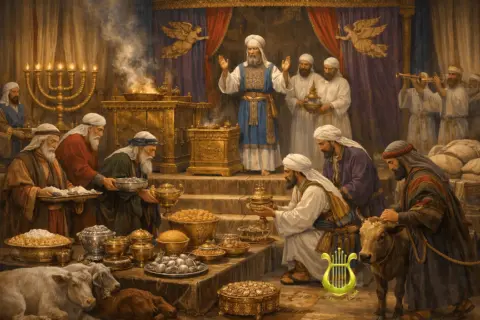
The bird sin-offering is performed below—below the red line, as it is written (Leviticus 5:9): “And he shall sprinkle some of the blood of the sin-offering on the side of the altar, while the rest of the blood shall be drained out at the base of the altar.” The lower half of the wall is at the base; this is the lower wall, below the red line. The upper wall is above the red line. This line was one cubit below the sovev. And the animal sin-offering is performed above, as it is written: “the horns of the altar.” The bird burnt-offering is performed above, as it is written: “He shall pinch its head at the nape and turn it into smoke on the altar, while its blood shall be drained out against the side of the altar.” The pinching of the head also takes place at the top of the altar. And the animal burnt-offering is performed below, as it is written: “at the base.”Commentary of Tosafot Yom Tov:
The bird sin-offering is performed below—Rav Ovadiah of Bartenura explains that this means below the red line, since the altar does not have two separate areas. And the animal sin-offering is performed above, as taught in the fifth chapter, Mishnah 3, of tractate Zevachim. The bird burnt-offering is performed above—Rav Ovadiah of Bartenura explains that the pinching of the head also takes place at the top of the altar. And the animal burnt-offering is performed below, as taught in the fifth chapter, Mishnah 4, of tractate Zevachim.Commentary of Ken Mefureshet:
The bird sin-offering is performed below—below the red line of the altar. At its base, the altar was a square measuring 32 cubits by 32 cubits. One cubit above the base, there was a one-cubit-wide ledge extending on all sides. The structure above it rose another five cubits, forming the sovev—a walkway—which created another ledge one cubit wide on all sides. It then rose another three cubits; this was the place of the fire. Finally, horns rose at the four corners. Each measured one cubit in height, length, and width. Mishnah 2 If a sin-offering became mixed with a burnt-offering, or a burnt-offering with a sin-offering, even if there was one among ten thousand, all must be left to die. If a sin-offering became mixed with obligatory offerings, only the number of sin-offerings contained among the obligatory offerings is valid. Likewise, if a burnt-offering became mixed with obligatory offerings, only the number of burnt-offerings contained among the obligatory offerings is valid—whether the obligatory offerings are numerous and the freewill offerings few, whether the freewill offerings are numerous and the obligatory offerings few, or whether the two are equal. Translation If a sin-offering became mixed with a burnt-offering, or a burnt-offering with a bird sin-offering—even one among ten thousand—all must be left to die. If a sin-offering became mixed with an obligatory offering, only the number of sin-offerings in the obligatory offering is valid. Similarly, if a burnt-offering became mixed with an obligatory offering, only the number of burnt-offerings in the obligatory offering is valid, whether there are more obligatory offerings, more freewill offerings, or equal numbers. Mishnah 3 When does this apply? To obligatory and freewill offerings. But when obligatory offerings belonging to different women became mixed—one nest belonging to one woman with one belonging to another, two with two, or three with three—half are valid and half are invalid. If one became mixed with two, three, ten, or one hundred, the smallest number is valid, whether they belonged to one person or to two people, and whether they came from one woman or from two women. Translation To what does this refer? To a mixture of obligatory and freewill offerings. But if the obligatory offerings of different women became mixed—one nest from one woman with one from another, two from one with two from another, or three from one with three from another—half are valid and half invalid. If one from one woman became mixed with two from another, three from a third, ten from a fourth, and one hundred from a fifth, the smallest number of nests is valid, whether they bear one designation or two, and whether they belonged to one woman or to two women. Mishnah 4 How is this understood when they have one designation? For childbirth and childbirth, or for a discharge and a discharge, from one designation. From two designations: childbirth and discharge. How is this understood with regard to two women? One woman brought an offering for childbirth and the other for childbirth; one for a discharge and the other for a discharge—this is one designation. Two designations: one brought an offering for childbirth and the other for a discharge. Rabbi Yose says: If two women purchased their nests together, or gave the money for their nests to the priest, the priest may designate any bird he wishes as a sin-offering and any bird he wishes as a burnt-offering, whether they were of one designation or two designations.Chapter 2
Mishnah 1 If one fled from an unidentified nest into the open air, or fled among those left to die, or one of them died, the owner must purchase a mate for the remaining bird. If it fled among those fit to be offered, it is invalid and disqualifies one opposite it, because the fledgling that fled is invalid and disqualifies one opposite it. Translation If one bird from an unidentified nest flew away into the open air, flew among birds destined to die, or died, a mate must be purchased for the remaining bird. If it flew among birds destined to be offered, it is invalid and renders one other bird opposite it invalid, because the fledgling that flew away is invalid and disqualifies one opposite it. Mishnah 3 How so? Two women—one had two nests and the other had two nests—and one fledgling flew from one to the other. By flying there, it disqualifies one; if it returned, by returning it disqualifies one; if it flew and returned, flew and returned, it caused no additional loss, for even if the birds became mixed, there would be no fewer than two valid nests. Translation How is this understood? Of two women, one had two nests and the other two nests, and one fledgling flew from one to the other, disqualifying one by its flight. If it returned, it disqualified one by its return. If it flew and returned repeatedly, it caused no further loss, since even if the nests became mixed, at least two would remain valid. Mishnah 3 One woman had one nest, another two, another three, another four, another five, another six, and another seven. One fledgling flew from the first to the second, then from the second to the third, fourth, fifth, sixth, and seventh, and one returned each time. It disqualifies one by flying away and one by returning. Thus the first and second have nothing, the third has one, the fourth two, the fifth three, the sixth four, and the seventh six. If a fledgling again flew and returned, it disqualifies one by flying away and one by returning. Thus the third and fourth have nothing, the fifth has one, the sixth two, and the seventh five. If another fledgling flew and returned, it disqualifies one by flying away and one by returning. Thus the fifth and sixth have nothing, while the seventh has four. Some say that the seventh lost nothing through the third exchange. If one of those destined to die flew to any woman, all her nests must be left to die. Translation One woman had one nest, another two, a third three, a fourth four, a fifth five, a sixth six, and a seventh seven. If one fledgling flew from the first to the second, then from there to the third, fourth, fifth, sixth, and seventh, and one returned each time, one is disqualified by its flight and one by its return. The first and second then have nothing, the third one nest, the fourth two, the fifth three, the sixth four, and the seventh six. If a fledgling again flew and returned, one is disqualified by the flight and one by the return, leaving the third and fourth with nothing, the fifth with one, the sixth with two, and the seventh with five. If another fledgling flew and returned, the fifth and sixth have nothing and the seventh has four. Some say that the seventh lost nothing through the third exchange. If one of the birds destined to die flew to any woman, all her nests must be left to die. Mishnah 4 If one fled from an unidentified nest into the open air, or flew among those left to die, or one of them died, the owner must purchase a mate for the remaining bird. If it flew among those fit to be offered, it is invalid and disqualifies one opposite it, because the fledgling that flew is invalid and disqualifies one opposite it. Translation If one bird from an unidentified nest flew into the open air, flew among birds destined to die, or died, a mate must be purchased for the remaining bird. If it flew among those fit to be offered, it is invalid and disqualifies one opposite it. Mishnah 5 A sin-offering is here, a burnt-offering there, and an unidentified nest in the middle. If one fledgling flew from the middle toward each side, one in each direction, no loss has occurred. One should say: “This one that flew toward the sin-offerings is a sin-offering, and this one that flew toward the burnt-offerings is a burnt-offering.” If it returned to the middle, the middle birds must be left to die; these are brought as sin-offerings and those as burnt-offerings. If it returned, or flew from the middle toward the sides, all must be left to die. One may not bring turtledoves corresponding to young pigeons, nor young pigeons corresponding to turtledoves. How so? A woman brought a turtledove as a sin-offering and a young pigeon as a burnt-offering; she must bring another turtledove as a burnt-offering. If she brought a turtledove as a burnt-offering and a young pigeon as a sin-offering, she must bring another young pigeon as a burnt-offering. Ben Azzai says: Follow the first designation. If a woman brought her sin-offering and died, her heirs bring her burnt-offering. If she brought her burnt-offering and died, her heirs do not bring her sin-offering. Translation A sin-offering is on one side, a burnt-offering on the other, and an unidentified nest in the middle. If one bird from the middle flew toward each side, no loss has occurred, but one says: “The one that flew toward the sin-offerings shall be a sin-offering, and the one that flew toward the burnt-offerings shall be a burnt-offering.” If it returned to the middle, the middle birds must be left to die; these are offered as sin-offerings and those as burnt-offerings. If it returned or flew from the middle toward the sides, all must be left to die. [One may not bring turtledoves corresponding to young pigeons, nor young pigeons corresponding to turtledoves. How so? A woman brought a turtledove as a sin-offering and a young pigeon as a burnt-offering; she must bring an additional turtledove as a burnt-offering. If she brought a turtledove as a burnt-offering and a young pigeon as a sin-offering, she must bring an additional young pigeon as a burnt-offering. Ben Azzai says: Follow the first designation. If a woman brought her sin-offering and died, her heirs bring her burnt-offering. If she brought her burnt-offering and died, her heirs do not bring her sin-offering.]Chapter 3
Mishnah 1 When does this apply? When the priest consulted. But when the priest did not consult, and there was one nest belonging to one woman and one belonging to another, two belonging to one and two belonging to another, or three belonging to one and three belonging to another, and he performed all of them above, half are valid and half invalid. If he performed all of them below, half are valid and half invalid. If half were performed above and half below, of those performed above half are valid and half invalid, and of those performed below half are valid and half invalid. Translation To what does this refer? To a priest who consulted. But if the priest did not consult, and there was one nest from one woman and one from another, two from one and two from another, or three from one and three from another, then if all were performed above, half the birds are valid and half invalid. If all were performed below, half are valid and half invalid. If half were performed above and half below, half of those performed above are valid and half invalid, and half of those performed below are valid and half invalid. Mishnah 2 One woman had one nest, another two, another three, another ten, and another one hundred. If all were performed above, half are valid and half invalid. If all were performed below, half are valid and half invalid. If half were performed above and half below, the larger number is valid. This is the general rule: wherever one can divide the nests so that the nests belonging to any one woman are performed entirely above or entirely below, half are valid and half invalid. Wherever one cannot divide the nests in this way, and the nests of one woman are partly performed above and partly below, the larger number is valid. Translation One woman had one nest, another two, another three, another ten, and another one hundred. If all were performed above, half the birds are valid and half invalid; if all were performed below, half are valid and half invalid; if half were performed above and half below, the greater number is valid. This is the rule: wherever it is possible to divide the nests so that the offerings of any one woman are performed entirely above or entirely below, half are valid and half invalid. Wherever this is impossible, and the nests of one woman are performed partly above and partly below, the greater number is valid. Mishnah 3 One woman had a sin-offering and another a burnt-offering. If both were performed above, half are valid and half invalid. If both were performed below, half are valid and half invalid. If half were performed above and half below, both are invalid, since I can say that the sin-offering was performed above and the burnt-offering below. Translation There was a sin-offering belonging to one woman and a burnt-offering belonging to another. If both were performed above, half are valid and half invalid; if both were performed below, half are valid and half invalid; if half were performed above and half below, both are invalid, because it is possible to say that the sin-offering was brought above and the burnt-offering below. Mishnah 4 There was a sin-offering, a burnt-offering, an unidentified nest, and a designated nest. If all were performed above, half are valid and half invalid. If all were performed below, half are valid and half invalid. If half were performed above and half below, only the unidentified offerings are valid, and they are divided among the women. Translation There was a sin-offering, a burnt-offering, an unidentified nest, and a designated nest. If all were performed above, half are valid and half invalid; if all were performed below, half are valid and half invalid; if half were performed above and half below, only the unidentified offerings are valid, and they are divided among the women. Mishnah 5 If a sin-offering became mixed with obligatory offerings, only the number of sin-offerings in the obligatory offerings is valid. If the obligatory offerings are twice the number of sin-offerings mixed with them, half are valid and half invalid. If the mixed sin-offerings are twice the number in the obligatory offerings, only the number contained in the obligatory offerings is valid. The same applies to a burnt-offering that became mixed with obligatory offerings: only the number of burnt-offerings in the obligatory offerings is valid. If the obligatory offerings contain twice as many burnt-offerings as those mixed in, half are valid and half invalid; if the mixed offerings are twice the number in the obligatory offerings, only the number contained in the obligatory offerings is valid. Translation If a sin-offering became mixed with obligatory offerings, only as many sin-offerings are valid as were required in the obligatory offering. If the number in the obligatory offering is twice the number mixed in, half the nests are valid and half invalid. If the number mixed in is twice the number required, only the number required is valid. The same applies when a burnt-offering becomes mixed with an obligatory offering: only the number of burnt-offerings required is valid; if the number required is twice the number mixed in, half are valid and half invalid; if the number mixed in is twice the number required, only the number required is valid. Mishnah 6 A woman said, “I undertake to bring a nest if I give birth to a male child.” She gave birth to a male child and brought two nests, one for her vow and one for her obligation. She gave them to the priest, who was required to perform three birds above and one below. If he did not do so, but performed two above and two below without consulting, she must bring one more bird, to be performed above, if both nests were of the same type. If they were of two types, she must bring two more. If she specified which nest was for her vow, she must bring three additional birds if they were of one type, and four if they were of two types. If she had established the vow but forgot its details, she must bring five additional birds if they were of one type, and six if they were of two types. If she gave them to the priest without knowing what she had given, and the priest performed them without knowing how he had performed them, she must bring four additional birds for the vow offering, two for the obligatory offering, and one sin-offering. Ben Azzai says: two sin-offerings. Rabbi Yehoshua said: This resembles what they said: “While it is alive, it has one voice; when it is dead, it has seven voices.” What are the seven voices? Its two horns become two trumpets; its two thighs become two flutes; its skin becomes a drum; its belly becomes a violin; its intestines become harp strings; and some say that its wool becomes sky-blue wool for tekhelet. Rabbi Shimon ben Akashya says: The elders of the unlearned become more foolish as they grow older, as it is stated (Job 12:20): “He removes speech from the trustworthy and takes away the sense of elders.” But the elders of Torah are not so; the older they become, the wiser they grow, as it is stated: “With the aged is wisdom, and with length of days, understanding.” Then one should stand and recite this prayer in any language: אתה חי חביבין ישראל לפניך וחבה יתרה נודעת להם שנקראו לך בנים רזה הוא במה שבראת בין הרבוי מיני עופות הכשרים שהם יותר מטמאים (כדאיתא בחולין ס׳׳ג, ב) רק תורים ויונים ביתיים להביא קרבן לפניך מהם ואנחנו דומים במדותינו להם עשה עמי חסד כרחם אב על בנו Transliteration Atah Chai, chavivin Yisrael lefanecha ve-chibah yeterah noda’at lahem she-nikre’u Lecha banim. Raza hu ba-mah she-barata bein ha-ribui minei ofot ha-kesherim she-hem yoter mi-teme’im (ke-de’ita be-Chullin sixty-three, amud bet), rak torim ve-yonim beitiyim lehavi korban lefanecha me-hem, ve-anachnu domim be-midotenu la-hem. Aseh imi chesed ke-rachem av al beno. Translation “You, Almighty, cherish the Children of Israel, and You have shown them an additional expression of love by calling them Your children. This is also demonstrated by the fact that although there are more kosher birds than non-kosher birds, only turtledoves and domesticated young pigeons may be brought to You as offerings. In our qualities, we resemble them. Please treat me kindly, as a merciful father has compassion on his son.” One should then present one’s request to the Almighty, with the hope that the prayer will be answered. If an answer is not received immediately, this should be repeated for three consecutive days—once a day.” (Based on the book “The Legendary Mother for All—Rebbetzin Kanievsky”; transliteration and translation by Rav Alexander Tzvi Sypkov)