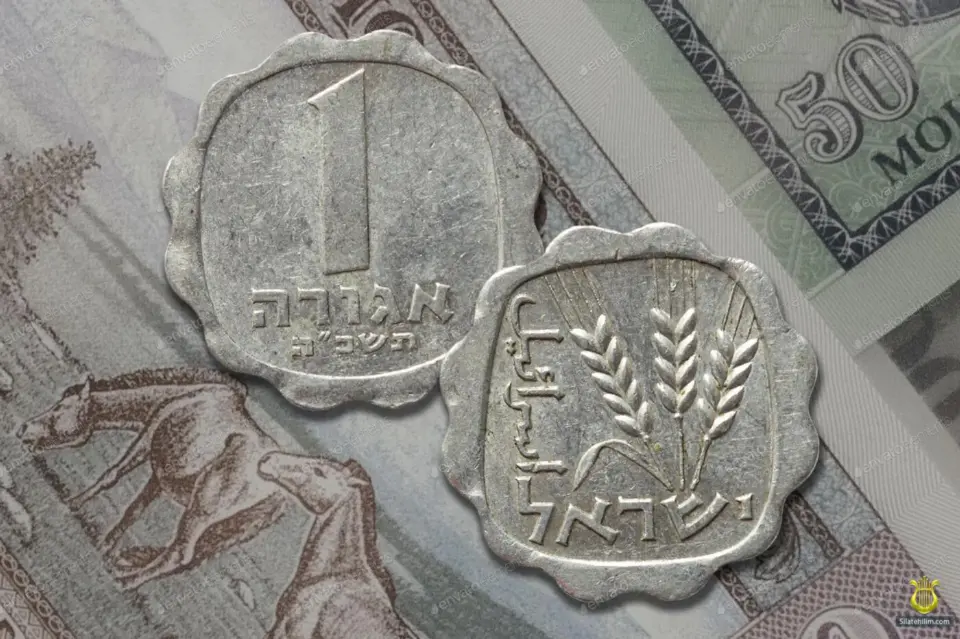
Alshich HaKadosh teaches us that even in the Torah we find a hint to «machatzit ha-shekel».
Eliezer, the eved (servant) of Avraham Avinu, when he came to Rivka, gave her «nezem zahav beka mishkalo» (a golden nose ring weighing half a shekel). This hinted that in the future Am Yisrael would have to give «beka la-gulgoleth» for each person.
Moshe Rabbeinu rectified the attribute of Yesod on Rosh Chodesh Adar when he brought the bones of Yosef HaTzadik out of Egypt. Therefore, Chazal say that when we give «zecher le-machatzit ha-shekel», we also perform Tikkun HaYesod.
«Machatzit ha-shekel» weighed 192 “se'orim”. Each «se'orah»—a barley ear—weighed approximately 0.05 grams. 192 is the gematria of the blessing «Bakol, Mikol, Kol» (in everything, from everything, everything).
If we examine the Hebrew word «machatzit»—מחצית—we find that exactly in the middle of the word is the letter צ—“tzedakah”. On either side of it are the two letters ח and י, forming the word חי “chai” (alive). The two outer letters of the word, מ and ת, form the word “met” מת (dead). This hints at what the Sages teach us: one who is close to tzedakah is always alive, while one who is distant from it is dead.
Coin Minting
The Midrash relates that our ancestors were the first to mint silver coins bearing images.
The first person to conceive of minting coins with images was Avraham Avinu, as written by Rabbeinu Chatam Sofer.
After Avraham, Yaakov Avinu continued minting coins. There is a hint to this in Parashat Vayishlach: «Vayikhen et-chelkat hasadeh asher nata-sham aholo miyad bnei-chamor avi Shechem beme'ah kesitah»—Yaakov gave them his coins.
Chazal teach that our ancestors were the first to devise the minting of silver coins and give them a specific form. They also depicted important historical events on them, so that their descendants would remember them.
On Avraham Avinu’s pure silver coin, one side depicted «zaken ve-zekenah»—an old man and an old woman, while the other side depicted «bachur ve-vetulah»—a young man and a young woman.
Avraham Avinu wanted to commemorate the miracle that had been performed for them in their old age—the birth of their son Yitzchak. Thus, one side of Avraham Avinu’s coin depicted Avraham and Sarah, while the other depicted Yitzchak and Rivka.
Yehoshua bin Nun continued the tradition of minting coins. One side of his coin depicted a «shor»—an ox, while the other depicted a «re'em»—a wild ox resembling an antelope. Yehoshua bin Nun was from the tribe of Yosef HaTzadik, and it is written about him: «bechor shoro hadar lo vekarne re'em karnav bahem amim»—“His ox is his firstborn, grandeur is his; his horns are the horns of a re'em. With them he shall gore nations together, to the ends of the earth.” (Devarim 33:17)
Thus, Yehoshua bin Nun preserved his lineage through a coin.
The next person who decided to preserve his memory for posterity was David HaMelech.
On one side he minted a «makel ve-tarmil» (a staff and a knapsack), and on the other—a «migdal»—a tower. In this way, he left his descendants a message about how he rose from being a simple wandering shepherd to one who built a tower, so that they would remember who he had been and what he became.
Mordechai HaYehudi also left behind special coins. On one side he depicted «sak ve-efer» (a sack and ashes), and on the other—«ateret zahav» (a golden crown)—commemorating the events of Purim, from the three-day fast of mourning and donning sackcloth and ashes to his rise to the rank of ruler.
It is interesting that at the end of his commentary on the Torah, Ramban writes:
“Blessed is the L-rd. Behold, I came to Acre and found there, in the hands of the elders of the land, an uncovered silver coin with an uncovered seal. On one side it was shaped like an almond branch, and on the other like a bowl; on both sides, writing was clearly inscribed around it. They explained that this was Aharon’s staff—the almond branch with its blossoms—and that the second image was a vessel containing the manna. We weighed it in shekels, and it weighed ten silver coins, which is half an ounce, as mentioned by Rashi. I also saw the half-shekel coin that was used for offerings.”
We see how our ancestors minted coins depicting important historical events in memory of them, in order to commemorate the miracles that had happened to them.
(based on a lesson by the Gaon Rabbi Yitzchak Cohen—a student of Rabbi Daniel Frisch, author of “Matok MiDevash”—and a lesson by Rabbi Yisrael Yakobov)
Was this helpful?
100% of readers found this article helpful (24 votes).
Please note: some articles on our site contain the holy Names of the Almighty. If you print these articles, they may not be thrown away or destroyed. Please handle printed copies with care and respect.
Material from our site may be copied for the purpose of spreading Torah, provided a link to Silatehilim.com is included. Any use of the site's material in print publications or for commercial purposes is prohibited without the rights holder's consent.