Which Prayer Is Accepted in Heaven First? — The Zohar on Tehillim 102
In one of his lessons, Rabbi Tzvi Nisanzon beautifully explained the meaning of the word "tefillah" according to the Zohar HaKadosh.
The word "tefillah" appears in three cases, and it is explained in connection with Moshe, with David, and with "the Poor Man."
- "Tefillah leMoshe ish ha-Elohim..." — (Tehillim 90:1) — (The prayer of Moshe — the man of G-d). There is no such prayer among other people.
- "Tefillah leDavid"... (Tehillim 86:1) — "The prayer of David". There is no such prayer belonging to another king.
- "Tefillah leani"... (Tehillim 102:1) — "The prayer of the Poor Man."
The Zohar HaKadosh asks: Which of the three prayers is the most important? And it answers—the prayer of the Poor Man! This prayer is more important than the prayer of Moshe and more important than the prayer of David. It is more important than all the prayers in the world.
Why?
The heart of the Poor Man is broken. And it is written: "The L-rd is near to the brokenhearted."
The Poor Man is always full of grievances toward the L-rd, as though arguing with Him, and the L-rd listens attentively and hears his words.
All the windows of heaven open when the Poor Man prays, and his prayer precedes and delays the entry of all the other prayers rising upward, because his heart is broken.
Concerning this it is written: "The prayer of the Poor Man, when he "ya'atof." Why is the word "ya'atof" ("he delays") written, rather than "he is enveloped"?
The reason is that the word "ya'atof" also means "he delays." Since all prayers can be accepted only after the Poor Man's prayer enters, it delays all the other prayers.
And all the heavenly hosts ask one another: What is the L-rd occupied with, and where are His efforts directed?
They are answered: With great passion, He unites with His vessels—that is, with people whose hearts are broken.
No one knows what takes place during the Poor Man's prayer: his indignation, the way his tears pour out before the holy King—and in this lies the Poor Man's passionate desire to unite with the L-rd.
And the L-rd's passionate desire is expressed in His accepting the tears that flow before Him. This is the prayer that delays all the prayers in the world, causing them to arrive late.
The L-rd said: "Let the other prayers wait, but let this prayer rise up to Me! There is no need for judges to decide between us; let him present his grievances to Me personally—let him be alone with Me."
The Poor Man's indignation appears before the L-rd in his prayer itself, as it is written: "ve-lifnei HaShem yishpoch sicho" — (and before the L-rd he pours out his prayer).
Moshe prayed, and during this prayer he was delayed for several days—because of the Poor Man's prayer.
David saw that all the windows and all the gates of heaven were ready to open before the prayer of the Poor Man.
And he saw that the L-rd listened to the Poor Man's prayer more than to all the prayers in the world.
When David understood this, he imagined himself poor and wretched, removed his royal garments, sat on the ground like a beggar, and offered this prayer: "The prayer of David: Incline Your ear, O L-rd; answer me." (Tehillim 86:1)
On what basis? "For I am poor and wretched."
The L-rd said: "David, are you not a king who rules over mighty kings? How, then, do you present yourself as poor and wretched?"
David immediately redirected the prayer: "Protect my soul, for I am a chasid."
David included every level: that of the poor man and that of the chasid. Despite his exalted position, David received Jewish women every day who wished to resolve doubts regarding their kosher status for their husbands.
That is why David was called a chasid.
David had the right to call himself poor because he recognized how little strength we have compared with the greatness of the Creator.
A person who does not recognize this suffers from immodesty, and therefore his prayer will not attain the level of "the prayer of the Poor Man".
Rabbi Shimon bar Yochai teaches: "One who is satisfied with his lot and does not give a portion to the Creator—how many woes surround him."
"A portion for the Creator" means bringing joy to the poor, because "He comes to look at His broken vessels."
What does it mean to be poor? Why is his complaint an expression of distress?
He says: "What am I guilty of, that You created me from desires shattered by egoism, and that because of this I have evil desires and thoughts? All this comes to me only because I came into being after the shattering of the vessels—for that was the original place where the desire to receive the Supreme Light appeared, with the desire directed toward oneself rather than toward bestowal. Because of this, I have egoism, I am far from spirituality, and I possess no spark of holiness containing the intention to act for the sake of the Creator. I suffer because I cannot draw near to spirituality, and I am distanced from You by egoism. I hate everything in my heart—and this is the result of Your having created me this way. I have no strength to change the nature You created, but this is what I ask of You: Just as You created my egoism, which is my first nature, give me a second nature—the desire to bestow. And I have proof that You are responsible for my lack of strength to resist egoism."
Thus, the Poor Man's complaint—that he has no strength to resist his nature unless the Creator helps him—is justified. The meaning is that the Creator deliberately gives him this state, because He awaits the prayer of the righteous—that is, those who pray to become righteous.
His distress that the Creator created him in such a fallen state is also justified; that is, the Creator Himself has made it so that he has nowhere else to expect help except from the Creator.
"The prayer of the Poor Man" is when a person finds himself in the worst condition of all.
"There are people who stand below me—in both Torah and spiritual work—but they do not feel the truth as I see my own condition, and therefore they do not need You to help them as much. But I see my state: I have no connection whatsoever to spirituality, despite all the work I have been able to do. And the more I want to move forward, the more I see that I am moving backward."
The Zohar HaKadosh states that the law is that Creation cannot openly receive something bad from the Creator, because this would cause harm: Creation would think that the Creator is imperfect.
In other words, to the extent that a person suffers, he denies the Creator's providence to that same extent. Therefore, before receiving strength from Above, a person must possess the desire to bestow. Only then can he ask for the next level—the level of David, which is Malchut Shamayim. Consequently, the Poor Man's prayer delays all the other prayers: until the Poor Man receives what he asks for, it is impossible to attain the next level.
After that comes the second prayer—the prayer of David, which is the level of Malchut Shamayim. Here a person asks to have faith in the Creator, who governs the entire world, because now he can perceive the Creator as acting solely for the good, thanks to his already-corrected desire to bestow. One cannot attain faith, which is Malchut Shamayim, before achieving the correction of one's qualities; a person must always be ready to bestow rather than receive for himself. Otherwise, he will not be granted the ability from Above to rise to the level of faith. This is what determines that "the prayer of the Poor Man" delays all the other prayers.
The third prayer is the prayer of Moshe, which is the level of Torah. One cannot merit the level of Torah before attaining the level of faith, because the Torah cannot be studied by idolaters, as it is written: "This is the Torah that Moshe placed before the Children of Israel."
The Zohar HaKadosh states: "Wine that gladdens the heart of man is the wine of Torah, for it is considered a secret. And just as wine must be tightly sealed so that it does not spoil, so too must the secret of the Torah be sealed. All its secrets are not for those who merely touch it, but for those who fear Him, because the level of Torah pertains to fear of the Creator." From this we see that the level of Moshe's prayer is the level of Torah, the next stage after Malchut Shamayim, which is called "fear." Therefore, the Torah was given specifically to those who fear the Creator.
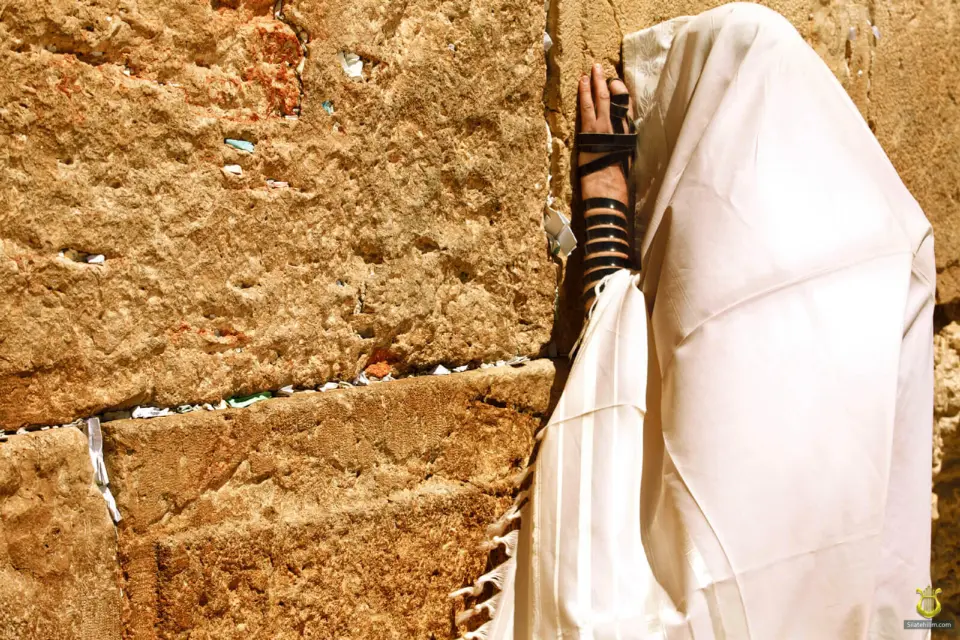
Why is the first prayer in the world—the prayer of the Poor Man (Tehillim 102)—associated with the arm tefillin?
The prayer of the arm precedes the prayer of the head, because it is written: "And you shall bind them as a sign upon your hand, and they shall be as frontlets between your eyes."
The Zohar explains: the prayer of the arm is Malchut, while the prayer of the head is Zeir Anpin.
The arm tefillin must be covered, as it is written, "and it shall be a sign for you upon your hand," and the sages explained: "a sign for you, but not a sign for others," because Malchut is called faith. This is why the verse hints at "you"—because it must remain concealed.
The Poor Man's prayer is accepted even when he protests against the judgments of HaKadosh Baruch Hu.
The sages say: if a person speaks lashon hara and does not correct it through teshuvah, his prayers are not accepted for forty days.
As for the Poor Man, even his protest against the judgments is accepted (which is lashon hara). When a person speaks out of a sense of distress, he is not punished.
The rule is: "A person is not judged for things he said in a state of dejection."
Thus, we arrive at the following outline:
Psalm 102—"The Prayer of the Poor Man"—is when we ask HaKadosh Baruch Hu to teach us the desire to bestow.
Psalm 86—"The Prayer of David"—is when we ask HaKadosh Baruch Hu to raise us to the level of Faith.
Psalm 90—"The Prayer of Moshe"—is when we ask HaKadosh Baruch Hu to grant us the level of Torah.
(Compiled by "Sila Tehillim" based on Rabbi Tzvi Nisanzon's online lesson on the Zohar on Tehillim, "Balak," Sulam)